
In a grim sort of way, Donald Trump could be said to have put Greenland on the 21st century’s mental map. As the US president threatens to militarily seize it or to buy it, by hook or by crook, the world has learned a bit about the world’s largest island, a Danish autonomous territory with a capital called Nuuk.
But two books published last year after Trump’s return to the White House give insight into some of the reasons that the ice-covered island has often been coveted.
Meanwhile, it takes an American poet’s lyrical chronicle of the Greenlandic landscape and the lives of its people to find out the Inuit have a couple dozen words for ice, cook a celebratory dish of auks sewn into seal bellies, still travel by dogsled and kayak and really really like being in the dark four months a year.
And just when you think Greenland is a world away from anywhere else on the planet, a novel set in Nuuk strikes a reassuring note. It turns out that it has many of the same social issues as everywhere else, not least angst-ridden youth plagued by messy relationships and self-doubt.
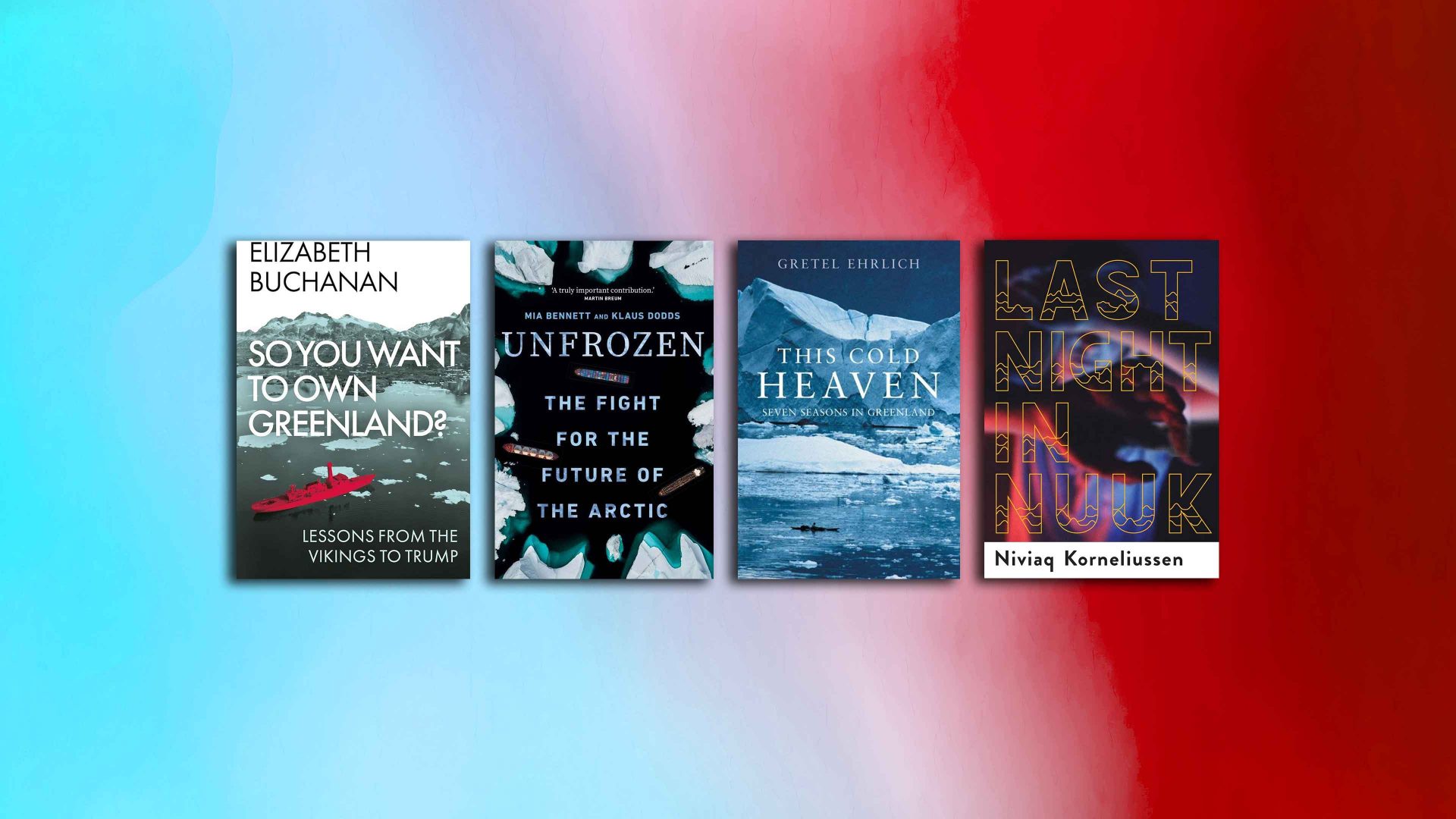
Polar geopolitics expert Elizabeth Buchanan’s So You Want to Own Greenland?: Lessons from the Vikings to Trump carries its title’s breezy tone right through her account of the island’s history and complex politics. “When Erik the Red brought some 2,000 Vikings over around 982 AD, he conjured up the name ‘Greenland’ as a branding exercise that was as attractive as it was misleading. Salesmen are the same, no matter the century,” Buchanan explains.
The Vikings, Greenland’s first colonisers, lasted a mere six centuries on the island, unaccountably disappearing in the 15th century. It would be another 300 years before Lutheran priest Hans Egede arrived, expecting to convert Norsemen and finding Inuit instead. That 1721 mission is considered the start of Danish colonisation of Greenland, which formally lasted until 1953.
But this is not to say the Danish embrace fended off lascivious glances from others. Much before Trump, the US was eyeing this frozen frontier as ideal for its geostrategic goals. Greenland is “essentially” the United States’s “front doorstep”, writes Buchanan, and “as with any house, you pay home insurance and invest in a capable security system”.
Whether that has to be outright takeover of another country’s sovereign territory is debatable but it certainly underlines Greenland’s unique problem. It’s located mostly in the same hemisphere as the United States, and a warming Arctic offers new extractive and trading opportunities to the bold, entrepreneurial and greedy.
It is a point stressed by two academics in Unfrozen: The Fight for the Future of the Arctic. Geographer Mia Bennett and political scientist Klaus Dodds note that competition for the Arctic has been heating up. That even includes the US, until recently “known as a reluctant Arctic state”.
Suggested Reading

When climate fiction stops being fiction
That said, the US has “intermittently” expressed interest in acquiring Greenland and, previously, Iceland too, as far back as 1867, when it acquired another Arctic territory, Alaska.
One of the reasons for the new scramble is China, they write. Though it is decidedly not an Arctic state, China seems to be pursuing a determined Polar Silk Road strategy. In 2003, it opened an Arctic research station in Svalbard; in 2018, it released its first Arctic Policy and it’s soon to operate five icebreakers.
But to portray Greenland and the Arctic as no more than a vast empty arena for great power rivalry and histrionics is to white-out its inhabitants. Bennett and Dodds note that “exotic representations” of reindeer and muskox in place of the Inuit and others, “perpetuate the age-old depiction of the Arctic as filled with animals rather than people”. At a pinch, complain the locals, “they are imagined as reindeer herders trapped in a snow globe”.
This is exactly what Gretel Ehrlich rejects in This Cold Heaven: Seven Seasons in Greenland. The book, published in 2001, delights in the island’s severe beauty, in Ehrlich’s experience of the rhythms of dogsled and kayak travel in a land of glaciers and icebergs, in the hardiness of the “cold-adapted” Inuit and in the freedom that comes from no longer keeping time in the modern way.
She writes a love song to her surroundings, celebrating the uplifting truth of transience: ”The landscape itself, with its shifting and melting ice, its mirages, glaciers and drifting icebergs, is less a description of desolation than an ode to the beauty of impermanence”.
And she sets the old Inuit ways on a high pedestal, saying the Greenlandic people live in communion with the spirits, land and water, while she comes from a place ”where greed supplants regeneration, litigation supplants intimacy, and envy supplants aspiration”. Interwoven with her account are excerpts from the writings of early 20th century Danish-Inuit explorer and ethnographer Knud Rasmussen, who believed that true wisdom could only be found “in great solitudes” as in Greenland.
But then there’s the other Greenland, portrayed by its flash new literary star Niviaq Korneliussen. A millennial who lives in Nuuk and writes in Greenlandic and Danish, she is one of the very few Greenlandic authors to be translated into English. Her novel, Last Night in Nuuk, has five 20-somethings desperately trying to sort themselves out. Some say it’s like a Greenlandic version of the sitcom Friends, with local words like “iggu” (sweetheart) thrown in.
Perhaps one of the few benefits of getting the world’s attention is for Greenland to be seen as more than just a featureless white expanse.
Rashmee Roshan Lall’s Substack This Week Those Books explains current affairs by recommending books by experts