The man in the red-striped shirt had been shouting for about 30 seconds before the hall caught up with him. He was to my left, deep in a crowd that had pressed into the second floor of Damascus’s Palace of Justice, addressing the police who had been stationed to stop people entering the courtroom.
Forget the trial, he was saying. “We don’t want sessions. We want him killed.” He was talking about Atef Najib, first cousin of the former Syrian dictator Bashar al-Assad, whose cruelty in Daraa in 2011 sparked the Syrian revolution and ensuing war.
Dozens of people around him, including men clutching papers and women in jeans, began chanting: “Allahu akbar. Allahu akbar. Allahu akbar.” The sound echoed from the pale stone columns and rolled upward through the double-height atrium, past the new Syrian flags that hung from the balustrades. The riot police watched on.
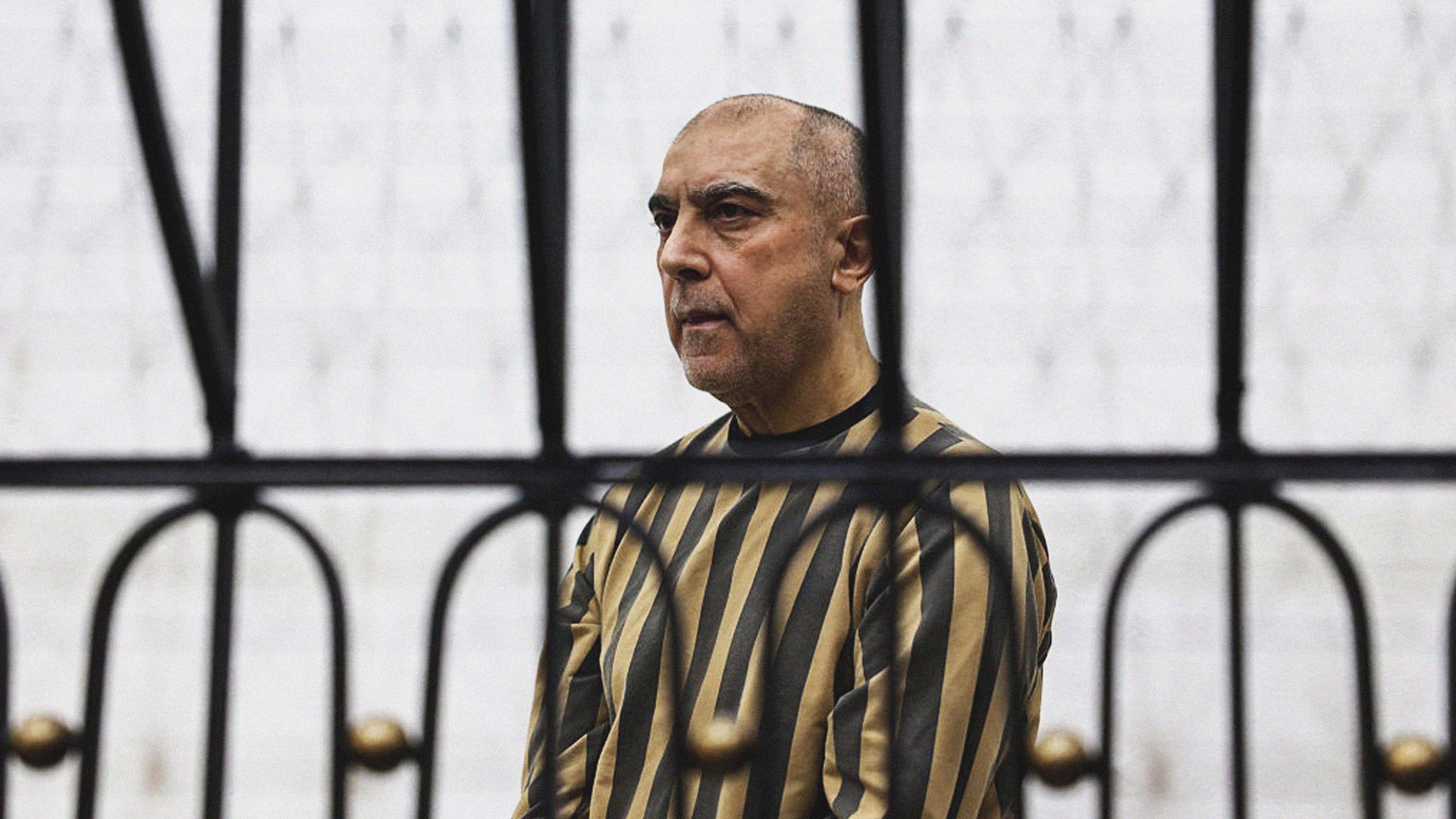
The accused, Najib, was in a cage inside the courtroom, wearing a prison uniform. He is the most prominent figure from the Assad era currently in the custody of the new Syrian government. He is charged with murder, torture and orchestrating massacres. On May 10 he told the court that he denied all charges. Outside, survivors and his victims’ families did not believe him.
I had been dropped outside a few hours earlier by a taxi driver who’d had something to get off his chest when he realised where I was going. The new government is doing this trial, he said, while the cost of electricity was eating people alive and half the city’s waste wasn’t being collected. “They do this to make people forget their problems. Najib is a criminal, yes, and he should be executed. But why do the trial now, when we have enough problems?”
The Palace of Justice, with its sand-coloured stone, has a horseshoe archway at its centre. The arched windows run the length of the facade in the French colonial, Arabesque style. Palm trees flank the entrance and a new Syrian flag snaps on the roof above the old inscription. It was built to project permanence and authority, which it still does – the difference now being whose authority it projects.
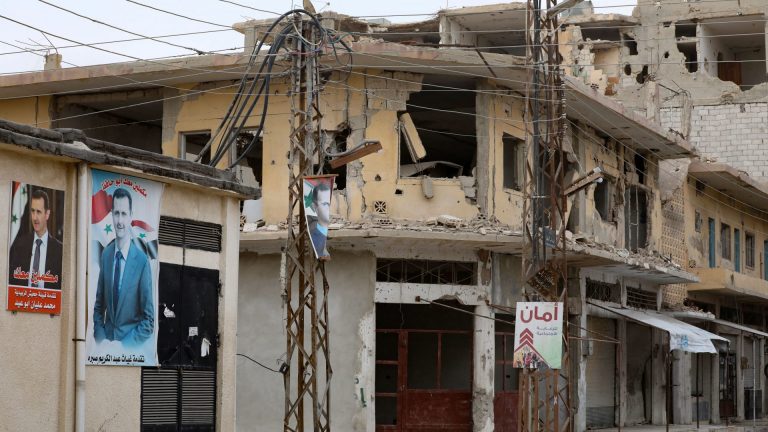
Eighteen months ago this building belonged to the Assad regime. The judges inside served that state, and the legal documents processed here were the paperwork of a system that disappeared, tortured and killed hundreds of thousands of people.
Suggested Reading
The terrorist who took over Damascus
Najib was not merely an instrument of that system, but also ran it in Daraa, the southern city not far from the Jordanian border, with a degree of savagery that set the template for what came after. When the parents of arrested children came to beg for their release in 2011, he told them to forget their sons, go home and make new ones.
He ordered the detention of teenagers who had written “it’s your turn, doctor” on a wall – the “doctor” being Assad himself, an ophthalmologist before he inherited his father’s dictatorship. Those arrests and what happened inside the detention cells afterwards are now understood as the moment the revolution started. What followed cost Syria roughly half a million lives and displaced half its population.
Moawia Sayasneh was one of those teenagers. He stood in the crowd speaking with the directness of someone who has been rehearsing this for a long time. They were detained for 45 days, he said, and tortured. Hung like chickens and beaten. Najib told their parents to forget about them – or worse, the version most Syrians know by heart, the crude instruction about what their mothers were for. He says: “Thank God that after 15 years, Atef Najib is in the hands of security.”
One man on the sidelines told me about his brother Ahmed who was in Sednaya, the prison outside Damascus where detainees were hanged in batches, their bodies buried in mass graves. They thought he was missing until they saw his mutilated body among tens of thousands of images of the dead that were smuggled out of Assad’s detention system by a defector.
This gave a forensic record of industrial killing that shocked the world and, for families like his, it became the only way to account for the missing relative. He showed me his phone and a photo of his brother. He had been an Olympic judo hopeful. He had muscular arms, a broad smile.
Suggested Reading
Our forever war on terror
“It was like a game for them,” said Ahmed. “They were having fun killing people. Animals wouldn’t do that to people.” Then he looked at the building. “Before the fall of the regime, if I had come here and said it is a beautiful feeling to be standing here, I would have been executed. It is a beautiful feeling. That is how all Syrians feel.”
Inside the courtroom, Najib denied everything. Ramadal al-Ali, who heads the Daraa victims’ committee, called for the death penalty. Anything less, he says, would be insufficient for what Najib personally ordered: the mosque massacre, the political security branch massacre, the detention of children, the killing of a father who refused to hand over his son. “He committed this massacre by himself,” al-Ali said.
And yet the taxi driver’s question remains. The trial is being run under Syria’s 1949 Penal Code, a framework with no provision for crimes against humanity. There is no formal transitional justice law in force.
Some lawyers and rights experts say the trial is premature for exactly that reason: that without a legal framework determining who is tried, when, and on what basis, the proceedings rest on shaky ground.
Suggested Reading
Syria’s forgotten victims
The transitional justice commission established by the new president, Ahmed al-Sharaa, has moved slowly. Its internal regulations are unclear, its mandate limited to Assad-era violations and excludes anything that happened after December 2024. Some lawyers will tell you quietly that the selective nature of the accountability – pointing at the old regime’s most obvious villain while the new government’s own forces face no equivalent scrutiny – is itself a political calculation.
Outside, after the Allahu akbar had settled and the crowd thinned into the bright Damascus afternoon, I stood near the steps and watched the faces of people who could not quite believe what they had just witnessed.
These courtrooms have processed the bureaucracy of at least two very different Syrias. Whatever comes next will use those same rooms.
Rachel Hagan is a freelance foreign correspondent based in Istanbul