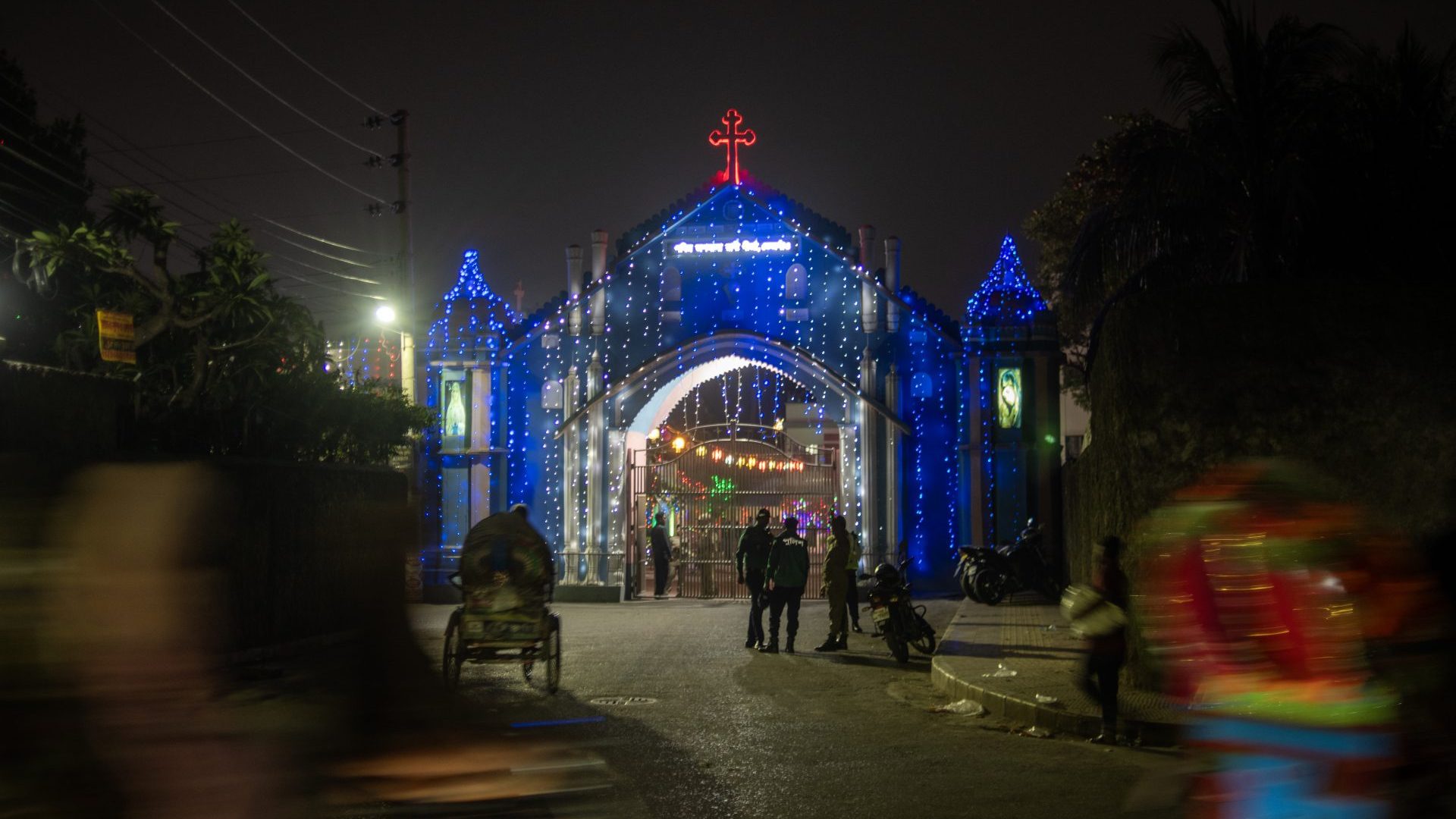
As December arrives, churches and surrounding neighborhoods in Dhaka light up with colour. Strings of lights, handmade paper stars, Christmas trees, and festive decorations appear in the city’s dust-filled streets. Children rehearse choir songs, preparations begin for midnight prayers, as Christian families move through the season. It’s a small yet vibrant community.
Alongside this is a persistent and familiar concern: security. Each year, as the festival approaches, celebrations are accompanied by heightened vigilance. The lights of Christmas now shine alongside police barricades and metal detectors. The joy and the fear exist side by side.
Christians make up only about 0.3% of Bangladesh’s population. Despite their small numbers, the community has a long and deeply rooted history in the country. Christian institutions have played a significant role in education, healthcare, and social welfare, often serving marginalised populations through schools, hospitals, and humanitarian work.
Yet, as Christmas approaches every year, the government deploys additional security forces around churches and Christian-majority neighborhoods. Police, Rapid Action Battalion (RAB), and sometimes even military personnel are stationed outside major churches. Many churches install CCTV cameras, metal detectors, and archway gates. While these measures offer some reassurance, they also mean that celebration becomes, in many ways, a carefully managed and “controlled joy”.
In 2025, these security concerns intensified. A series of incidents has sent shockwaves through the Christian community here. The first occurred on October 8, at around 10 pm, when a crude bomb exploded at the gates of the Holy Rosary Catholic Church in Tejgaon. Founded by the Portuguese in the 17th century, it is one of the oldest churches in Dhaka.
Then, on the evening of November 7, another bomb exploded near St. Mary’s Cathedral in Kakrail. In the early hours of November 8, yet another explosion occurred in front of St. Joseph’s School and College, one of the country’s best-known Christian educational institutions. The rapid succession of attacks renewed fears not only among Christians but also among the wider public.
Dhaka police spokesperson Muhammad Talebur Rahman stated, “We are trying to determine whether these incidents are connected or isolated. What is clear, however, is that they were intended to spread fear.”
The Bangladesh Catholic Bishops’ Conference strongly condemned the violence and called for swift legal action. A statement signed by Archbishop Bejoy N. D’Cruze, Archbishop of Dhaka, emphasised that Christians have lived in the Tejgaon area for over three centuries and that the Holy Rosary Church is among the oldest Christian places of worship in Bangladesh. An attack on such a historically and religiously significant site, the statement said, was deeply distressing and unacceptable.
Suggested Reading

The Italian town that doesn’t celebrate Christmas
On November 8, Father Bulbul Rebeiro told a press conference, “We are a very small and peace-loving community. But repeated crude bomb attacks on churches within a month have left us deeply frightened. The motive behind these attacks remains unclear. We urge the authorities to investigate swiftly, identify those responsible, and ensure that minority Christians can observe their religious festivals peacefully.”
Sajal John Gomes, 35, lives in Dhaka with his wife and child. “Since these incidents, fear is always at the back of our minds,” he says. “When my family goes out, especially to church, there is constant anxiety. Only when I hear that they have returned home safely do I feel some relief.”
This year, Gomes says, he may not take his family to the Christmas Eve prayer service. “Given the current situation,” he adds, “I truly feel insecure about my family’s safety.”
In response to the threat, many churches have decided to scale back Christmas programs. Some are ending midnight prayers earlier than usual, while others are discouraging large gatherings. Christmas is still being observed, but security is no longer solely a matter for the state. It has become part of the daily calculations of church committees, volunteers, and ordinary worshippers.
The lights of Christmas, therefore, represent more than celebration. They are also a quiet form of resistance, an assertion of faith in the face of fear. They remind us that a community’s dignity and rights do not diminish with its size.
Christmas in Bangladesh today is no longer just a religious festival. It is a test for the state, for society, and for politics. The question remains: can Bangladesh become a country where a small minority can celebrate its most sacred festival. The answer will determine how strong Bangladesh’s commitment to pluralism truly is.
 Most popular


Matt Goodwin’s road to derision

GB News Scandal: How Ofcom let GB News corrupt British media

GB News sets its lawyers on to The New World
Matt Goodwin’s new book: The missing chapter