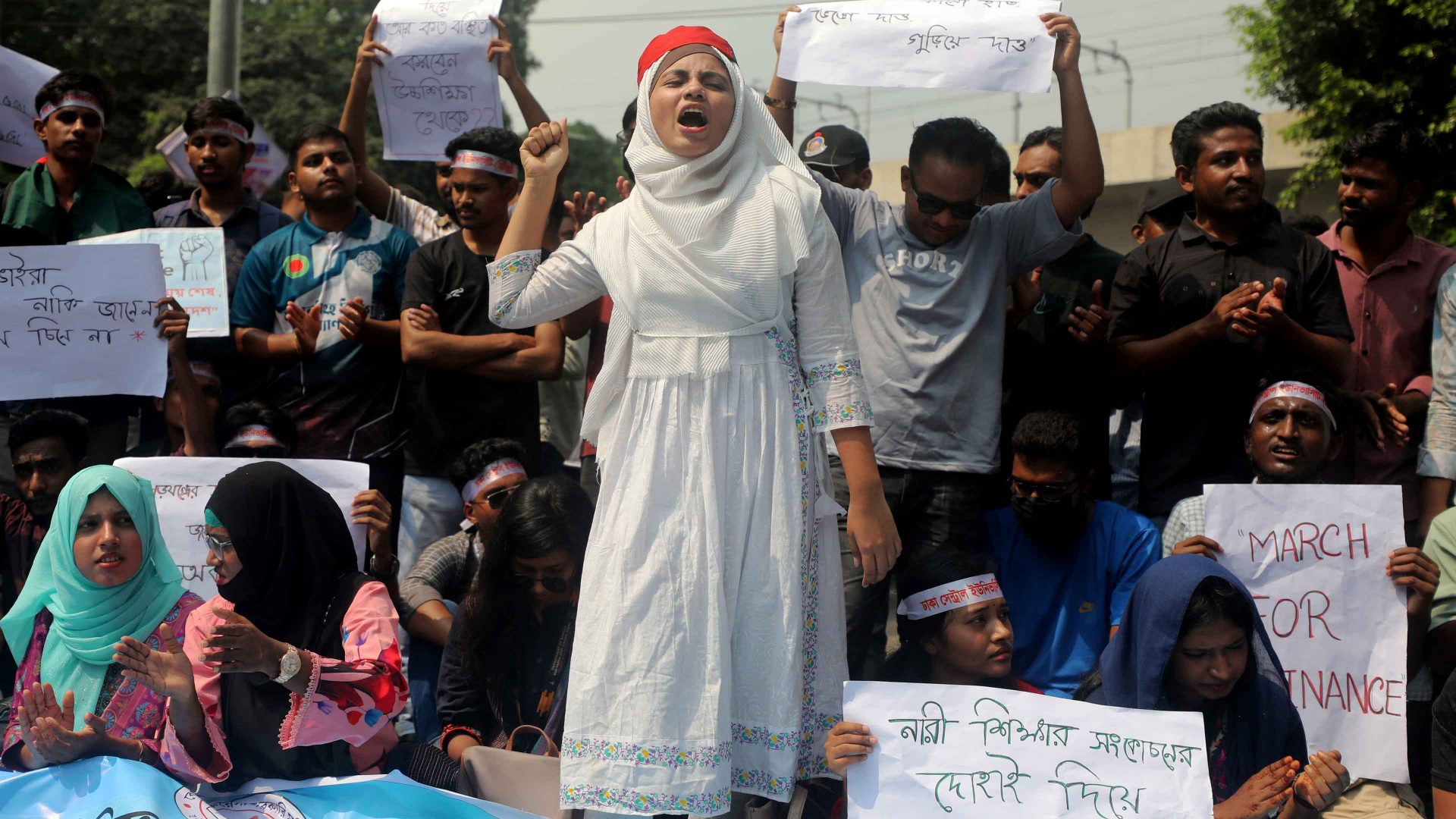
Bangladesh’s 2026 general election is just a matter of weeks away, and as I walk through the streets of Dhaka, the remnants of last year’s student-led uprising are still visible. Faded slogans on walls recall a time when thousands of young people filled the streets, demanding justice, accountability, and an end to authoritarian rule.
That movement, which forced Sheikh Hasina’s government to step down in August 2024, was one of the most powerful popular uprisings in Bangladesh’s recent history. Students, workers, and ordinary citizens risked their lives to demand reform. For a few intense weeks, it seemed as if we stood on the edge of a new beginning.
A year later, however, the outlook feels less certain. The passion that united thousands has given way to a mix of hope and frustration. Some young activists continue to organise, determined to turn their ideals into political action. But many others have stepped back, discouraged by the slow pace of reform and the persistence of old political habits.
Following Hasina’s fall, I began to notice new conversations among young people. Some of those who participated in the uprising sought to turn the movement’s energy into a political platform. One such initiative is the National Citizen Party (NCP), a youth-led party that calls for what its founders describe as a “Second Republic”.
During an interview with Jubairul Hasan Arif, the NCP’s 28-year-old chief joint organiser and coordinator for Chittagong, he told me that the party emerged out of disappointment. “We had hoped other political parties would show maturity in post-uprising Bangladesh,” he said. “Instead, they became preoccupied with dividing up power. That’s when we realised, if we want the uprising to become a true revolution, we need to establish a new political party.”
Formed in early 2025, NCP presents itself as a people-centric democratic force advocating for social justice, transparency, and the dismantling of entrenched authoritarian structures. The party’s leaders, many in their 20s and 30s, believe that without political reform, the spirit of the uprising will fade into history.
Yet not all young Bangladeshis are so engaged. A recent survey by the South Asian Network on Economic Modelling (Sanem) and ActionAid Bangladesh paints a sobering picture: 82.7% of young people aged 15-35 said they were not interested in participating in politics. The top reasons were fear of violence (58.7%), corruption, and lack of ethics in political culture (56.4%).
Only 1.6% said they were actively engaged in political activities, but three-quarters said they planned to vote in the next election, showing that while disillusionment runs deep, young people haven’t completely given up.
Suggested Reading
The Bangladeshi food that came down from the hills
When I asked Rasme Aktar, a 23-year-old sociology student at Dhaka University, about her experience, she sighed. “I joined the movement because I loved my country,” she said. “But a year later, that mindset is now changing. The most urgent task is to change Bangladesh’s political system, yet too many things remain the same.”
Rasme was among thousands of women who played a leading role during the protests. But like many of her peers, she has since withdrawn from public activism. Online harassment, gender bias, and moral policing have made it increasingly difficult for women to stay politically engaged. “Even when we share opinions on social media,” she said, “we face attacks and hate comments. It’s exhausting.”
These frustrations reflect a broader challenge. Despite a year of political transition, Bangladesh still struggles with unemployment, inequality, and corruption. Many young people are preoccupied with survival, finishing degrees, finding jobs, or supporting their families, leaving little space for civic or political engagement.
For decades, politics has been dominated by ageing leaders and entrenched patronage networks. In such an environment, youth leadership rarely flourishes. The barriers are even higher for women. The same social conservatism that limits women’s roles in the workplace and public life also restricts their political participation. In recent months, conservative groups have become bolder, targeting women’s clothing, sports, and even mobility. Moral policing is a worrying trend.
Yet women were among the most courageous during the 2024 protests, organising, documenting, and leading from the front lines. The fact that many now feel unsafe or unwelcome in politics speaks volumes about how fragile Bangladesh’s democratic transition remains.
Walking past Dhaka University’s courtyards, I often see students lounging in the sun, scrolling through their phones, or chatting about exams. Yet behind their casual conversations, there’s a quiet awareness of what’s at stake. They talk about the upcoming election, about reforms, and about whether the sacrifices of 2024 will lead to lasting change.
Bangladesh’s 2026 election will be more than a test of the interim government’s credibility. It will be a measure of whether the generation that brought down a government can now help to rebuild a nation. Will they step forward to shape the reforms they fought for, or will the weight of old politics push them back into silence?
Piyas Biswas is a multimedia journalist and documentary photographer in Dhaka