
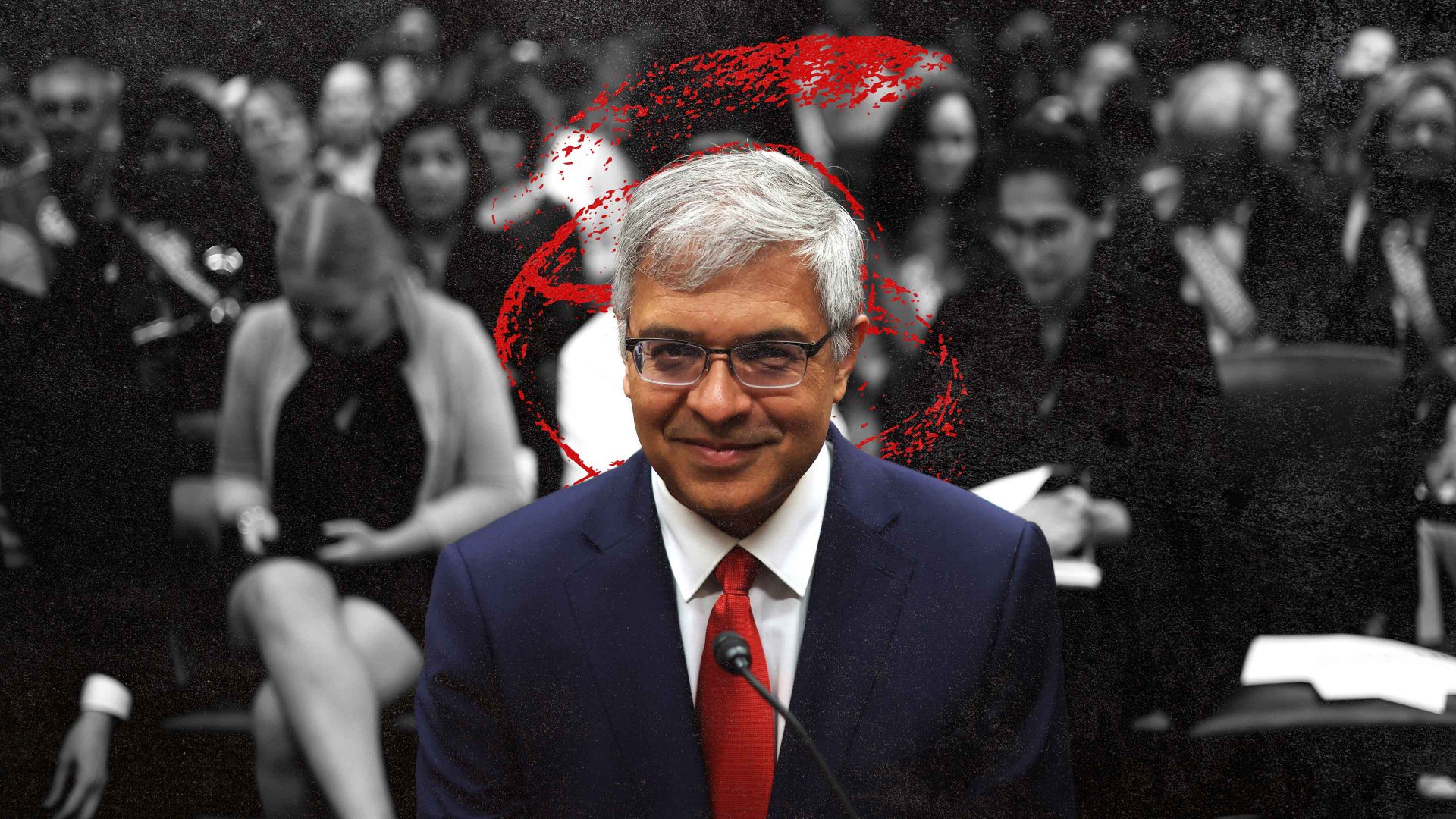
In January the journal Nature Medicine published a commentary by Jay Bhattacharya, director of the US National Institutes of Health (NIH), and colleagues titled: “The new vision from the National Institute of Allergy and Infectious Diseases (NIAID)”.
This institute, a part of NIH, oversees US research on infectious disease. During the Covid pandemic it was directed by Anthony Fauci, a bête noir of the American right and the Trump administration. Bhattacharya is a Trump appointee under whose direction NIH has suffered mass lay-offs, dismissals of previous heads of staff, and resignations from those who refuse to stomach his capitulation to health secretary Robert F Kennedy Jr’s anti-vaccination strategy and his cranky views on autism.
Bhattacharya has previously claimed that the mRNA technology vital to the Covid vaccine “failed to earn the public’s trust”. One of the authors of the anti-lockdown Great Barrington Declaration during the pandemic, he has been one of those actively sowing such distrust.
Bhattacharya is widely and rightly regarded as a disaster for NIH and for US public health. So the decision by Nature Medicine to give him a platform was bound to be controversial. His article asserts that “much of the American public lost trust in the NIAID, the NIH, and in the greater scientific community”: trust that he and his colleagues say that their “new vision” will restore.
They parrot the Trumpian line about “gold standard science”, and talk of focusing on the causes of common allergic and autoimmune diseases rather than cures – reasonable in principle, less so when one recognises Kennedy’s obsession with the idea that conditions like autism have an environmental cause that might be childhood vaccines.
It is not clear whether the “gold standard science” Bhattacharya has in mind includes the trial of a hepatitis B vaccine in Guinea-Bissau originally planned by the US Centers for Disease Control and Prevention under Kennedy’s purview, which has now been suspended because of ethical concerns.
But as virologist Angela Rasmussen has said in a recent commentary also in Nature Medicine, the anti-vax propaganda of Kennedy’s “Make America Healthy Again” tribe “is branded as “gold standard science” by senior US health officials and is published as guidance on government websites”.
Suggested Reading
Why human evolution is so hard to pin down
I would normally defend giving a controversial head of a scientific institution the opportunity to make their case. But the situation has deteriorated to such an extent that the argument for offering a platform to enablers of Trump’s anti-science campaign in a scientific journal is far less clear.
Rasmussen has compared Bhattacharya to Trofim Lysenko, the scientific adviser to Stalin whose denial of Darwinian genetics led to a catastrophic agricultural policy in which millions died from famine. Unvaccinated American children have already died recently from measles – the first such deaths since 2015. Kennedy’s plans will very probably lead to more.
But if we are talking of US deaths under Trump, it’s time for the scientific community to mount a broader response. While people are being seized from the streets to die in custody without any due process, and innocent citizens are being gunned down by government agents, it is hard to justify any international scientific conference being planned in the US for the foreseeable future. It is no longer reasonable to ask any person of colour, especially from Central or Latin America, to travel to the country for that purpose (nor, one imagines, would any Dane be keen to do so).
This isn’t a call for a boycott. American science has already suffered appallingly, and US scientists are overwhelmingly opposed to Trump’s policies in science and beyond. But withdrawing meetings from the US would be a courtesy to non-American scientists and an act of solidarity with their American colleagues.
To those who say “What about human rights abuses in other countries, like China?”, I’d reply first that scientific meetings have been cancelled there, and second, that whataboutery is an empty argument. The Nazis defended their antisemitic policies by pointing to the American race laws.
Calls of this sort should not be seen, and indeed not be made, as knee-jerk reactions to a single event that, precisely because it was so appalling, has uncertain near-term consequences. But the killing of Alex Pretti in Minnesota was an important marker on a trajectory that has been getting ever worse, and scientific organisations would do well not to commit themselves now to future actions in the blind hope that somehow this course will reverse.