
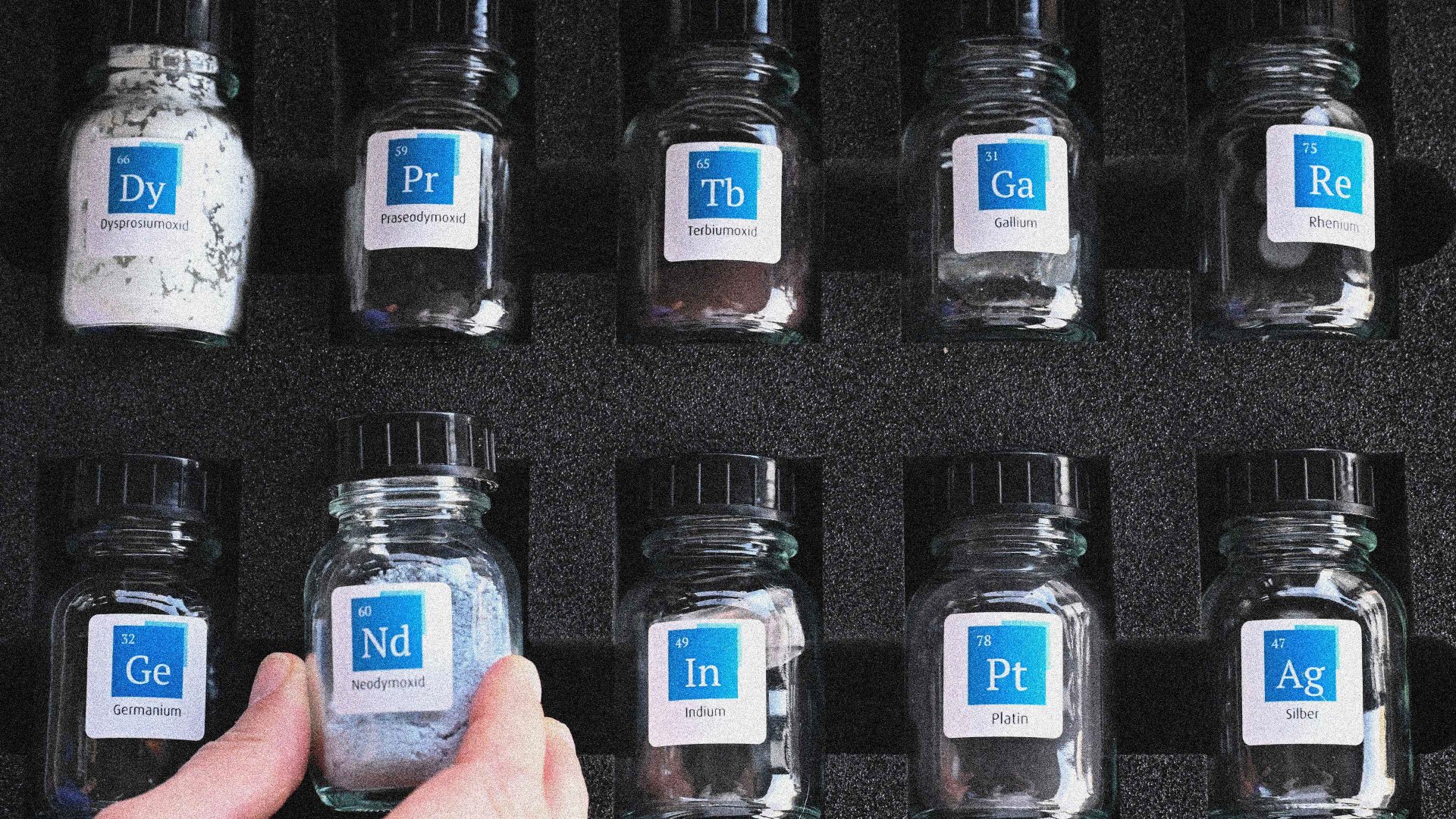
Planet Earth is not a well-stirred mixture, and that’s a geopolitical problem. Historical conquest and dominion has often been motivated by the uneven distribution of natural resources, whether it’s oil, timber, gold or diamonds. The precious assets stoking international tensions today are the metal elements called rare earths.
These metals are critical to a wide range of modern technologies. The strongest permanent magnets, used for example in MRI scanners, electric vehicles and wind turbines, are made from alloys containing the rare earths neodymium, dysprosium and samarium. Yttrium, terbium, and europium are used in materials that emit coloured light, making them indispensable for visual display technologies in televisions and smartphones.
Lanthanum is important for camera lenses and lighting applications, while cerium is a component of catalytic converters in cars. Clearly, some of these uses are central to green technologies, and researchers are eager to find alternative materials that are less economically fraught.
The clue to the problem is in the name. Compared to technological mainstays such as iron, copper, and lead, rare earth elements aren’t abundant in the Earth’s crust. Many of them were discovered as trace elements in other minerals, particularly those mined in the Swedish town of Ytterby, after which four of the 17 rare earths are named (including yttrium and terbium).
But the Swedish deposits were minor. Around 40% of the world’s available rare earth reserves are thought to be in China, which is responsible for nearly 70% of global production: around a quarter of a million tons per year. The United States ranks second, with a mere 12% of global production. All of that comes from a single mine in the Mojave Desert, where proposals to expand extraction and processing collide with its location in a National Preserve. China, meanwhile, is seeking to secure its dominance by investing heavily in reserves in Africa and South America.
Because of the key importance of rare earths, this monopoly gives China immense market power that its government is happy to exploit for wider political gain. In 2010, for example, it halted exports of rare earths to Japan during a territorial dispute, sending prices soaring and causing alarm because China and Japan were the only suppliers of rare earth magnets. China doubled duties on rare earths during the first trade war with Trump in 2018, and in 2022 it placed export controls on seven critical rare earth elements.
The US in particular is worried about reliance on China. Trump has pressed for a deal with Ukraine over rare earths and other critical mineral resources in the country, shamelessly leveraging Ukraine’s ongoing vulnerability. (Some have argued that the Russian invasion was itself motivated in part by the rare earth resources.)
Greenland has rich deposits too – the eighth largest in the world – that are so far unexploited. Some think that under the ice sheets there is enough to rival China. (And you thought Trump’s plans were all about Russian and Chinese warships?)
Where else might rare earths be found? There are big resources in Brazil that are not yet being exploited, and claims of deposits in Turkey. But figures for both rare earth mineral reserves and production are notoriously inaccurate, if available at all. Taking advantage of such opportunities needs time – new mining facilities don’t materialise overnight – and can incur a heavy cost.
Suggested Reading
The iron law of history
It’s a terrible irony that some of the key materials needed for a transition to green technologies can be extracted only by wreaking huge environmental damage. Creating new mines in Brazil could accelerate degradation of the biodiverse Amazon rainforests; mining in Greenland would be equally ugly.
But Julie Klinger, a geographer at the University of Delaware, says that turning rare earths into a source of geopolitical conflict “is completely avoidable, and if we make them so it will be totally our fault”. She says the problem is that “extraction is organised according to a competitive market logic”: whoever produces them most cheaply wins, which means that ethical practices that respect human rights and environmental regulations often can’t compete.
One reason China controls the market is because it has turned a blind eye to damaging and sometimes illegal mining operations. One – Chinese! – estimate a decade ago claimed that 40% of all rare earths are traded illegally.
Klinger argues that what is needed is much the same as for green technologies themselves: subsidies and public investment, and perhaps also a global strategy rather than a free-for-all.
In other words, it’s the same old story of natural resources and their uses generally, everywhere and always.