I was once told by a Chinese friend that one of her compatriots, while visiting London, had commented on how lazy Londoners were. Why so, my friend asked? Well, came the reply, look at all these old buildings they leave standing instead of replacing them with new ones.
I can no longer connect Shanghai or Beijing today to the wonderfully ramshackle streets I remember from my visits in the 1990s. But I know that to many Chinese people all this concrete and steel is progress: hot water, air conditioning, elevators, all accompanied by a rise in living standards that pampered westerners take for granted – or used to.
When the march of modernity – the rise of the internet, social media, cheap air travel, globalisation – draws the comment “that’s progress”, it’s a response steeped in ambivalence. But as conventional measures of progress stall – living standards stagnating or even regressing, young people lacking job prospects, democracies crumbling, antibiotics failing – we have to wonder: have we lost our grip on, and even our faith in progress? And do we want it anyway?
Those are questions asked in a recent BBC radio series, What Happened To Progress?, presented by Matthew Sweet. I was one of the interviewees, and the discussions left me, as I hope they left listeners, more thoughtful about the concept. Progress might seem like an unalloyed good to Davos Man, but the idea is a relatively recent one historically and arose within a context that we can’t idly assume remains relevant today.
The concept of progress emerged from the prosperity and nascent secularism of the 18th century, associated with Enlightenment thinkers like Kant, Hume, Adam Smith, Voltaire, with the rise of republics and of capitalism. That humankind is (or can be) on a trajectory towards betterment is a notion barely 300 years old, and it was only in the 20th century that it became normal to suppose that our children would have a higher living standard and more sophisticated technologies than we were born into.
In that sense, there surely has been progress, even if it has been distributed unevenly through society and across the world. On average we live longer, eat better, and have better healthcare than we did 100 years ago. Global literacy rates have risen, democratisation has spread, global poverty and violent crime rates have fallen, and we have easier access to news, art, information of all sorts.
The case made by the cognitive scientist Steven Pinker in his 2018 book Enlightenment Now that, in both material and moral terms, the world has progressed since Kant’s day has (despite some challenges to his data) much to recommend it.
But it would be foolish to suppose that such “progress” has been a smooth (let alone inevitable) upward gradient. Sceptics of Pinker’s brand of optimism point to the catastrophic world wars, totalitarianism, and the atrocities of the 20th century. They jeer at the complacency of Francis Fukuyama’s alleged “end of history” in the 1990s. They call attention to global warming, deforestation, the accelerating extinctions of species. And they too are right.
Perhaps the better question is whether the changes Pinker identifies warrant being labelled “progress” at all. What is the concept supposed to convey? In science, progress tends to connote an amassing of reliable knowledge and the development of more accurate theories: better representations of the real world.
Even those historians and philosophers who stress the social embeddedness of science will mostly agree that this has happened. But what about political progress? If that corresponds to fairer democratic representation, China for one has demonstrated that it is not an essential component of material progress.
And moral progress? Readers of The New World might be inclined to say it includes the recognition of basic human rights, tolerance of diversity, altruism. But there are substantial sections of the global population who regard some of the corollaries, such as abortion, gay or trans rights, and even foreign aid, as signs of moral decadence.
To the brand of conservative thought rooted in the works of Edmund Burke, progress is inherently suspect because what is good in society comes from stability and tradition rather than change and novelty. On the left, meanwhile, progress might be seen as tarnished by the dominance of the capitalistic entrepreneur.
Suggested Reading


Is this the best lab in the world?
Wasn’t the Enlightenment ideal merely a cover for the bourgeois exploitation of the oppressed, for colonialism and late imperialism? After all, didn’t all the noble-sounding declarations of Kant, Voltaire, Jefferson and Paine exclude people who the (progressive?) science of the times conveniently declared naturally inferior? US slavery was ended not by progressive ideas but by armed conflict. When Pinker and others celebrate and defend “Enlightenment values”, they are obliged to pick from them carefully.
One influential strand of the 18th-century project concerned governance and international relations. In his 1795 book Perpetual Peace, Kant advocated an international framework in which governments commit to renouncing war and abolishing standing armies, and to non-interference in one another’s business and territory. He stopped short, however, of calling for a World State, fearing it would become “the most horrible despotism”.
Political philosopher Lea Ypi has argued that Kant saw in the French Revolution, and perhaps in revolutions more generally, the prospect of moral progress. “Revolutions transform the normative and conceptual categories available to us, and change our perception of the boundaries of what is feasible”, says Ypi. “Across time they play a morally educative role in developing a learning process from which future generations benefit.”
But is revolution the only route to political progress? Kant’s vision began to seem more than utopian dreaming with the creation of the League of Nations in 1920 and the United Nations in 1945. Neither, of course, has led to perpetual peace, and neither embodies the kind of World State envisaged by HG Wells in his 1943 book The New World Order.
But they and other international institutions arguably reflect the Enlightenment idea of progress away from the Hobbesian State of Nature in which nation states pursue only their own hegemonic agendas.
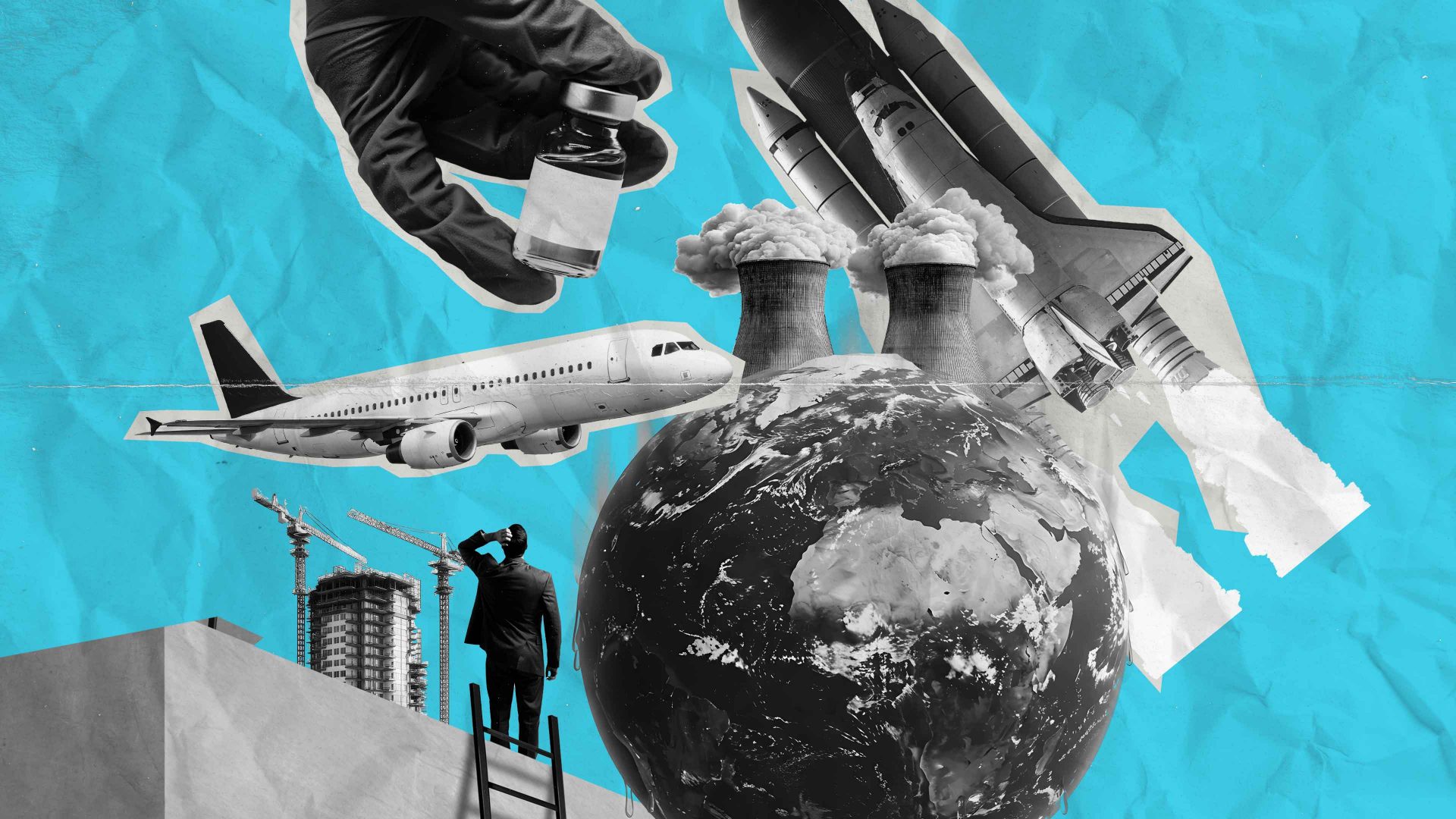
Perhaps this is not a good time to be evaluating the prospects for such political progress, when no one can say whether the dissolution of old alliances is a historical blip or a transition to something else (and worse). We might seem to be on firmer ground with scientific progress. Vaccines, gene therapies, quantum computers, space telescopes, MRI scanners: who can gainsay these advances?
Climate change is, meanwhile, arguably the legacy of the old ways: the industrial reliance on fossil fuels from which green technologies and nuclear fusion now promise to liberate us. More scientific progress, please!
Oh, but wait. Might we not instead see in the rise of technological prowess a proliferation of scenarios of apocalypse, from chemical and nuclear weapons to gain-of-function virology, ozone depletion, crop monocultures, and superintelligent AI? This is where the narrative of progress gets complicated – not because of the simplistic notion of “dual-use” technologies or trite slogans about power and responsibility, but because those science historians are right: science always has a social and political context, and is driven by motives besides curiosity.
Notice that the future technological developments often presented by tech boosterists, especially in Silicon Valley, as moral imperatives – increasing human longevity (“conquering death”), colonising other planets, eugenic engineering to “improve” humankind, uploading minds for “digital immortality” – are all imaginary: they are what I have called oneiric technologies.
Suggested Reading

Barack Obama is right about aliens
In this view, progress towards colonies on Mars (say) is presented as an essential precaution for preserving humanity in the face of potential global catastrophe. Multiplying our species into the trillions by colonising the stars is necessitated, according to the dictates of the Effective Altruists, by the gain in net happiness (even if individually these enormous future populations have rather miserable lives). Death becomes an evil to be “cured” like any other disease. And so on.
Having been fetishised in this way, technological progress becomes morally obligatory. Anything seen to hinder such a future – regulation (of science or entrepreneurism), ethics, even democracy – becomes wicked. Such visions are shared to some degree by many of the most powerful tech leaders, such as Elon Musk, Sam Altman of OpenAI, Peter Thiel, and Marc Andreessen. The extraordinary wealth of these libertarian tech-lords not only enables them to enforce their visions on the rest of us, but it also buys them political influence.
One could argue that this has little to do with the original Enlightenment idea of progress and everything to do with the pursuit of power and money. Perhaps. But I don’t believe that case is so clear. For one thing, this breed of libertarianism has deep roots within the neoliberalism that emerged from Enlightenment ideals, as Quinn Slobodian describes in his 2025 book Hayek’s Bastards. What’s more, the links between such ideology and the mainstream of science and technology are strong. Nasa depends on Musk’s rockets to access space, and he retains his Fellowship of the Royal Society.
It is not enough, then, to say that Musk and his ilk weaponise and corrupt the idea of progress. Rather, they illustrate the contradictions at its core. To suppose that we could have enjoyed the material improvements since the 18th century without nuclear and biological weapons, industrialised genocide, environmental destruction, species extinctions, and so forth is a phantasm. The dark side of progress might not have taken these specific forms (although many do seem inevitable), but it reflects our fundamentally conflicted nature: kind and mean, wise and stupid, wicked and saintly.
To deal with that, it’s not enough to appeal to the “better angels of our nature” (Abraham Lincoln’s phrase, borrowed by Pinker for the title of his 2011 book on the decline of violence). We need robust institutions with not just legislative powers, but also reserves of wisdom and compassion.
Those are two words absent from the subtitle of Pinker’s book, Enlightenment Now, which reads: “The case for reason, science, humanism, and progress”. These are not the obvious and inevitable bedfellows that Pinker, and many others, seem to suppose, let alone a sufficient recipe for improvement.