
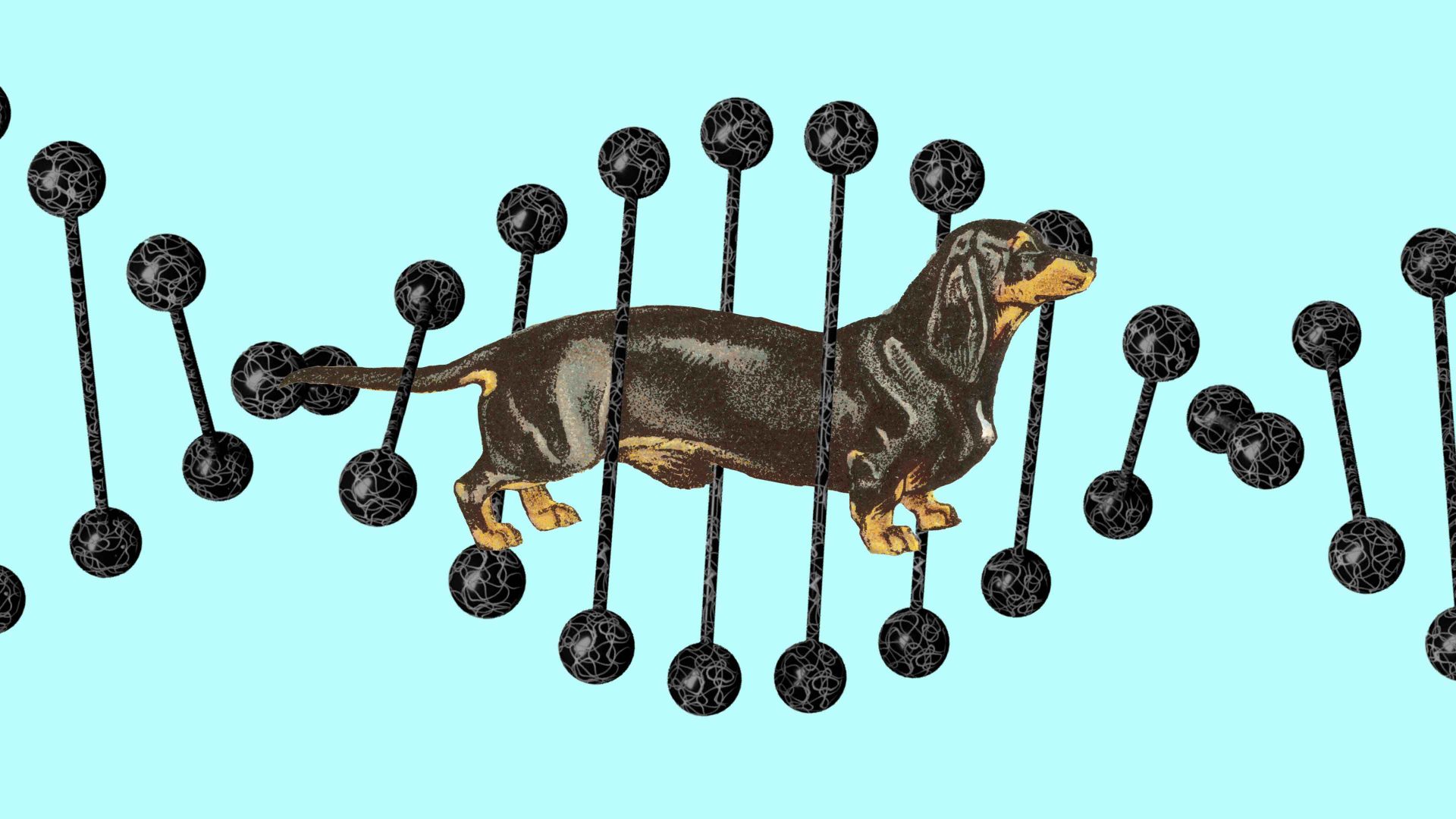
You want a dog that is well behaved, won’t yap at strangers or ignore commands? Then don’t trust genetic analysis to predict any of that. A new paper by a team at the University of Massachusetts Chan Medical School reports that genetic screening of prospective pets to deduce behavioural traits – a service now offered by several companies – can’t tell you much about your dog’s personality. These tests can give you a pretty good idea of what the dog will look like – but you might reasonably suppose there are easier and cheaper ways to find that out.
Here’s the idea. Just about every attribute in complex animals like humans and dogs can be shown to have some correlation with the genetic profiles of individuals: the different gene variants they carry. So by looking at genetic sequences – the exact chemical structure of the organism’s DNA – it should be possible to make predictions about their attributes.
Sometimes this can be done with impressive accuracy. Genetic screening of IVF embryos is routinely conducted for couples who know they could be carriers of gene variants linked to specific diseases, such as Tay-Sachs disease or cystic fibrosis, thus making it possible to select an embryo that does not carry the disease variant.
This approach is reliable, however, only for diseases with a known and simple genetic basis, typically stemming from just one gene. Most common diseases, such as type II diabetes or heart conditions, have much more complex genetic associations. They may be linked to many different genes, and then only in a way that increases risk on average.
For example, some gene variants raise the risk of certain types of cancer, but by no means imply that an individual carrying them will actually develop the condition. The same is true for non-disease genetic associations – for example, linked to height or intelligence.
It’s the same for dogs. A type of inherited progressive blindness in dogs, for example, has been linked to a specific gene and can be predicted reliably. Some physical traits like height are also highly heritable and predictable, as you’d expect from a species that has been so stringently selected into breeds: you’re not going to get a chihuahua the size of a St Bernard.
Suggested Reading


The lessons we need to learn from the Covid inquiry
But some companies also claim to predict dog personality this way: to tell you if an animal is likely to be aggressive, say. That’s far less clear. Behavioural traits can vary nearly as much within breeds as between them, and there is relatively little genetic data on dogs for spotting correlations with traits, compared with humans. The UMass team put such claims to the test using a “community science” online initiative called Darwin’s Ark that collects both genetic and behavioural information about more than 3,000 dogs (both pure and mixed breeds).
They found that no genetic variants were of much use for predicting behaviours, for the simple reason that behavioural traits just aren’t that heritable. These characteristics depend a lot on the animal’s environment – how it was raised, say – but also on complex mixtures of genes that don’t get passed on as a package.
Some of the problems with such predictions are specific to dogs, because breeding methods create very complex ancestries. Identifying correlations with gene variants requires a diverse database of genetic information and becomes less feasible for individuals whose genetic ancestry is under-represented. More data might help make prediction better, but probably not by much.
Here, though, is the kicker. Reading the first line of the new paper – “Genetic tests for behavioral and personality traits in dogs are now being marketed to pet owners, but their predictive accuracy has not been validated” – you might be inclined to consider that a pretty poor situation.
What, then, if I tell you that the statement remains true if you replace “dogs” and “pet owners” with “babies” and “parents”? Such tests, applied to IVF embryos, are illegal in the UK, but are being offered by a New York-based company called Nucleus Genomics. Sample report: “Embryo 1 will have green eyes, black hair, +4 IQ points, -1% chance of autism.” “Have your best baby”, says the company’s website, adding that the technique is “powered by the world’s most advanced genetics”.
It is not. The science of predicting complex traits from screening of many genes is still controversial, and in any case will always be probabilistic. If that child predicted (at considerable cost) to have high intelligence or reduced risk of autism turns out not to fulfil these expectations, what then? It might not be ideal, but at least you can take the unexpectedly aggressive dog back to the dog home.