
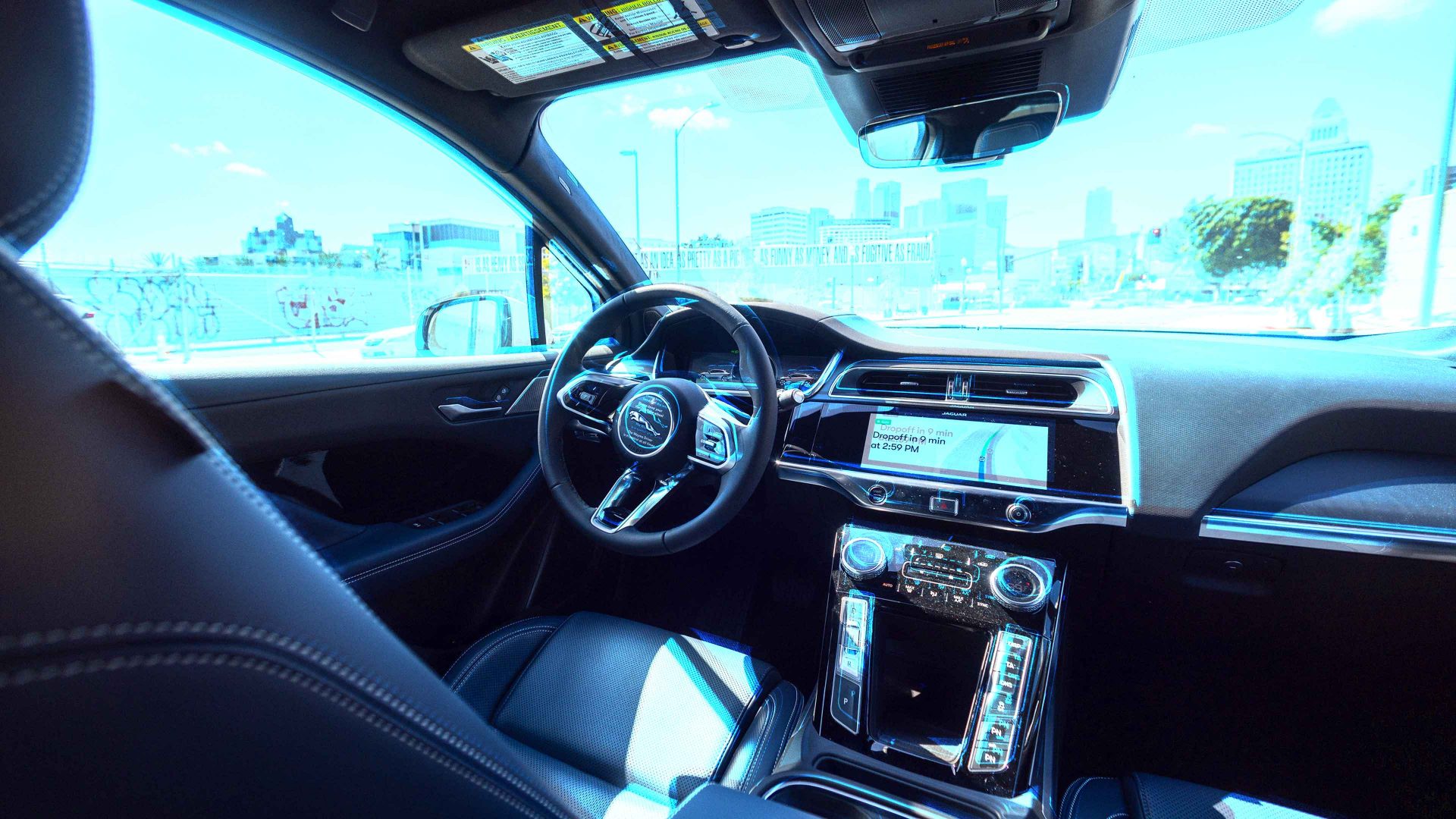
At a technology conference in Las Vegas at the start of the year, Jensen Huang, CEO of the computer-chip company Nvidia – the highest-valued publicly traded company in the world and the key provider of hardware to the information industries – announced that his company has made a breakthrough in the development of AI systems for self-driving cars. Huang claimed that his team had cracked the problem of enabling such autonomous vehicles to respond rationally and safely to rare scenarios – a bugbear for those, such as Elon Musk’s Tesla, who have been striving for decades to make these vehicles reliable.
What’s more, said Huang, Nvidia’s system, called Alpamayo, can explain why it is making the decisions it does, rather than remaining a mysterious and sometimes erratic black box. “In every single scenario,” he told the conference, “it tells you what it’s going to do, and it reasons about what it’s about to do.”
The advance, Huang added, will allow Alpamayo-guided vehicles to take to the road very soon, starting with an automated taxi service next year, which Nvidia is developing with an unidentified collaborator. He showed a video of an AI-controlled Mercedes-Benz taking a passive passenger through the streets of San Francisco.
That’s basically the story reported by the tech media in the wake of the Las Vegas conference. What you’ll struggle to find is any assessment of what to make of all this. Of course, everyone wants to know what Musk thinks. And of course Musk obliged in a tweet, which was predictably dismissive. He believes Alpamayo is doing nothing very different from Tesla’s Autopilot driver-assistance system, and that – and for once Musk might be speaking the truth here – Nvidia will find it’s the last 1% of rare scenarios that make a truly road-safe self-driving system hard to attain.
Suggested Reading

The ‘super flu’ that wasn’t
But all this is just claim and counter-claim. How do we know whether we can trust Huang’s statements? We don’t. What we do know is that there is a long and ignominious history of tech leaders making false claims about the power, scope and market-readiness of autonomous-driving systems, Musk most prominent among them. We know, too, that this is a pattern repeated for AI more generally, especially in the context of the rather meaningless chimera of “artificial general intelligence” or superintelligence. Huang is at least talking here about a concrete application, the performance of which can in principle be evaluated. But absent any such independent assessment, all we have right now is an extremely wealthy man in a snazzy leather jacket telling us his company has made a thing. “We are still letting hypey CEOs mark their own homework,” says Jack Stilgoe, an academic at University College London’s department of science and technology studies, who has followed the development of self-driving vehicles closely.
More to the point, Stilgoe says, the question is not merely “does it perform as claimed?” Driverless cars could have profound social impacts, raising ethical and legal questions about responsibility and accountability as well as access, employment, pedestrian behaviour and more. That new technologies may have unanticipated consequences has been evident at least since the Industrial Revolution, and was especially true of the automobile itself. We are only now (too late) waking up to the disruptive influence of AI itself, which tech CEOs assured us would be a marvellous advance for humankind (or, equally distractingly, humanity’s nemesis). “What we need is independent assessments of the social experiments that are taking place,” says Stilgoe. He and others are wondering whether new technology like this should be treated in the same way as new drugs: being subjected to careful clinical trials before being licensed for market.
As it stands, driverless cars are already here. Waymo, a subsidiary of Google’s Alphabet, already operates autonomous rides in US cities like San Francisco, Los Angeles and Phoenix. They are also available in some Chinese cities. The European Commission president, Ursula von der Leyen, is eager to welcome them to Europe. If they really are safer – that’s unproven, although European roads are safer than American ones anyway – then perhaps there’s a case. But European cities tend also to have more bikes and better public transport, and narrower streets. The case is far less clear than in the car-obsessed US. Besides, have Europeans even been asked what they want?
“The ChatGPT moment for physical AI is almost here,” Huang said in Las Vegas in regard to Alpamayo. He seemed to consider that a reason for triumphant excitement, although if he is right, it would be better regarded as a warning.