
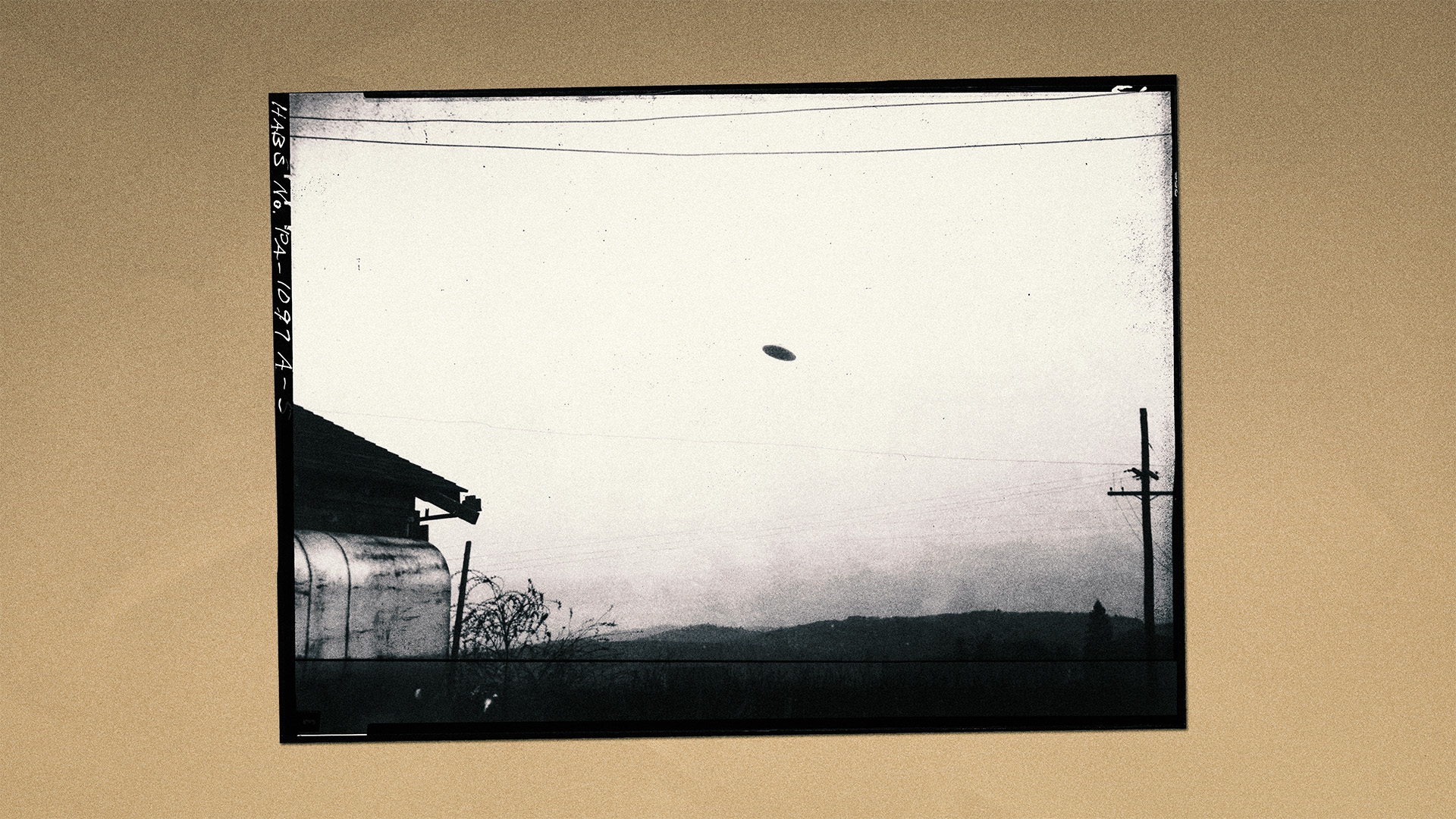
Barack Obama says aliens exist! Not undocumented immigrants to the US (although of course they do too), but aliens of the outer-space variety. In a “rapid-fire” Q&A during an interview with podcaster Brian Tyler Cohen broadcast on 4 February, Obama was asked “Are aliens real?” “They’re real”, the ex-president responded, “but I haven’t seen them, and they’re not being kept in Area 51 [the US air force site in Nevada that has become the focus of many alien conspiracy theories]. There’s no underground facility unless there’s this enormous conspiracy and they hid it from the president of the United States.”
It was clearly a light-hearted answer, and the absurd headlines Obama’s comments provoked (“‘They’re real’: Barack Obama’s shock alien claims”) speak volumes about the crude level of public discourse on the subject. Such was the feverish response that Obama felt obliged to issue a clarification: “Statistically, the universe is so vast that the odds are good there’s life out there. But the distances between solar systems are so great that the chances we’ve been visited by aliens is low.”
That’s a sensible and informed view, and speaks to an ongoing debate among scientists. The universe is indeed vast – no one knows just how vast – and it is evidently thronging with stars that have solar systems of planets like that of our own Sun. Thanks to astronomical instruments such as the James Webb Space Telescope, we now know of more than 6,000 known “extrasolar” planets, and it’s generally thought that nearly all of the hundreds of billions of stars in each of the trillions of galaxies in the observable universe will host some.
But for planets to host life, they must have habitable conditions. Quite what counts as habitable is not clear. Many researchers believe it demands liquid water, meaning the planet can’t be too hot (like Mercury) or too cold (like the dwarf planet Pluto). But others speculate that other liquids, existing outside the temperature range of liquid water – such as the liquid hydrocarbons on Saturn’s moon Titan – might act as the solvent for alien life forms quite unlike those on Earth. Meanwhile, other moons in our solar system, such as Jupiter’s Europa and Ganymede, and Saturn’s Enceladus, seem to have global oceans of liquid water beneath an icy crust, even though their parent planets lie outside the “habitable zone” (neither too hot nor too cold for liquid water) of the solar system. Such moons boost the potential tally of inhabitable worlds even further.
And we can be confident that, even if Earth-like extrasolar planets – rocky, with oceans of water – are in a small minority among alien worlds, there will still be vast numbers of them. But how likely is it that life will have begun on any of them? Some astrobiologists – scientists studying the prospects of extraterrestrial life – think the origin of life on Earth was an extraordinarily unlikely, chance event. Others argue that life is almost inevitable when the conditions are amenable. They point to geological evidence suggesting life began almost as soon as it became possible at all once our planet had cooled from its fiery birth.
But even if life is common on other habitable worlds, the chance that it would become intelligent – as we like to consider ourselves – is far less clear. An argument proposed by cosmologist Brandon Carter in the 1980s implies that for life evolving by Darwinian natural selection to get to our level of complexity and intelligence demands that it pass through several unlikely “bottlenecks” in the evolutionary process. In this view, we are only here pondering these questions because we’re the lucky ones who made it when most alien life got stuck at the level of bacteria and algae. Recently, however, other scientists have challenged Carter’s “hard steps” hypothesis, saying that on the contrary it might be common for Darwinian evolution to deliver high intelligence, given enough time.
Suggested Reading


Epstein and the moral rot of US public intellectuals
When we speak of “aliens”, it’s typically this intelligent variety we have in mind – no one seems to care much about alien slime that will never build spaceships. Obama is right that “Statistically, the universe is so vast that the odds are good there’s life out there” – that’s an uncontroversial, even if not universal, scientific view. He’s also right that the physical obstacles to interstellar travel by intelligent aliens look daunting, perhaps insurmountable. The only reason we got excited about a US president saying such things is that it seems like a wink at Area 51 conspiracy theories. But for that sort of thing – witness Trump’s past interest in the US military’s “UFO files” – we’re looking at the wrong president.