According to some historians, the invention of quantum mechanics in 1925 emerged within a pervasive sense of political and cultural crisis, which meant that its apparent challenges to established physics, to common sense, even to causality and objective reality, reflected the zeitgeist.
In this centenary year, it’s tempting to suppose we are in another such time. The UN’s 2025 International Year of Quantum Science may have highlighted the extraordinary new technologies that now draw on what we like to call quantum weirdness – powerful quantum computers, ultra-secure quantum cryptography – but it also invites parallels between the political extremism developing in 1925 and that of today.
All the same, a retrospective of 2025 shows quantum science looking vibrant at 100, adding another set of Nobel prizes to its name. A new poll shows that physicists still don’t agree on what quantum mechanics tells us about reality, but rather than getting hung up on such questions, many are moving on to fresh questions such as whether we can find evidence in the lab that gravity is (as is overwhelmingly suspected) quantum-mechanical, like the other forces of nature.
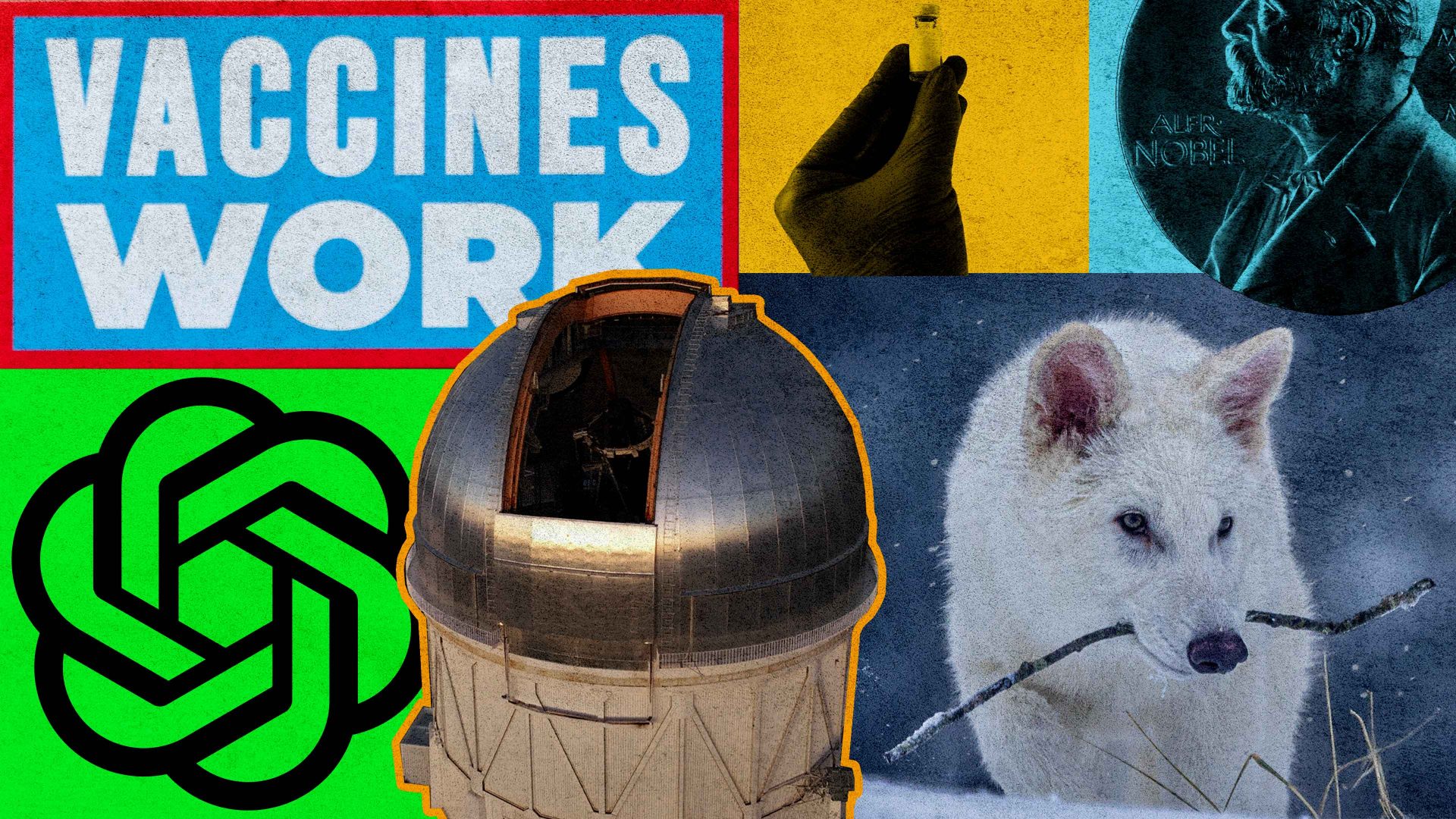
Astronomers, meanwhile, can celebrate the launch of the Vera Rubin Observatory in Chile, which back in June began its mission to image the entire southern sky every few nights for 10 years. The return to the moon continues, with lunar landings and orbits of several uncrewed spacecraft, some from private companies.
The challenges remain: Nasa’s Lunar Trailblazer orbiter mission went silent soon after launch, and a lander craft made by a Japanese company was seemingly destroyed in a crash landing. The US space agency’s Artemis mission to return humans to the moon this decade is still laden with risk.
It was a hopeful year for medicine. In September, scientists at University College London announced a promising advance for Huntington’s disease. There is still no cure, but the new treatment, a type of gene therapy, slowed it by 75%. Encouraging results were announced too for treating breast and pancreatic cancer.
Suggested Reading

Dog DNA tests are barking up the wrong tree
But biotech is also beset by hype. There is ever more talk of “designer babies” from the genetic screening of IVF embryos: some US companies now offer predictions of IQ, musicality and other traits from genetic profiles. But many scientists doubt the “polygenic scores” for such traits – based on many gene variants believed to influence them – have any real predictive value.
And we were confronted with the unedifying spectacle of gene-edited grey wolves engineered by the US company Colossal being passed off as resurrected “dire wolves”, which went extinct just after the ice age. These photogenic white-haired canines featured on the cover of Time, named after the fictional dire wolves in George RR Martin’s Game of Thrones series (Martin is an investor in the company).
Many scientists question whether Colossal’s genetic tinkering can ever be considered a kind of de-extinction, or indeed whether it is ecologically ethical. The company meanwhile welcomes all publicity as good publicity and is pressing ahead with plans to bring back the dodo and the woolly mammoth.
Looming over everything was the ongoing destruction of US science by the Trump administration. Health secretary Robert F Kennedy Jr’s war on vaccines and other medicines has spawned unevidenced claims about the “causes” of autism and the dismantling of US efforts in the mRNA vaccine technology that helped end the pandemic.
There is no reasoning with such superstition. Nasa seems set to drop its climate monitoring programmes as Trump’s climate-change denialism sheds any pretence of scientific credibility. In such circumstances, there was little hope that the Cop30 climate summit in Brazil would come up with agreements likely to slow the pace of warming. Some conclude that only more natural disasters will convince many of the public of the US administration’s lies – this hurricane season in the Atlantic generated three Category 5 events for only the second time on record. Perhaps it will take lethal outbreaks of disease, such as the US measles epidemic, to shift opinion on health. It’s not clear that either will be enough, or come soon enough.
Perhaps, however, the sight of Trump in a fighter jet dumping excrement on protesting crowds will be something of a watershed moment for AI, showing how ugly, destabilising and plain shit many of its products are. As AI slop pollutes the infosphere and floods music streaming services, there could be relief when the AI bubble finally bursts, despite the financial pain it could cause. Maybe 2025 will prove to have been peak AI: the year when we decided to restore it to being a mere useful tool for data analysis, and not to let it run and ruin our lives.