To listen to western policymakers and pundits, you would have thought that the Biden administration, Britain and their allies always thought Ukraine’s wartime survival was vital for the rest of Europe.
In fact, as the last pre-invasion days ticked down four years ago in February 2022, the strategy for the defence of Europe favoured by Washington was very different. It was based on the fast abandonment of Ukraine, the extraction of its government and a clear message to the Kremlin that Russia could expand no further – at least, not onto Nato soil. It was much the same in Whitehall.
It was a plan that envisaged arming Ukrainian insurgents, who would then fight a likely doomed campaign, ideally for years, for the benefit of the rest of Europe. US intelligence was right in its assessment that the assault was coming – but wrong in its conclusion that Russia had enough forces to overrun the country.
Senior Ukrainians, accounts suggest, had their own variety of beliefs – but in many cases, including at the top, also had something very wrong. While they expected an assault in eastern Ukraine towards the Donbass to create a land bridge towards Crimea, they thought the Russian forces forming up in Belarus were a feint to divide Ukraine’s forces by threatening Kyiv. They did not think it was a true grab for the capital.
Ukraine defeated Russia’s airborne assault at the airstrip in Hostomel, to the west of Kyiv. The Kremlin failed to fly in more paratroopers. The Russian column that should have seized Kyiv ground to a halt. The verdict of history is likely to be that this was when this war was won and lost.
Right now, Vladimir Putin continues to throw forces into Donbass, advancing at a snail’s pace with enormous losses.
The prospect of a much wider Ukrainian collapse remains a possibility – perhaps due to a Russian technological breakthrough that brings down Ukraine’s drones, but more likely a European failure to deliver sufficient arms. But that may be getting more unlikely. Eastern European states and Germany know that a Ukrainian defeat, or even just a ceasefire, would start the countdown to a much wider threat to Europe.
Recent polls suggest that Ukrainians are determined to keep fighting, in order to further drain Kremlin resources. They want EU membership – but more importantly, national survival.
A deal to end the war would halt their own military strikes deep inside Russia, but would allow them to rebuild and reshape their nation as a militarised colossus. Even more than Poland, which is rearming fast, Ukraine would act as an arsenal and inspiration for its allies with its innovation, industry and grit.
A future Kyiv government could follow the growing string of countries including South Korea, Japan and Poland that are now giving quiet consideration to building their own sovereign nuclear deterrent.
Even a much milder version of that outcome is a defeat for Russia – although the Kremlin has achieved another goal quietly in the background, a gradual acknowledgement in Washington, Europe and increasingly Kyiv that Crimea will likely keep on Russian-held, not least because any Ukrainian attempt to overrun it might bring Russian nuclear response.
That brings the first very awkward truth of what Russia losing means – an immediate effort by the Kremlin to present that loss as victory, as a historic success in securing Crimea for the long-term, by overrunning Mariupol and seizing the coastline “land bridge” along the Azov Sea.
Suggested Reading
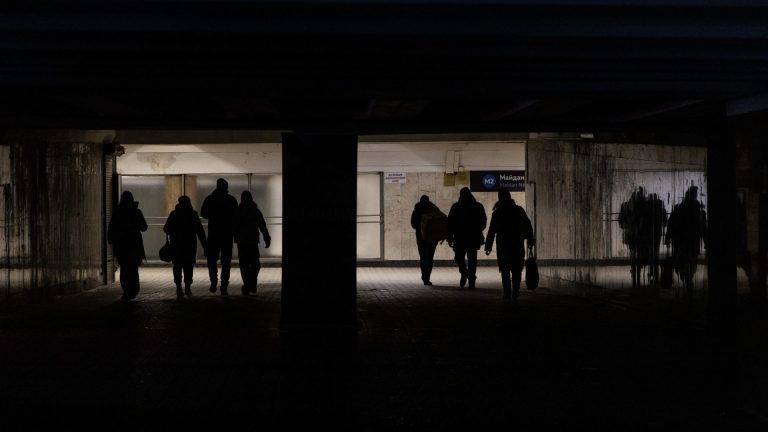
In blackout Kyiv, Putin’s new weapon is the cold
But that could have been secured several years ago, without the enormous losses since. Putin’s security state may be able to keep the resulting discontent under wraps for now, but an ageing leader will need to find new routes to further “wins” – and fast.
That, then, is the awkward reality. European pundits and officials are right to warn that “if Russia wins”, Estonia or another Baltic state might well be next. But the same may also be true if Russia loses, providing that loss does not lead to the collapse of Putin’s government. Such a prospect would be disastrous for Xi Jinping, which means Beijing is incentivised to keep Russia’s economy from overnight collapse.
That’s the scenario that keeps many Europeans up at night. Because a Russia that keeps manufacturing arms at its current rate but is no longer using them, and which moves its troops from eastern Ukraine to Nato’s borders, might outgun even a rearming Europe.
If the US is prepared to fight alongside Nato, even without sending many further troops, that should be enough to keep Russia in check – the Pentagon has quietly given a steer to Eastern European states that “tripwire” forces such as the fourteen US tanks currently in Estonia are likely to remain for the remainder of this presidency.
That is good news, particularly for the UK-led Nato detachment also in Estonia, and which would be vulnerable without US participation. But Britain is also now looking to deploy yet another force: the so-called Ukraine “coalition of the willing” in parallel with France.
Suggested Reading

The message to Trump, Putin and Xi: big countries lose wars
Ukrainian officials know where they would like those troops to be: somewhere north of Kyiv to confront any future Russian assault on the capital. Vladimir Putin knows that, not so long ago, a distracted Labour government sleepwalked into an Afghan misadventure, biting off more than it could chew before taking unsustainable casualties and later pulling out.
Sending foreign troops to a post-war Ukraine is very far from stupid: done sensibly, with proper well-resourced plans to threaten elsewhere in Russian territory if such forces are attacked, it could help to establish a lasting deterrence.
But handled poorly, it could make things worse. It is a reminder that, even if Russia loses, Europe will still be fraught with danger.
Peter Apps is a global defence columnist for Reuters news agency, a British Army specialist reservist and author of “The Next World War: The New Age of Global Conflict and the Fight to Stop It”, published by Wildfire and available in bookshops and on e-book and audio.
 Most popular

Trump has devastated Iran – and damaged himself
Here's what Zelensky really thinks of JD Vance


A Green wave is ready to wash away Labour London – and this is why

Exclusive: New Ofcom chair appointed – but will he fix Musk and GB News?