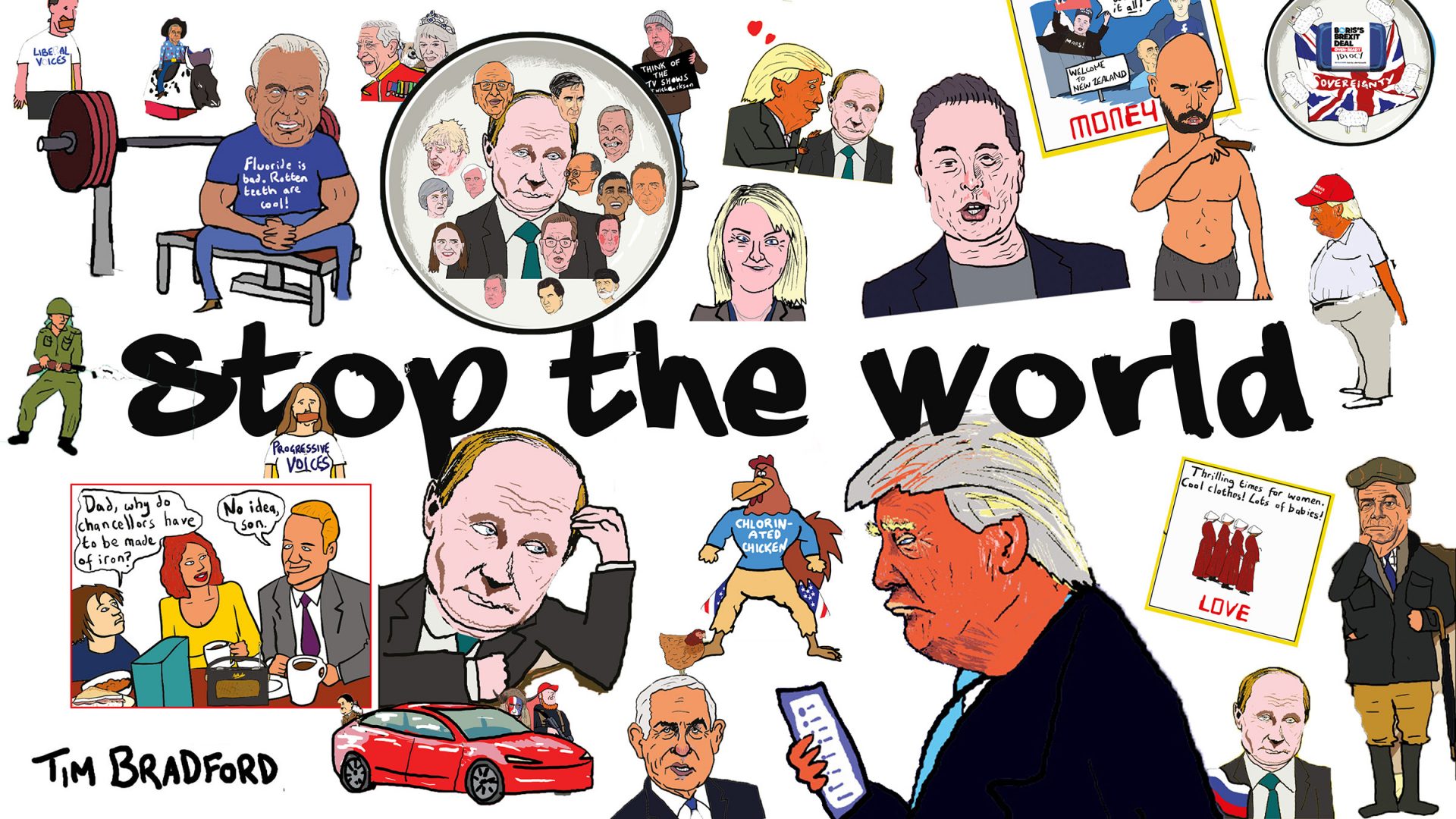
The consequences of Donald Trump’s national security bombshell are still reverberating around western capitals. Trump told Europeans they are on their own in the deterrence of Russian aggression. He promised to destabilise European democracies and to replace their liberal governments with authoritarian nationalists like himself.
He is currently trying to force Ukraine into an unjust peace, but western security officials know their problems are now greater than that. If, as threatened, Trump pulls serious parts of America’s conventional armed force out of Europe by 2027, it will require a massive and rapid rearmament just to maintain the current balance of power.
Yet most populations remain oblivious to the threat. As a result, we’re seeing politicians and military leaders go public with language that has not been used since the full-scale invasion of Ukraine.
General Gwyn Jenkins, head of the Royal Navy, warned last week that Russia was engaged in much greater hybrid aggression against the UK than the mere appearance of the Yantar spy ship off our waters:
“The advantage that we have enjoyed in the Atlantic since the end of the second world war is at risk. We are holding on, but not by much. There is no room for complacency. Our would-be opponents are investing billions. We have to step up, or we will lose that advantage.”
Nato secretary general Mark Rutte warned that, after Ukraine, the defence aliance is Putin’s next target, adding: “We must be prepared for the scale of war our grandparents or great-grandparents endured.”
French army chief general Fabien Mandon was even starker, telling an assembly of mayors: “If our country wavers because it is not ready to lose its children… or to suffer economically because the priority has to be military production, then we are indeed at risk.”
So if Trump’s outburst of petulant isolationism has achieved one thing, it is forcing those who see the intelligence briefings to start levelling with the population about the danger we are in.
Yet we’re not just up against complacency. We’re facing a type of person I call the “useful idiot savant” – people who parrot bland pacifist catchphrases, or “anti-imperialist” phraseology, in full knowledge that the threat is real.
They have strong antecedents: in April 1937 the former Labour leader George Lansbury visited Hitler to ask him to a peace conference. After delivering two and a half hours of pacifist platitudes to the führer, Lansbury asked if he could take a message to his Jewish constituents in London’s East End. Hitler stood up, did a Nazi salute and issued a torrent of invective, terminating the meeting there and then. Yet Lansbury stood in front of the cameras and issued a statement entitled “Hitler Wants Peace”.
Militarily we are strong enough to deter Putin. European members of Nato have collectively three times the naval power of the Russian state and 12 times its GDP.
But it’s our fragmenting social cohesion, the profound and rising mistrust in the institutions of democracy, our slow-moving civil service, our complacent political class and a security elite that – until General Jenkins’s speech – has preferred to speak in euphemisms, that worry me.
Suggested Reading

How Reform’s Nathan Gill became a Russian agent
As Clausewitz taught, defeating an enemy is about removing their will to fight and their means to fight. Unfortunately, after years of peace, and with a fragmented national culture, the UK’s will to fight is uncertain.
To remedy this, we need to win five arguments – and I put them forward as someone who opposed nearly all Britain’s wars of choice.
First, the threat is real. Putin could do to us what he’s doing to Ukraine without the conflict going nuclear, or even kinetic. Seventy-five percent of our liquefied natural gas comes through one pipeline, and there is very little redundancy in the internet cables that supply our information. The lights could go off, the internet could go dark and the supermarket shelves could empty without a shot being fired.
Second, deterrence works. Nuclear deterrence has kept the peace since 1945, but to deter you have to show yourself willing to match the capabilities of your opponent. Both Russia and China are rapidly proliferating the means of warhead delivery. And while Britain has opted to join Nato’s nuclear sharing, whereby tactical nukes will be made available on RAF planes, we might need greater autonomy if Trump’s isolationist threats are made good.
Third, rearmament has upsides. Jobs in the defence industry typically earn £15k more than the average in manufacturing – and as warfare goes digital and high tech, the growth multipliers from defence investment should increase.
Unlike other high-value sectors, there is no automatic tendency for defence to cluster in the Oxford-London-Cambridge “golden triangle” – in fact north-west England is the hands-down biggest recipient of defence spending, with 31% of all defence hours worked.
Fourth, the trade-offs are not binary. We can afford a generous welfare system because the bond market sees the UK as a secure and stable country. As the threat increases, and Russia’s destabilisation operations boost the extremes of UK politics, the “welfare not warfare” slogan becomes a kind of ritualised idiocy. If we want to keep a welfare state, we have to deter aggression effectively.
Finally, the left has to turn up. We have unique contributions to make to the defence of our country: we can insist on ethical standards in defence research; we can push for the armed forces to have greater civil rights and greater connectedness to the society they are defending. We can play our part in mobilising all communities in Britain to resist hybrid aggression, and bring our organising power to the challenge of civil defence – just as the left did during the Blitz.
By the late 1930s, after they’d seen the realities of the Spanish civil war, there were very few people on the left like Lansbury. It was the right who failed to turn up – from Oswald Mosley to Unity Mitford to Edward VIII and the Tory appeasers who signed the Munich Agreement.
Today’s Munich is also being designed by the right – Trump, Orbán, Le Pen and the German AfD – but it is being facilitated by people like Corbyn, Sultana, Polanski and their supporters.
There is nothing pacifist about their objections to rearmament. It’s just that they don’t seem to like the state they live in. Trump’s dolchstoss should make them understand that, faced with a nuclear-armed ethnonationalist aggressor, the British state is all we have.