
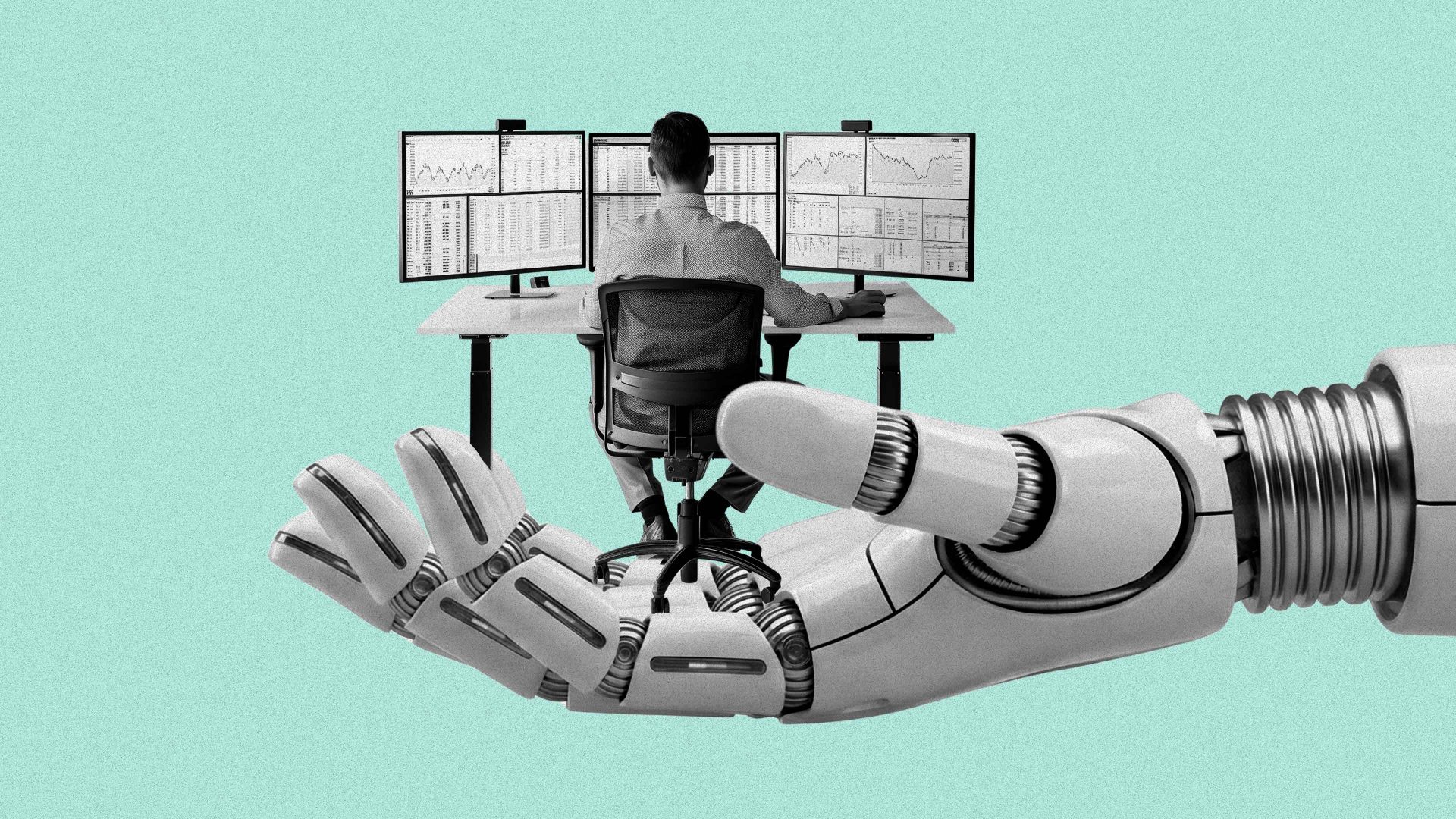
The artificial intelligence revolution is accelerating at speeds that, if you’re not using the technology – even in a basic way – are hard to grasp. We are a little over five years into the deployment of Large Language Model AI, and it already has a history more spectacular than the entire computing era.
When it started, it was little more than a sophisticated predictive text conversation. Then it moved into producing and analysing images. Throughout 2023 its makers improved their models’ ability to learn from human feedback.
In 2024 we saw the beginnings of “reasoning over long chains of thought”. Next the most competent of the AI tools began to pop up inside the applications we use on our computers.
And then we entered the “agentic” phase. LLMs have moved from basically “ask me and I give you an answer” to “set me a task and leave me to it” and “by the way I may interact with another AI to do it”.
Right now, the AI tools that are sparking fantasies of mass unemployment among the skilled salariat are Claude Code and Claude Cowork, both of which are applications that run on your computer, can see your files and make new ones, and can use your screen.
Claude Code lets the AI write software and, though its product has been judged patchy, on some tests it scores 92% against a benchmark for competence on basic tasks. Cowork has wowed non-coders because, even in its early iteration, you can use it like a digital AI employee. Unlike their predecessors, these products no longer need to store their reasoning in their working memory: it’s as if the intelligence now has a hard drive.
Suddenly, two sets of people – software engineers and office workers – can see how a machine might replace them, and \experience how rapidly the agents learn.
To inhabit the communities around these agentic AIs – with Gemini, Claude and ChatGPT being the big three at present – is to meet once again the wide eyed euphoria that was generated by the first Internet browsers, and before them, by email.
To get a sense of both the hype and fear that it’s generating, one blogpost predicting mass graduate unemployment and an economic slump by 2028 has garnered more than 22 million views.
In “The 2028 Global Intelligence Crisis”, the consultancy Citrini Research predicts an AI-driven economic and financial boom over the next two years, as productivity rockets, followed by a techno-slump.
Suggested Reading
US spy chief: Trump is repeating the mistakes of Vietnam and Iraq
Once the layoffs began, says the author, in an imaginary report written in October 2028, “It was a negative feedback loop with no natural brake. The human intelligence displacement spiral. White-collar workers saw their earnings power (and, rationally, their spending) structurally impaired. Their incomes were the bedrock of the $13 trillion mortgage market – forcing underwriters to reassess whether prime mortgages are still money good.”
In the scenario, the slump happened because the layoff cycle in software and business services spills over into everything that is not manual work. Firms that were paying gazillions for bespoke software decide to build it themselves. Firms that were essentially selling consultancy and management expertise on top of enterprise computer programmes found machines doing their work instead.
But that’s just the start. Since much of the consumer economy in the west is based on exploiting the asymmetry of information between for example, customers and supermarkets, or bank account holders and credit card companies, suddenly everyone has the equivalent of Martin Lewis in their pockets. All the GoCompare-type sites disappear and the same happens in business-to business relationships.
Friction, basically, evaporates, and with it the monopoly profits of everyone except the AI companies. Software engineers fight each other for welding jobs. Everyone downsizes. It’s like 2008 all over again but it never stops, because the real economy is tanking faster than the financial sector.
As someone who has written books on the intertwined long-term fates of information technology and capitalism, it gladdens my heart to see the techno-elite panic about the future.
But I am less worried about the doom scenario than they are. First, because in the short-term AI is giving workers more power, not less. Anecdotally, AI usage is much higher among people who work from home and do hybrid jobs than office workers. The latter face strict rules on what they can use it for, because of the risks of giving away intellectual property.
For those of us who use it regularly, it allows us to remove arduous work tasks on products that, for now, still sell at the same price as if we’d done all the leg work ourselves. In work on my upcoming history of communism, I still need a Russian speaking human researcher to find a rare and ancient Bolshevik memoir.
Suggested Reading

Meet Claude, the $14bn AI that thinks it wears a tie
But I don’t need to pay a graduate student to come up with an expert bibliography for my research (even though in the early days, the AI replacement was hallucinating articles it thought I wanted to read). The challenge for people like me is when machines become good enough to churn out books people want to read, and booksellers decide to sell them.
And though I don’t fear that in the short term, it has made me – as a writer, consultant and human-to-human communicator – start thinking much more about what is unique about the stuff I do.
Even if they’re wrong about the speed, the doomsters are right about the processes that are under way. We are seeing potentially the rapid automation of repetitive intellectual work. We are seeing the power to innovate placed in the hands of people who didn’t have it before. And all business models based on information asymmetry are going to be challenged once there’s a mass rollout.
And what encourages me the most is that, alongside the corporations making multi-billions out of the hype, there are 90s-style user communities swapping the stuff they’re innovating with each other for free.
Conventional economics believes that, as AI shrinks the number of people needed to do office work, and robotics shrinks the manufacturing workforce, most of the value creation in the economy will move to human-to-human services.
As I wrote in my book Postcapitalism, more than ten years ago, the question remains: does this take place primarily within market mechanisms, or does the sphere of human activity happening in free time, with no money changing hands, also grow.
If it does, then capitalism begins to shrink. The 250 year process whereby innovation creates new needs – for example replacing one heavily staffed vaudeville theatre with ten barely staffed cinemas – does not automatically replicate itself in a world of information abundance.
All this is a long way from the preoccupations of politicians, who are still in the breathless phase of engagement with AI. So how the politicians respond to the dangers and potential paradigm shifts is a major variable in how rapidly the economic effects take place. We’ve seen this with the showdown between Claude’s maker Anthropic and the US government over military access to the tool.
But the strategic challenge is real. In the agentic dystopia, the people earning the money are welders, electricians, nurses and slaughterhouse people – and of course the super rich owners of the AI.
I’ve covered corporate and large-scale computing since the mid-1990s and I’ve spent most of that time aware of the macroeconomic limitations of techno-hype. This time I genuinely do not know where it leads, or how fast.
 Most popular

‘Operation Epic Fury – as it happened’

Is Star Wars dead?

Morrissey returns.. and heaven knows he’s mythical now


Iran War: Trump has now sealed his own fate