
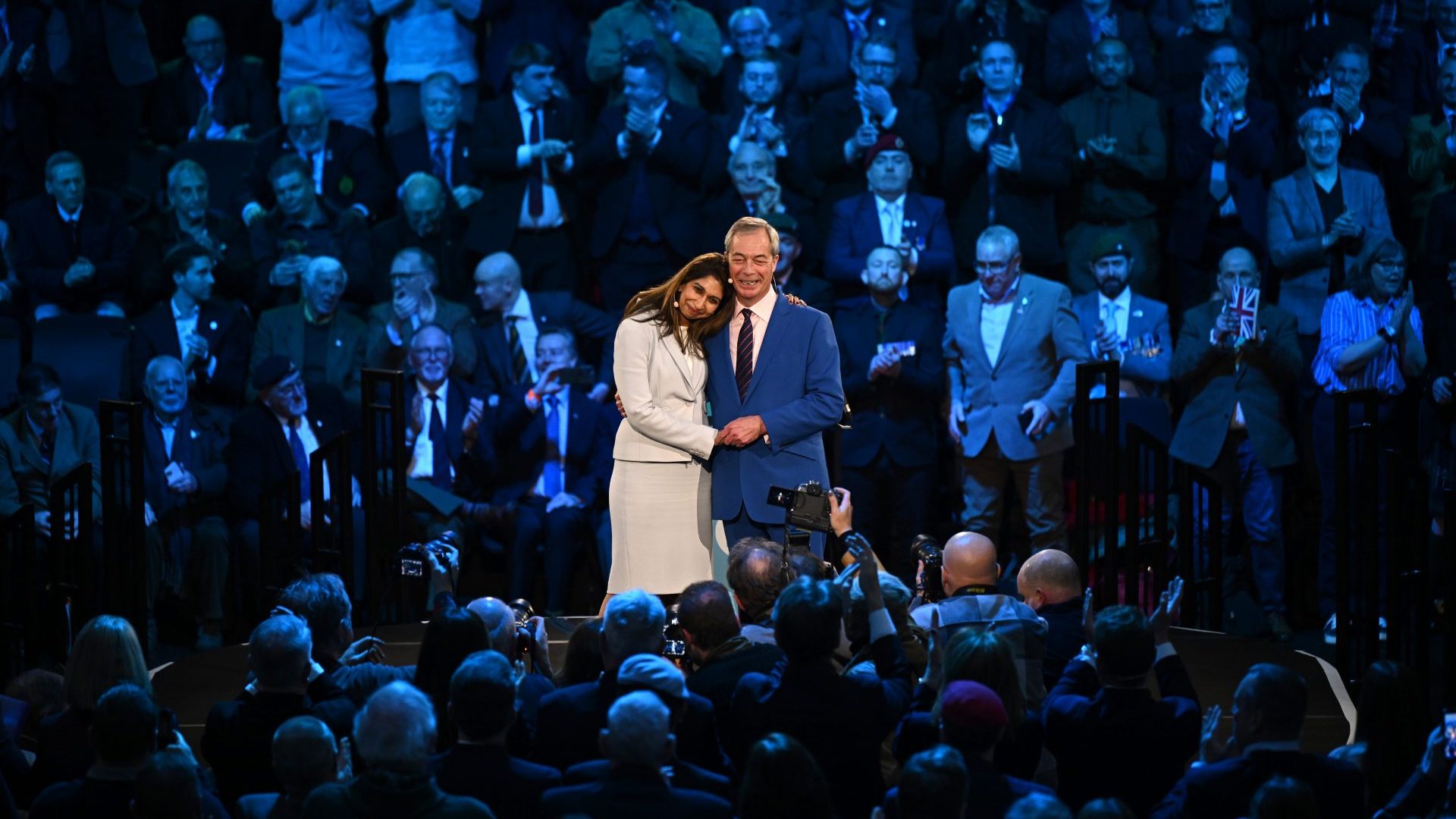
In business schools, they teach that “when a new person joins the team, it’s a new team”. By that measure, Reform UK is becoming a new team every week. January has seen the defections of three sitting Tory MPs to Nigel Farage’s party, with two of them – Robert Jenrick and Andrew Rosindell – coming directly from the shadow cabinet.
When backbencher Suella Braverman jumped ship, bringing her trademark deranged oratory to the launch of “Veterans for Reform”, it signalled a moment of critical mass. Some 23 current and former Tory MPs have joined Reform, quickly transforming it into a kind of political sump for Conservatism’s overt racist overspill. The party risks becoming a blend of the worst of Trussonomics and the worst of racist nativism.
With Reform still polling in the high 20s, and money rolling into the party from the Russia-adjacent super-rich, defection raises the defectors’ chance of re-election and, in the meantime, is the gateway to a life of parties, receptions and adulatory rallies that the Conservative Associations they’ve left behind could never provide.
Robert Jenrick, whether performatively or genuinely, has become the middle-class white guy obsessed about black kids who misbehave. Braverman famously claimed it was her “dream” to see failed asylum seekers flown to Rwanda shackled on to the floor of a plane. Rosindell is more of a dog-whistler, complaining about black footballers taking the knee.
But once you look past the common denominators – racism and Islamophobia – they are importing all the contradictions of elite conservatism into the heart of the populist right. Probably the only serious thinker among them is Danny Kruger, MP for East Wiltshire, who pioneered “National Conservatism”.
Kruger is opposed to abortion and same-sex marriage, and believes politics should be “re-Christianised”, telling followers that the traditional family is “the only basis for a safe and stable society”.
A regular speaker at MAGA events, Kruger was the vector for “anti-woke” Christian nationalism into the Conservative Party. He wants an end to “globalism” and the return to a world where nations are “sovereign”.
But the arrival of this mixture of the mad, sad and bad creates obvious tensions within Reform.
There is now, at the very least, a competition between the “respectable” ex-Tories and the street populists – like Zia Yusuf and Matt Goodwin – over who will set the tone for Reform, and who are key to its outreach to the unashamed fascist plebs. The more its ethos evolves towards that of the shire Tories and ex-military types, the more it alienates the 100,000 drunk racists who followed Tommy Robinson into Whitehall last year.
And the sudden expansion of Reform’s parliamentary group poses an obvious question. With Farage more or less boycotting parliament, who is to be the figurehead? And with Farage once again mired in allegations over dodgy money, should Farage for some reason no longer be around, who would succeed him?
But the most fundamental tension within the 2026 version of Reform is over foreign policy. Farage is a veteran Putin-understander. He appeared on, and was paid by Russia Today, where he praised Vladimir Putin as a “shrewd operator”. One of his key allies just went to jail for taking bribes from Russia.
Some key donors to the party have business links to Russia, while the wider ecosystem of the British far right is awash with Russian influence.
And at the level of social media, Reform’s traffic is said by researchers to be driven substantially both by MAGA-aligned bots and those operated by Russia.
But figures like Braverman, Jenrick and Kruger have no record of alignment with Russia. Indeed, I understand Kruger is now on a mission to de-Kremlinise Reform, bringing its positions on Ukraine and Nato closer to that of the party he’s just left.
That is to be welcomed: the fewer Putinists of the far right or far left we have in parliament, the better. But soft Putinism has been one of the British far right’s raisons d’être, and it will take more than a couple of quiet chats to convince the British security elite that Reform could be trusted with power.
Right now, I see the polls and the by-elections not as signals of voter intent for the 2029 election, but as flag waving for identities. Racists are polling for Reform, progressives disgruntled with Labour, together with Muslims angry over Gaza, are polling Green.
Suggested Reading
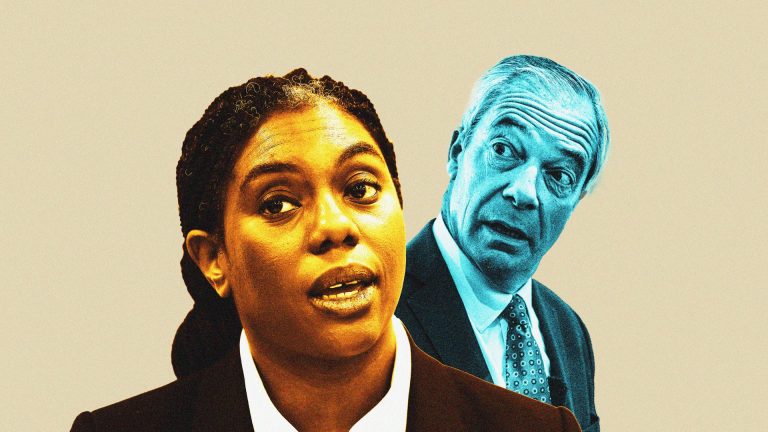

Congratulations Kemi: Robert Jenrick is no longer your problem
But sooner or later Reform will have to start spelling out concrete policies: it is telling that, on the parliamentary website, the party has refused to list its spokespeople for policy issues. While the four Green MPs have managed to divide 20 quasi-ministerial topics between them, Reform has yet to sort out who does what.
Jenrick was shadow foreign secretary. Braverman for a few mad months ran the Home Office. Kruger was political secretary to Boris Johnson in No 10. They know how government works, what its limitations are, and understand the extreme unlikelihood of being able to enact any of Reform’s flamboyant promises to the electorate – with or without Britain’s departure from the European Convention on Human Rights.
And then there is the slight problem that Trump almost collapsed Nato over Greenland, and has declared tariff war against the UK, the US’s closest ally.
Kruger tried to grandstand in the Commons by demanding Britain send a “proper joint expeditionary force” to defend Greenland against Trump. But the British far right is going to end up as disoriented as the Mosleyites in the 1930s if it tries to ride both the horse of MAGA isolationism and British patriotism.
Trump’s project is no longer simply to split Britain off from Europe. It is to force the entire western world into financial submission – buying American debt without any expectation that we can export to American consumers. And the photographic evidence is there, going back more than a decade, that Farage is the British avatar for whatever Trump wants.
The truth is that Reform has no long-term answers for the structural, economic and geostrategic problems Britain faces. It has been, until now, held together by hate – a real hate that is swirling across white plebeian Britain, exacerbated by a reciprocal rising sectarianism within Muslim community politics.
Faced with the strategic problems of welfare dependency, re-armament, the maintenance of European alliances and trade links beyond Brexit, the fragmentation of the rules-based order, Reform registers as a symptom, not a solution.
The far right is increasingly attracting people on welfare – the “shirker” demographic that traditional conservatism despises. It is mobilising embittered veterans who claim there’s no point fighting for our country because “the war is here” – ie against Muslims and asylum seekers.
The opportunity for progressives is clear. At the forthcoming Gorton & Denton by-election, the Reform candidate Matt Goodwin can be eviscerated for his overt racism. Goodwin claims that black and Asian people who were born here, and have citizenship, are “not necessarily British”. He has claimed that 50% of social housing in London is occupied by “non-Britons” – again conflating recent migrants with UK citizens of colour. These and other instances of racism and Islamophobia must become the mud that adheres to the glossy lapels of every Tory deserter to Reform.
The bigger their parliamentary party gets, the less it will cohere – above all because Farage, its figurehead, is unable to exercise leadership other than through bullying and money. Meanwhile the sharp-elbowed but talentless cadre of Tory misfits will lord it over the brickies and van drivers who mistakenly thought this was some kind of anti-elite project.
Soon the Ryecroft Report will appear, documenting the influx of foreign money into the British far right and, hopefully, placing new restrictions on foreign donations – above all through cryptocurrencies.
But Reform won’t be defeated due to its inconsistencies, divisions and transgressions: it needs a strong, confident Labourism and Liberalism to mobilise the progressive majority and to seal off its route to power, and a Tory Party with the confidence to say “good riddance” to any MPs who want to follow Kruger, Jenrick and Braverman.