The three masked figures in the video don’t look like trained Iranian terrorists. The first one carries a bucket through the streets of North London at 1.36 am; the second is doing a kind of road man strut; the third looks like someone’s younger brother who has tagged along for fun.
What we see of the crime, on the synagogue’s CCTV footage, looks amateurish: two of the figures huddle curiously around the leader as he sets an ambulance on fire. In a second video, twenty seconds later, they are shown running away separately: the leader still clutching his bucket, the others displaying the body language of panic rather than purpose.
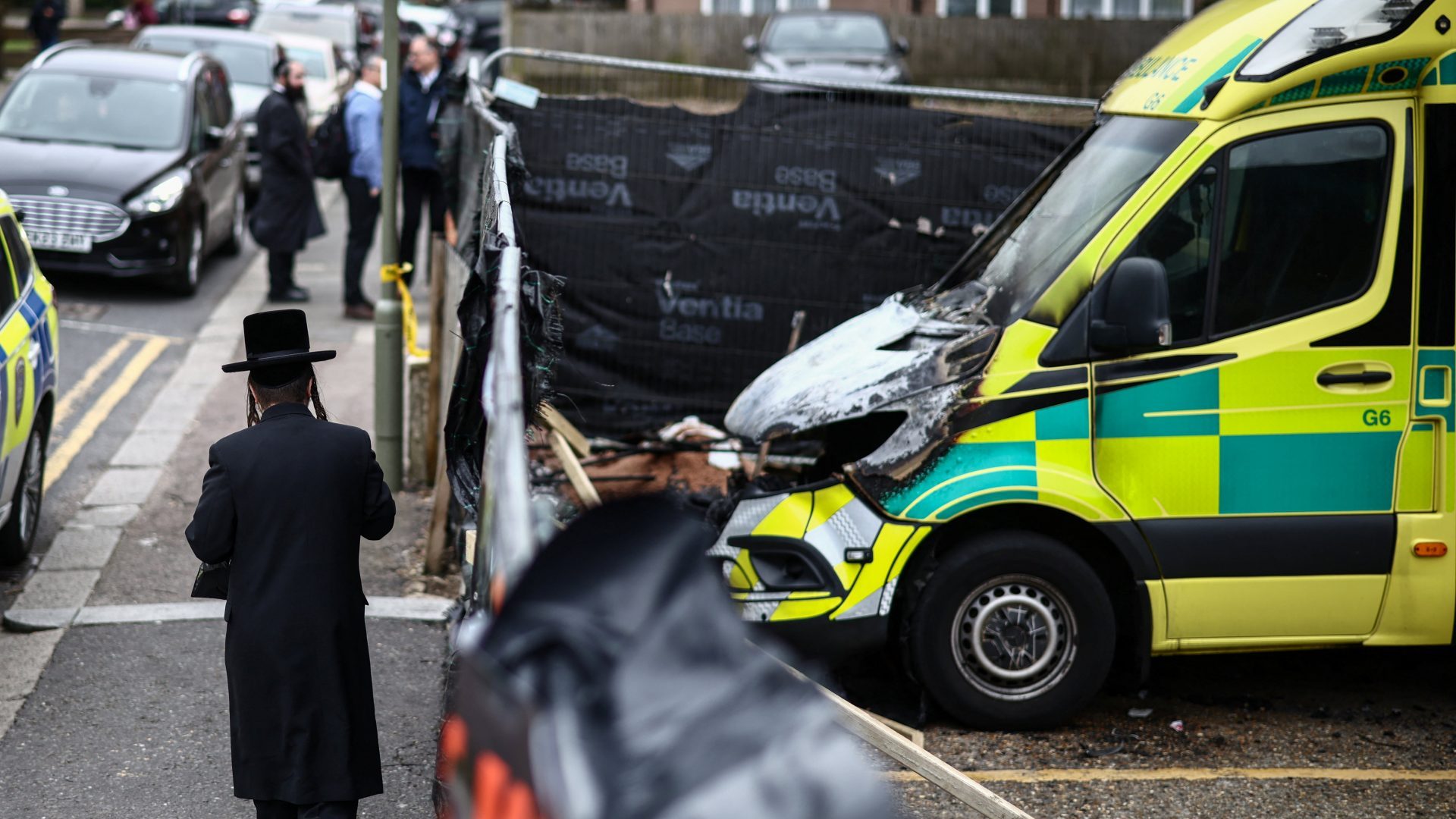
Yet the effect of the arson attack on four Hatzola ambulances, next to a synagogue in Golders Green, was to strike fear into Britain’s Jewish community, just as it was intended to. Coming hard on the heels of the Prestwich Synagogue attack, in which an Islamist terrorist killed two Jewish worshippers in November, and the Bondi Beach atrocity, whoever did this was pursuing a “strategy of tension”.
The attack was claimed by Harakat Ashab al-Yamin al-Islamiyya, a purported Islamist terrorist group which only appeared after Israel and the US attacked Iran. Since March 9 it has claimed responsibility for bombing a synagogue in Liège, an arson attack on a synagogue in Rotterdam, and an explosive device at a Jewish school in Amsterdam. Attacks claimed against Jewish targets in Athens and Antwerp have not so far been verified.
It is possible, but not proven, that the perpetrators are “gig economy” criminals, recruited either for money or via low-level political networks, to carry out non-lethal attacks on Jewish cultural symbols across Europe.
The group, though it is using language and imagery associated with pro-Iranian Shi’a militias in Iraq, has never previously been heard of. The inconsistent nature of its statements and iconography – which some analysts believe have been generated using AI – suggest a recent invention, with no centralised leadership.
So we need to educate ourselves fast about what kind of event this was. It was, of course, an act of violent antisemitism; it is justifiably being investigated as potential terrorism. But its wider informational and political effects put it cleanly in the bracket of cognitive warfare.
“Cognitive warfare,” write researchers Oliver Backes and Andrew Schwab, “is a strategy that focuses on altering how a target population thinks – and through that how it acts”. Other definitions are available, but what marks out cognitive as distinct from “information war” or simple propaganda, is that the entire purpose is to change the way populations and decisionmakers think.
Both China and Russia have official cognitive warfare doctrines, so it is safe to assume the Islamic Republic of Iran does too. Russia’s doctrine aims at “reflexive control”: forcing us to frame issues in ways beneficial to Russia itself.
And if you follow political reactions to the torching of four Jewish ambulances, you can see the effects achieved. The aim of the attacks by Harakat Ashab al-Yamin may be imputed: to stir up a Europe-wide war between Muslims and Jews; to create the impression that our cities are unsafe; to drive spiral of “whataboutery”, mobilising young people outraged over Gaza against “Zionists”, and giving them ideas about what to do about it.
The British far right responded immediately. Though the dominant trope of their response was to blame asylum seekers and British Muslims, there was a strong antisemitic theme as well. “Why do Jews have special ambulances,” asked Britain First leader Paul Golding. Pat McGinnis of the far-right National Housing Party supplied the response: so that “Jewish patients do not have to be seen by goyim (animals)… Jewish supremacy is alive and kicking”.
Suggested Reading

The Jewish suitcase is back in the hall
Samantha Thompson, a far-right X account with 12.5k followers, wrote: “Unless they release audio of them screaming Allahu Akbar I have no reason to believe this isn’t three Jews setting their own ambulances on fire”.
It did not surprise me to see “anti-Zionist” elements of the UK far left join in. The former British diplomat Craig Murray published an article claiming the attack was a false flag staged by Israel itself. David Miller, the UK academic who appears regularly on Iranian TV, posted:
“Looks like the Zionists have now launched at least three attacks on the UK – a drone attack at Akrotiri in Cyprus, the ballistic missile attack on Diego Garcia – and now four (about to be) decommissioned ambulances in Golders Green.”
The false flag theory was echoed by the rapper Lowkey, who said aspects of the group’s statements carried “Zionist connotations”. As a result, 48 hours after the attack, the “false flag” trope has metastasised into the timelines and WhatsApp groups of thousands of impressionable people who believe they are progressive.
The subtext of these responses is not hard to discern: the Jews did this to themselves; they deserve it because of Gaza; and Synagogues are synonymous with Zionism, and therefore legitimate targets.
And while the extremes fight this mental civil war with each other, resorting to increasingly frequent acts of intimidation, harassment and violence, the centrist majority stands passive but terrified of social disintegration, and reliant entirely on useless media regulators and corrupt social media companies to protect them.
Even once the suspects are identified and apprehended, we cannot know for certain who initiated Harakat Ashab al-Yamin. What’s important is to realise that, whether it is fascists, ultra-leftists, Islamists or just petty crooks doing this, it is part of a wider onslaught designed to alter the way we think; to trigger our fight and flight reflexes; to disintegrate social cohesion and poison trust in the state.
Cognitive warfare uses a mixture of violence, technology and psychological manipulation to paralyse democratic societies. But the search for strategies to defend ourselves against it has only just begun. Nato, for example, only published its first “exploratory definition” of cognitive warfare in 2023.
Current thinking revolves around the rapid attribution of attacks; official statements about which videos and documents are real, and which are fakes; building public knowledge of how hostile foreign states use such events to destabilise democracies; and tough law enforcement to prevent these incidents affecting electoral dynamics.
On all these metrics the British state is running to catch up. Though we’ve had strong public condemnation of the attack, it is being treated as a law enforcement problem, with no state intervention to quash “false flag” rumours, and no official judgements about the origins of the online statements from the group.
Something needs to change about the way we, collectively as a society, react to extremist provocations. There needs to be tougher policing of all public order events; an end to the policy of not naming arrested suspects under 16; rapid provisional attribution of attacks; and a duty on schools and universities to shut down disinformation spreaders.
But beyond all this there must be a moment of realisation. It’s not just some Jewish ambulances they’re trying to torch. It’s our democracy.
 Most popular
James O’Brien says the press have gone mad – and it’s worse than you think

Screen scandal: How Ofcom lets GB News get away with it
My late friend’s final message: Never work for the Daily Mail

Now it’s official: Brexit was a disaster. Next, we must join a new EU