I can still remember the anger smouldering in his eyes: a tall Iranian guy in his early twenties. “There were hundreds of us”, he told me, “sitting with Kalashnikovs in a tower block in Tabriz, just waiting for the word to move. It never came.”
That was some time in 1983, two years after the Organisation of People’s Fedai Guerillas (Minority) were smashed by the Islamic Republic, during the final showdown between Khomeini’s Basij militias and the Iranian left.
Inspired by a mixture of Mao and Che Guevara, they had assumed – as had many of the workers whose strikes helped bring down the Shah – that the revolution would be a space shared between Islam, liberalism and Marxism. And that after the first, democratic phase – as the Leninist textbooks told them – there would be a second, socialist phase. Their beleaguered presence in the draughty meeting halls of London, Paris and Berlin by the mid-1980s was evidence of their mistake.
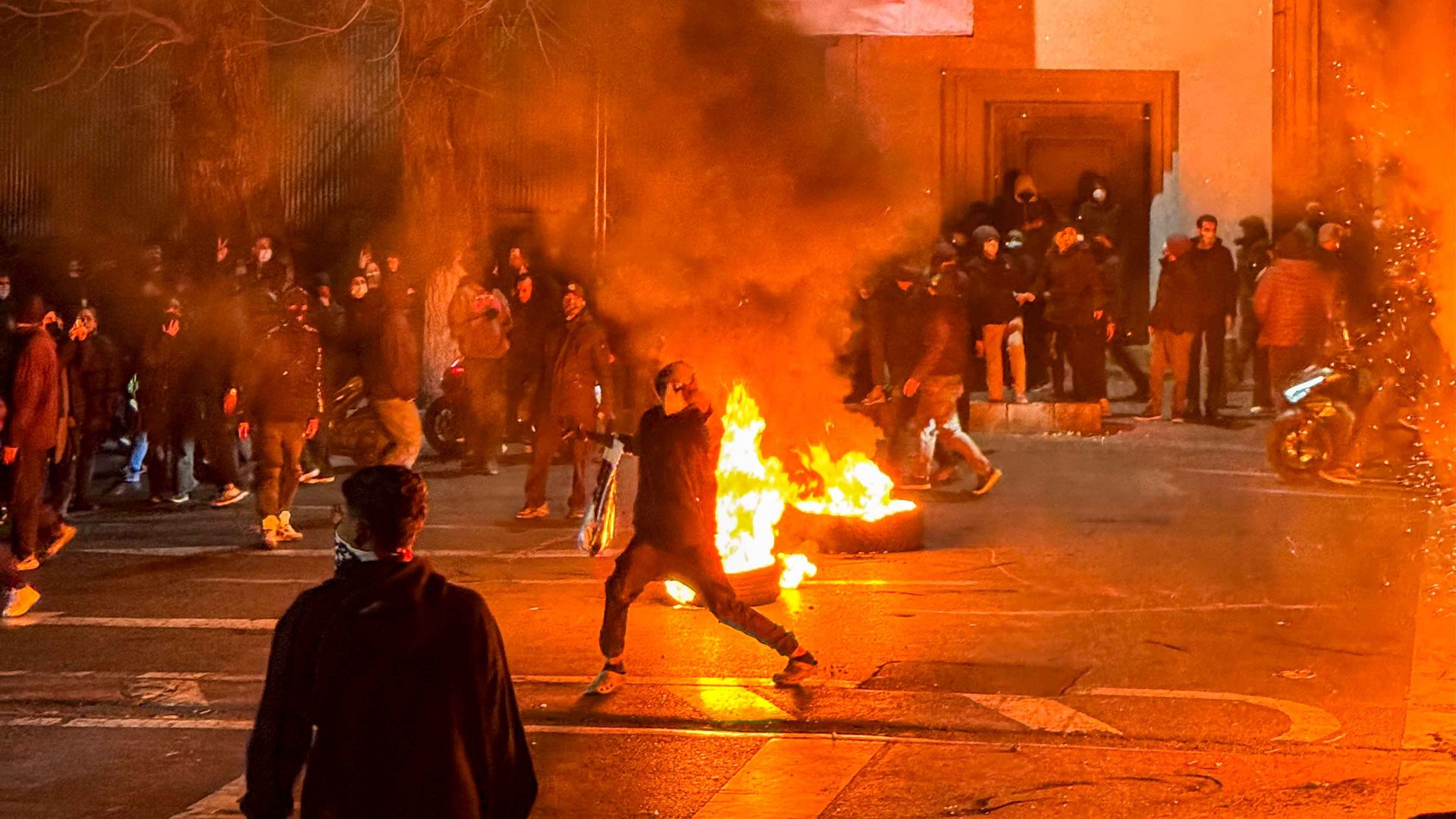
More than 40 years on, the fate of the Islamic Republic hangs in the balance. The massive demonstrations sweeping Iran’s cities cannot, alone, topple the theocratic regime of Ali Khamenei. But nor can the Basij, together with the Islamic Republican Guard Corps, maintain order.
Reza Pahlavi, son of the Shah deposed in 1979, may have instigated the biggest and deepest mass resistance event since the “Persian Spring” of 2009, but it is not obvious that he has an organised monarchist movement on the ground, willing or capable of taking power.
As always, it is the young putting their bodies in the way of danger, in hope of a future free of thought control, economic backwardness and corruption. With the Internet shut down and the lights off, there is networked co-ordination but not enough hierarchical direction, yet, to fracture the regime.
Because there are only two ways to stage a revolution: either people with guns seize the centres of power, defeating the forces of the state; or the state cracks, its figurehead flees the country, and a coalition of insurgent forces takes over the state.
The latter is what happened in 1979. With the masses on the streets, the Shah fled, Khomeini arrived by plane, a coalition of liberals, Islamists and leftists tried to govern for two years, but the social vacuum was filled by a genuine, populist, Islamist reaction, whose base-level militias destroyed every secularist alternative.
The chances of a symmetrical event in 2026 are slim. Unlike the monarchy of 1979, the Islamic Republic today has a mass base – the Basij militia system is a form of localised patriarchy and privilege – though the fact that the protests originated among small-scale traders in the bazaars, traditionally a pro-regime demographic, is encouraging. Add to this the fact the regime can draw on international support – from Russia, China and Shia militias in Iraq.
So my hunch is it will have to crack. The youth mobilised onto the streets will have to do what my long-lost Iranian comrade didn’t: take on the state and fight it until its soldiers begin to take off their uniforms and switch sides. The most likely instigators of an insurrection are those with most to gain from it: the Kurds, whose cross-border networks into Syria and Iraq give them access to the decisive tools which, 40-odd years on, are still Kalashinkovs.
What happens then, most likely, is a civil war. Iran is a vast country, whose southern half is bare and mountainous. You only rule such a state, with its dense cities and sparsely populated countryside, by consent – by establishing a clear project that delivers security and, eventually, economic wellbeing, to a highly educated population.
But though the geography of Iran is immutable, its demographics have changed dramatically since 1979. Back then there were 40m Iranians; today the population stands at 88m. Back then the urban-rural divide was 50:50; now it’s closer to 80:20.
And there is a huge demographic bulge of people in their late twenties, thirties and early forties, people who have known nothing but the Islamic Republic in its years of failure. On top of that, there are up to 8m Iranians living abroad, if you count the second and third generations who were born there.
If it turns out that this vast, urban population has had enough of medieval despotism, they have the power to turn not only the Middle East but the world upside down. Imagine a world where one of the biggest Muslim countries transitions from a theocracy to a democracy; where China’s biggest client state tells Beijing to get lost; where the supply of Shahed drones to Russia gets switched off; and where the words “Iranian” and “Ballet” can once again appear each other on a playbill.
Suggested Reading
Iran, Trump and the slide into global anarchy
There is little that we in the UK can do to shape the insurrectionary moment directly, but our powers are non-negligible. For a start we can make sure that the democratic and secular parties among the Iranian and Kurdish diaspora here are protected from IRGC harassment and that opposition media channels can broadcast freely.
We can and should place maximum pressure on regime institutions and figures, by shutting down their bank accounts, deporting their operatives from the UK, declaring the IRGC a terrorist group and exposing the network of influence it has built up both among Islamists and the neo-Stalinist left.
And if the tables are turned, and thousands of theocratic hangmen and torturers seek asylum in the West, the maximum hospitality we should show them is life imprisonment.
Together with our European allies we can prepare a diplomatic pathway for Iran’s reintegration into the world, should it survive as a unitary state, and support self-determination for any Kurdish state that can demonstrate legitimacy.
Both the US and Israel have, through the air strikes of last summer, played a role in precipitating this crisis – but Trump’s petulant isolationism, deprioritising the Middle East in favour of the Americas and a face-off with China, means the collapse of the Islamic Republic is a challenge for Europe and its Middle Eastern partners.
As someone who met the exiled victims of his father, I have little affinity with Reza Pahlavi. But Iranians are chanting his name because they believe – rightly – that nothing can be worse than to go into the century of artificial intelligence ruled by an elite for whom all reason is blasphemy.