

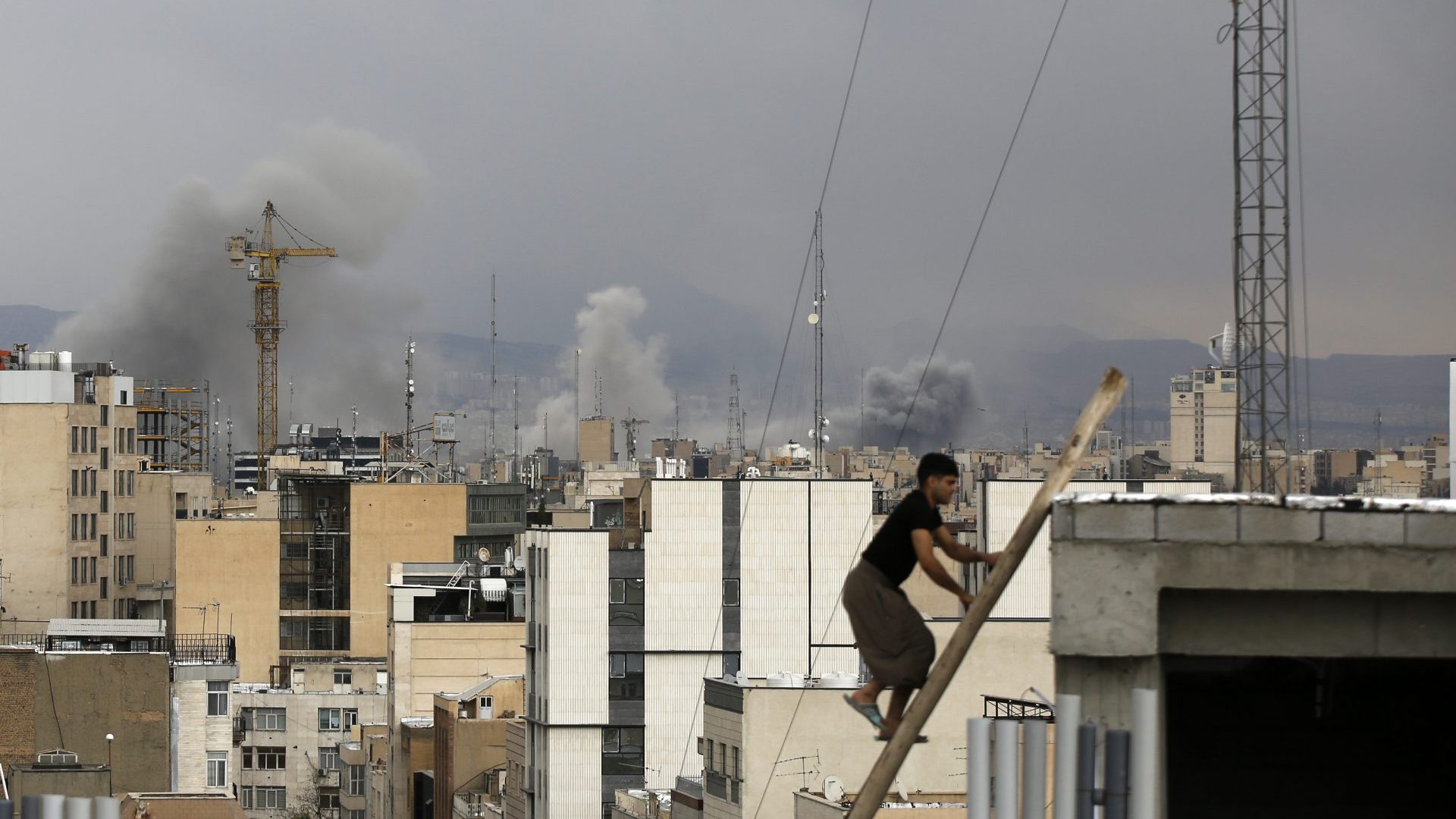
Donald Trump attacked Iran in the middle of negotiations that were heading towards agreement. In the end, it turns out that talks over Tehran’s nuclear programme did not break down: they were a deception plan.
Trump brought no evidence to the UN of an Iranian threat, and declared war without consulting the US Congress. The attack was, in both senses, unlawful.
That’s why Britain, Germany and France were right not to take part, or to facilitate it, and why – even as Iran attacks British interests in the Gulf and the RAF base in Cyprus – we are right to limit our participation to the collective defence of ourselves and our allies.
To join a war with no clear objective, and with no control over its conduct, would have been folly – and the Conservative/Reform politicians calling for it need to explain how they would have squared it with the UK’s obligation to uphold the UN Charter.
Though Trump has called on the Iranian masses to take power, he can offer them no obvious help in doing so apart from obliterating the gang of thugs who run the country.
Even if decapitated, the regime has a mass base, in the form of the local Basij militias, which can mobilise around a million men cognisant of the fact that, if the Islamic Republic falls, it is they who will end up hanging from lamp-posts.
The only way this ends, now, is either through a civil war in Iran or a change within the Islamic republican elite. Even the exhaustion of Iran’s missile stocks and the decimation of the Republican Guard won’t pacify the region until there is a government in Tehran prepared to observe peaceful norms of behaviour with its neighbours.
The US/Israeli decision to go to war was, in short, an act of folly – and the British government should find the courage to say so. Keir Starmer has done well to keep the E3 (Britain, Germany and France) in lockstep during the first days of the war: using their own forces for defensive purposes only and steering clear of support for the US and Israeli attacks.
The decision to let the US use British bases for strikes on missile launch sites and stockpiles is clearly legal, under the UN’s Article 51.
But war is a vortex. With Iran reported to have attempted 20 terror attacks on British soil in recent years, it is probable that, if it can find the means, the Islamic Republic will attack Britain directly.
In that case, the UK must act proportionately and within the law. But we must also respond to the fact that international law itself is disintegrating.
Gruesome as it was, the Iraq war of 2003 began with Bush trying to win support at the United Nations, providing (false) evidence of WMD, pulling together a genuine coalition of willing states and going in with a realistic plan.
This time Trump has done none of the above. If the Pentagon understood the risk that Iran would respond with indiscriminate attacks on civilian targets, putting global economic stability at risk, then the attack was reckless. If it did not accurately calibrate that risk, the folly was even greater.
But we are now faced with a situation where calls for negotiations and off-ramps are unlikely to be heard. Israel, once again, is under simultaneous rocket attacks from Iran and Lebanon – and even Gulf states that were trying to mollify Iran are seeing their ships and office blocks go up in flames.
We have seen, not twenty years ago, what happens when the US breaks something and then walks away. No matter how just the struggles of the Iranian youth and women are against their religious overlords – I have supported them for decades – the best thing the UK can do is help them to survive the coming collapse of the regime, and offer our expertise in stabilisation.
The liberation of the Iranian people – including the Kurdish and Balochi minorities – is a task for them alone. It is vital that, whatever the provocation, the UK continues to observe and to set norms of behaviour consistent with the rules based order, even as it is degraded.
The war demonstrates in the grimmest terms what the “multipolar world” has brought us. China, Russia and their proxies have revelled in the paralysis of the United Nations, mobilising a coalition of corrupt, autocratic regimes in the global south to declare the West and its values finished.
In their minds, the supporters of multipolarity see it as a new and better order, replacing the one where universal rights are guaranteed by a global charter. China, Russia and maybe India are accorded Great Power status alongside the US. Each has their sphere of interest where they decide what democracy and human rights mean, and where they write the history books. Europe, in this new order, either survives united, or fails divided.
But from Sudan to Yemen to Gaza and now Iran, the multipolar world is not an order but an increasing chaos. To those trying to operate normal diplomacy and alliance building, it feels like working in an anti-gravity chamber: nothing is nailed down, everything floats away from your grasp, there are no anchor points.
And though the Western alliance is fragmenting under the impact of Trump’s petulant isolationism, solidarity in the global south is also fraying.
The CRINK alliance – tying together China, Russia, Iran and North Korea – was always more of an acronym than a reality. The BRICS – which now includes Brazil, China, Egypt, Ethiopia, Indonesia, Iran, Russia, Saudi Arabia, South Africa, the UAE and its current chair India – is a more formal alliance designed as a counterweight to Western power within the UN.
But neither the BRICS nor the CRINK nations have mounted a coherent response to the US/Israeli attack. China, which sent warships to shadow the US fleet as it prepared for action, will not lift a finger to save its number one client state. And neither will Putin.
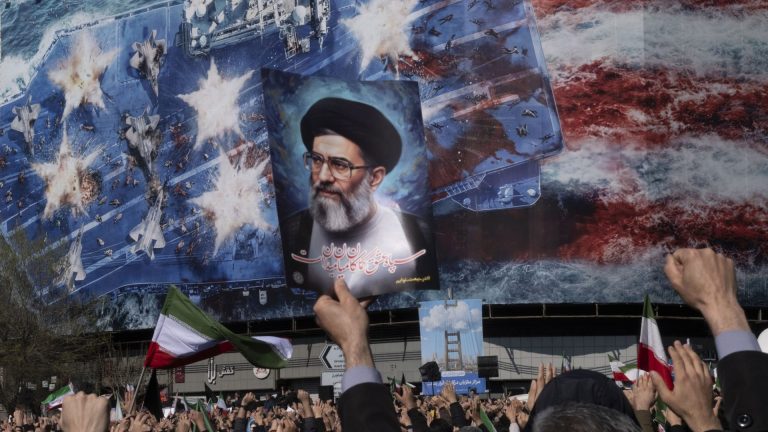
Days before the US strikes began, China supplied Iran with drones and anti-aircraft missiles, and signalled it would soon supply missiles advanced enough to be able to sink a US carrier. Khamenei duly posted on X an image of the USS Gerald Ford laying at the bottom of the ocean.
But as the regime falters, Beijing loses not only its key Middle Eastern ally, and its key supplier of oil, but – worse – it loses face with a string of weaker client states across the global south.
Russia has been kicked out of the Syrian bases from which it projected power into the Mediterranean, and is about to lose a second and much more strategically important ally. Iran is not only the supplier of Shahed drones to Moscow, but it is also a vital conduit for sanctions busting and a major lever for Russian pressure on the West.
So instead of the multipolar order they promised their citizens, where China and Russia were treated with respect by a humbled America and Europe divided, Xi and Trump are discovering that multipolarity is chaos.
We are already facing a string of failed states from the Horn of Africa to Yemen. If the Iranian state now fails – with Kurds and Balochis staking their claims to autonomy and Iran splintering into local fiefdoms, both Moscow and Beijing will be forced to confront reality: the rules-based system they are trying to break, and on which global security and prosperity depends, cannot be easily replaced once shattered.
Suggested Reading

Attacks on Iran: this is going to spread
It is too soon to know whether the young, educated and secular-minded people of Iran can defeat the mass base of the Islamic Republic in a civil war; or whether a moderate wing of mullahs emerges that wants to call it quits.
The problem is that Trump does not really care. He simply wants an Iran disarmed of nuclear weapons and ballistic missile technology, so that his Gulf monarchic allies can get rich and the expat millionaires of Europe can sun themselves peacefully in Dubai.
The attack follows the vision laid out in Trump’s National Security Strategy (NSS), published in December. America steps away from global responsibilities – both to its allies or its adversaries. It seeks control and economic dominance in the Americas; it wants Chinese military power in the Pacific contained; it wants European liberalism overthrown by the far right; it wants Ukraine forced into an unjust peace; and the Arctic both militarised and divided between the new great powers, with Europe and its pesky environmentalists shut out of it.
In short, the attack on Iran signals that America has become a gestural superpower. Move fast and break things used to be a business mantra, now it is US doctrine – with the rules-based democracies of Europe left to pick up the pieces.
That is the world we now live in, and all domestic political projects based on denying it will fail.
The most obvious consequence of the US-Iran war is that British defence spending must rise substantially and fast. Venezuela showed, and the Greenland crisis confirmed, that hard power is the only currency that matters.
I have called for Britain to rearm since before the full-scale invasion of Ukraine, but the imperatives for doing so have now doubled. The shocking sight of what a relatively cheap ballistic missile can do is being beamed onto the smartphones of people in real time.
But the drones hitting US bases in Bahrain, and civilian suburbs in Tel Aviv, are the ones that got through the most sophisticated and expensive missile defence system in the world. The UK’s missile defence system consists of six Type 45 destroyers, whose Aster 30 missiles can hit incoming rockets at a range of 120km, plus the recently invented Dragonfire laser system.
Ballistic missile defence is highly expensive: experts calculate it costs four dollars-worth of defensive missile equipment for every one dollar of incoming missile fired. But without it, we are defenceless in the world of missile proliferation.
So one of the first things Keir Starmer should do is spell out a concrete and costed path to meeting Britain’s NATO pledge: to spend 3.5% of GDP on defence and 1.5% on related infrastructure.
Suggested Reading

US attacks on Iran push the world towards chaos
The second objective should be maximum unity with our European allies. Every gestural stunt Trump stages, from Venezuela to the Greenland threat and now Iran, demonstrates the need for Europe to begin acting as a “great power” in its own right. Strategic autonomy – once a French obsession – must become the objective, and Britain needs to sink a lot of diplomatic resources into helping achieve it.
Finally, those of us with progressive politics must face down those who would, under the guise of “anti-imperialism” undermine our determination to defend ourselves. Starmer is engaged in realpolitik – refusing to criticise Trump, giving conditional access to British bases – because in a world of hard power realpolitik is obligatory.
We will see, in the coming days, the flag of the Islamic Republic – red with the blood of workers, gays, Kurds and feminists – waved alongside that of Palestine. We are seeing demonstrators carry placards with the face of Khamenei, warning us to “Choose the right side of history”. It is one thing to oppose war on religious grounds. It’s right to have doubts about facilitating US air strikes.
But the extremes of the “anti-Zionist” movement – which has now worked its way into the Green Party – are not pacifist. They support Iran, they support Hamas and they support Hezbollah. The “intifada” they want to globalise is not the struggle for social justice – it is the war of the multipolarists against law and universal rights.
It’s hard for an ordinary person to understand why the opening of a branch of Gail’s should cause it to have its windows smashed and its walls daubed with the slogan “End corporate Zionism” – but the extremes of left politics are now inhabited by people gripped with a psychosis that fuses opposition to Israel and America with rejection of our own democratic norms and values. In fact, the proximity of their ideas to those of fascists makes it hard even to label them left-wing.
The war, and the inevitable economic impact, will create new stresses within British society, even if Iran does not manage to lay a finger on us militarily. We are in a cognitive battle now, and it is vital for progressives to defend the interests and values that make this country a force for good in the world, which means rejecting, stigmatising and where necessary suppressing those who would aid Iran – which like it or not has declared the UK its enemy.
 Most popular
US attacks on Iran push the world towards chaos

Yet another Brexit prediction turns to dust

Dear Matt Goodwin, why are you such a bad loser?

The big secret of Small Prophets