
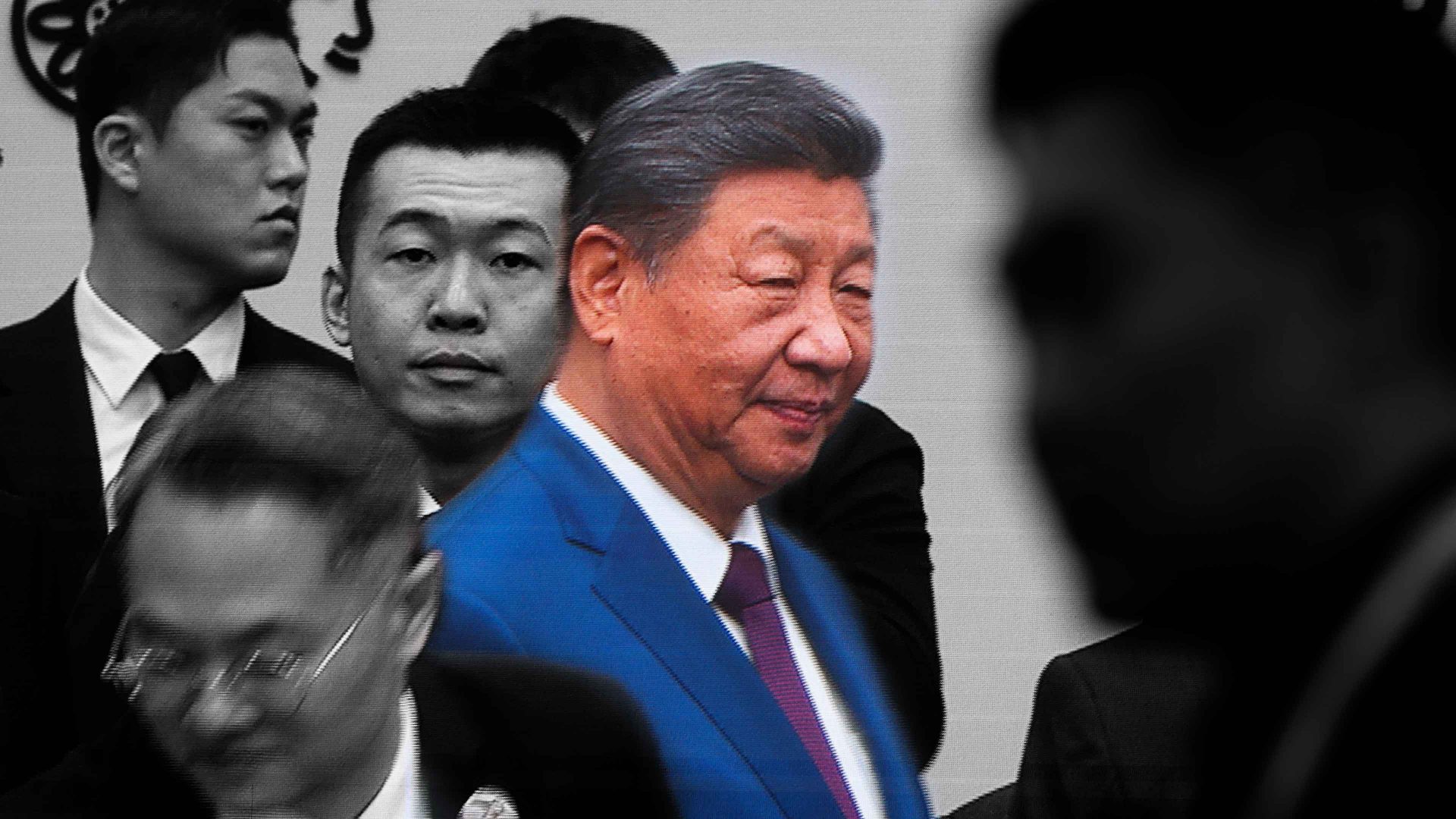
While we’re dithering over planning permission for solar farms, Xi Jinping is planning a “low-orbit economy” of flying cars, vans and sightseeing planes.
On the face of it, despite their colliding visions of the future, Donald Trump and Xi want the same thing: for China’s economic growth to be based on consumption in China, not on eating the rest of the world’s lunch through cheap exports.
Trump’s recent National Security Strategy spells this out explicitly: not only will the US shut Chinese imports out; it will put pressure on Europe to do likewise, by “adopting trade policies that help rebalance China’s economy towards household consumption”.
Together with Europe and Japan, Trump wants western economies to start exporting into the very markets China has claimed for itself – Africa, South-East Asia and Latin America – if necessary changing the rules of the WTO, IMF and World Bank to achieve that.
In response to the threat that western economies will “decouple” from China, in December Xi published an article reinforcing recent calls within the Communist Party to expand domestic demand.
Though this is often touted as an anti-crisis measure, to shore up the growth slowdown contingent on the massive indebtedness of China’s companies and local governments, Xi’s article makes clear that boosting consumption is now a strategic goal.
If the west does wean itself off Chinese goods, and if it begins to compete in the export markets targeted by China’s Belt and Road Initiative, changing the way its domestic economy works will be crucial to its survival. Because – as with planners in the USSR – the basic instinct of every Chinese official is to meet a slowdown with investment in infrastructure, energy and factories.
But before we go congratulating Trump and Xi for rebalancing the world economy, there’s a catch. Xi doesn’t only want to boost the domestic economy – he wants China to excel and dominate the world in industries that don’t even exist yet.
Since 2023, Xi has demanded that Chinese economic strategy be based on what he terms “new quality productive forces”. This is not the standard wish-list of western industrial strategies, but a comprehensive and mind-boggling plan for technological acceleration.
The base layer of Xi’s plan to make China a hi-tech economic hyperpower is formed of eight “major emerging industries”: next-generation information technology; artificial intelligence; hydrogen energy and “virtual” power plants; new materials; robotics; biomedicine; intelligent electronic vehicles; and carbon capture. Some or all of these new sectors figure in most industrial strategies outlined by western countries, including our own.
Suggested Reading


We are Putin’s next target
But it’s in the follow-on phase that China’s vision looks revolutionary. In a list of 10 “major future industries” – to be funded by targeted long-term bond issuance and a special insurance regime – Xi wants China to become globally dominant in: quantum computing and communications; 6G telecoms; biomanufacturing (growing a machine instead of making it); humanoid robots; the commercialisation of space travel; brain-computer interfaces; nuclear fusion; “brain-inspired intelligence” and the colonisation of the seabed.
He also wants to create a “low-altitude economy” with electronic aircraft that can do vertical take-off and landing, replacing road logistics by drones and promoting “low-altitude cultural tourism”.
And the point here is that rather than dreaming about this – think the entire airspace of a city like Shanghai populated by flying cars, delivery vehicles and sightseeing drones – China is actually planning it.
While we in the west allow fiscal constraints, planning rules and sheer mental laziness to get in the way of the organised deployment of innovation, China is “just doing it”, using government cash and regulatory preference to unlock the future.
And unlike us, China builds new industries from the bottom up: by providing 30% of all cash needed to develop new, public databases and test beds for the micro-precise equipment needed to break into these new industries.
I am no fan of the People’s Republic of China under Xi. I lament its interference in our politics and the brutality of its regime towards workers, ethnic minorities and dissidents. But when the leader of a nominally Marxist state starts talking about “productive forces” you have to sit up and listen. Because the Marxist theory of history states that, when the “productive forces” – ie the technology and commercial relationships surrounding it – outgrow the social superstructure of laws, culture and political institutions that nurtured them, is when a revolution occurs.
Xi’s goal is for the PRC to become, by the anniversary in 2049 of its creation, “a great modern socialist country that leads the world in terms of composite national strength and international influence”. And he has a precise algebraic formula for calculating “national strength” – comprising economic, military and science power, together with soft power, democratisation and leadership competence.
Xi’s China, in short, means both to achieve what the west is demanding – by switching on domestic consumption as an engine of growth – and to go on eating the lunch of western manufacturers by staking a claim to industries that do not yet exist.
If I could meet just one western politician with the ability to imagine doing the same – massive state direction and subsidy to hew rock-sized chunks out of the economic future – I would be encouraged. But so much of our current debate is about the possible; the dreary art of meeting self-imposed fiscal rules; the relentless “innovation theatre” whereby spin-offs from universities flourish briefly in the limelight, but never blossom into billion-dollar corporations.
The result is that ours is an economy where it’s easier to open a new branch of Itsu than it is to open a factory; easier to become a Deliveroo rider than to train as a welder; and more lucrative for an engineering graduate to go into the City than do the job they were trained for.
There are many risks to China’s future: it is heavily in debt, consent for authoritarian government relies on economic delivery, and its rapid re-armament comes at a fiscal cost – just as it did for the USSR.
But if the PRC can create entire new industries from scratch – creating global demand and exclusive domestic supply – it can repeat what it did to the low-value manufacturing sectors of the west, which was to destroy them, only this time using space lasers and flying cars.
What to do about it? The UK is full of scientists and engineers who know how to emulate what China intends, and to do it better. We need a political leadership that’s prepared to rip up the existing industrial strategies – hard won though they’ve been following decades of neoliberalism – and just think bigger about the future.