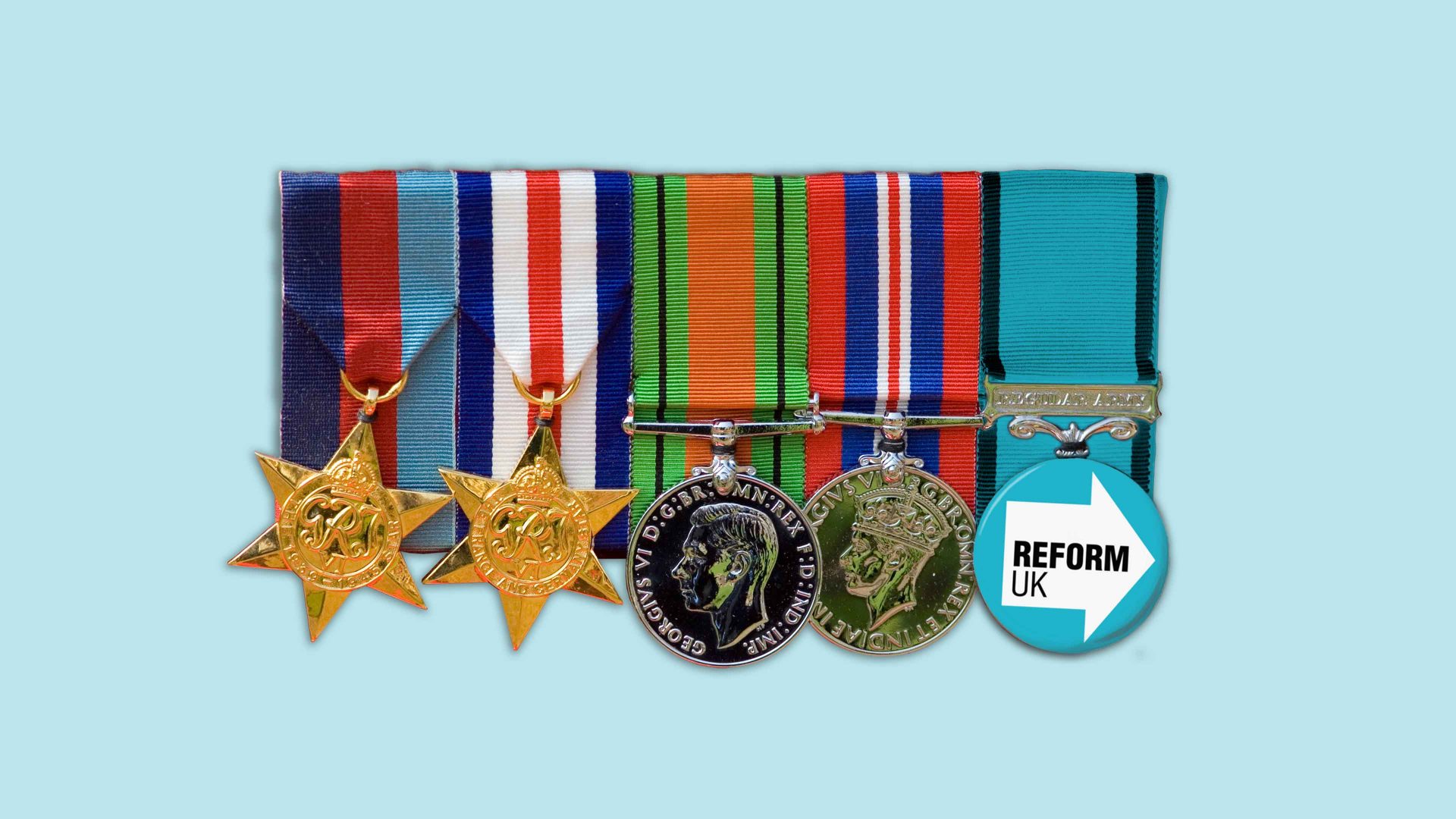
In February 2024 a report by the Royal United Services Institute warned that far‑right groups in the UK were actively courting veterans. RUSI found that far‑right organisations try to recruit former service personnel through social media and veteran charities, recognising that those leaving the forces may lack support and might miss the sense of belonging and structure that military life provides.
One group, the National Support Detachment [NSD], a splinter from the neo-Nazi Patriotic Alternative, openly states that it seeks to recruit veterans because of their discipline, pride and self‑respect.
Hope Not Hate’s “State of Hate 2024” report paints a similar picture. Far‑right groups like Patriotic Alternative, the Homeland Party and the NSD have disguised themselves as “local resistance”, aiming to blur the line between genuine community concerns and extremist agendas.
In Lincolnshire, NSD leaders organised a 24/7 protest camp at RAF Scampton that became a magnet for far‑right activists including members of English Defence League splinter groups and anti‑Muslim activists. By portraying themselves as defenders of local heritage, and of British values more broadly, these groups hope to normalise their ideology and recruit veterans who feel neglected. And because many veterans are comfortable with hierarchical structures and direct action, they can unintentionally lend a veneer of professionalism to extremist movements.
RUSI’s authors emphasise that better support for military personnel at the point of leaving service is essential to reduce the appeal of the far‑right. That includes assistance with employment, mental health and housing, and veteran‑led organisations that offer camaraderie without ideology. We owe veterans more than platitudes and charity wristbands. We owe them support and protection.
A common trope exploited by extremists is the claim that veterans are “left on the streets” while asylum seekers are showered with benefits. This is false. People seeking asylum cannot claim mainstream welfare benefits. Destitute asylum seekers may apply for basic accommodation and a small allowance of about £49 per person per week, and those in catered accommodation receive just £8.86 per week. They cannot work and must survive on this modest sum while their cases are processed.
Veterans, by contrast, can claim war pensions and compensation: a 100% disablement assessment yields £239 per week – £12,471 per year – with additional age‑related allowances from 65.
Veterans Aid, one of more than 1,500 charities dedicated to supporting former service personnel, notes that there is more capacity than demand for veteran‑specific housing and calls comparisons between veterans and asylum seekers “false and inhumane”. Pitting veterans against asylum seekers is a toxic myth. The real challenge is ensuring that veterans access the support to which they are entitled rather than scapegoating vulnerable migrants.
A troubling cadre of culture‑warriors
The far‑right’s strategy of presenting itself as pro‑veteran dovetails with the emergence of several retired senior officers who regularly air culture‑war talking points in the media. Recently, rear admiral Chris Parry, a Falklands War veteran and Reform UK mayoral candidate, remarked that deputy prime minister David Lammy – a Black British politician – should “go home to the Caribbean where [his] loyalty lies”. He also suggested asylum seekers should be forced to eat bacon to prove they really are Christians fleeing persecution.
Parry later described his message as “clumsily worded” but eventually apologised under pressure from his party. The Independent reported that Nigel Farage, the Reform UK leader, instructed Parry to apologise. The paper also noted that Parry had previously praised Enoch Powell and questioned the loyalties of Black and Asian MPs.
These remarks echo the far right’s obsession with racial “loyalty” and have little to do with the self‑deprecating humility celebrated in the Royal Marines ethos where the colour of a Bootneck’s skin is truly irrelevant. When such comments come from a former high‑ranking officer, they give oxygen to extremists who present the military as aligned with their worldview.
Another retired officer, Colonel Richard Kemp, has become a prominent commentator on GB News and social media. According to a July 2024 blog by Adeyinka Makinde, Kemp chairs a pro‑Israel organisation [UK‑AWIS] and frequently condemns pro‑Palestine protesters as “terrorist sympathisers”.
Suggested Reading

Reform UK’s guide to the history of Britain
Supporting Israel or criticising protest tactics is entirely legitimate and valid – and yet the constant framing of pro-Palestine activism as an existential threat to “our way of life” feeds the fictional narrative that retired soldiers are the guardians of a beleaguered nation threatened by Muslims.
It is clear that neither Parry nor Kemp advocate any form of violence – but their words can be weaponised by those who do. Some far‑right activists speak of forming “veterans’ militias” to enforce their agenda. Extremist groups always seek respected figures to legitimise their rhetoric.
Fortunately, these individuals are outliers – evidence from 2021 shows that far‑right activity triggered only a small number of security‑service investigations. Nonetheless, at least 16 members of the armed forces were referred to the Prevent programme over far‑right concerns and some were convicted of belonging to banned neo‑Nazi groups. MPs criticised the Ministry of Defence for not acting sooner. These incidents highlight that vigilance is necessary.
Accountability in Northern Ireland and Afghanistan
While countering far‑right exploitation is vital, respect for the armed forces also demands that we confront allegations of wrongdoing. The Northern Ireland Troubles Bill, introduced by the Labour government, seeks to replace the previous government’s Legacy Act, which created a conditional immunity scheme that halted criminal investigations into Troubles‑related offences. It also offered immunity to perpetrators who cooperated with the authorities.
The High Court ruled that scheme incompatible with the European Convention on Human Rights. The new bill proposes to remove immunity, allow civil actions and inquests to resume and allow the Legacy Commission to conduct criminal investigations.
Forces News reports that some Northern Ireland veterans are worried by the new bill, fearing that scrapping immunity could leave anyone who fired a weapon during the Troubles exposed to prosecution. Nine retired generals warned that human‑rights legislation was paralysing the army.
Victims’ groups and human‑rights organisations, however, argue that accountability is essential to reconciliation. The tension reflects a broader question: how do we honour service while upholding the rule of law? The answer lies in due process. Accountability mechanisms must be fair, evidence‑based and timely; they must neither hound veterans nor provide impunity for deliberate killings.
A judicial inquiry into alleged war crimes by British special forces in Afghanistan underscores this point. These allegations were made internally in 2022, but first surfaced in public in May 2025 on Panorama. The programme included testimony from army whistleblowers alleging war crimes by members of British special forces in Afghanistan.
The programme caused vitriol and anger among serving military personnel, retired personnel and others, mainly on the “patriotic Right”. The most frequent allegation was that the BBC was a nest of unpatriotic, bleeding heart lefties determined to slander the good name of the British Army. They reserved a special degree of venom for the Labour Party, who were not even in power at the time, alleging without any proof that a party of uber-liberal north London lawyers was simply out to denigrate the Armed Forces.
The truth of the matter was that none of the allegations made against members of the SAS were made by civilians, either journalists or politicians. Panorama had simply made public allegations dating back to 2022 by multiple whistleblowers inside the army, both from within the SAS and also the Special Investigations Branch of the Royal Military Police, who claimed to have been deliberately thwarted by senior Army leaders.
The “Independent Inquiry Related to Afghanistan”, chaired by Lord Justice Haddon-Cave, is now examining night‑time raids conducted by the SAS in Afghanistan between 2010 and 2013 during which whistleblowers allege members of the SAS killed 54 people under suspicious circumstances.
Testifying in late 2025, a former assistant chief of staff known as N1466 said he became suspicious in 2011 when official reports showed that the number of “enemies killed in action” exceeded the number of weapons recovered. He found it incredible that detainees repeatedly attempted to pick up weapons or use grenades after capture.
N1466 told the inquiry, “We are talking about war crimes… taking detainees back on target and executing them with a pretence that they had conducted violence against the forces”. He reported his concerns to the director of special forces, but instead of referring the matter for criminal investigation, the director ordered only a review of tactics.
N1466 regretted not approaching the military police earlier and said he was “deeply troubled” by what he believed were unlawful killings of innocent people, including children. He stressed that most special forces soldiers would never condone such behaviour.
Suggested Reading
America isn’t as good at fighting wars as Donald Trump thinks
Investigations like this are painful but necessary. If British troops executed detainees, that fact cannot be brushed aside as having occurred in the “fog of war”. Our credibility in condemning war crimes abroad depends on our willingness to address them at home. Accountability strengthens rather than weakens the military: it reinforces the principle that state power derives from democratic consent and must be exercised lawfully. Human rights are not optional; subjecting state forces to the law ensures equality before the law and upholds the army’s integrity.
I will make a firm prediction. If Lord Justice Haddon-Cave’s inquiry upholds allegations that SAS personnel committed war crimes, or breached the laws and customs of war, there will be huge political and social fall-out. The same social media reaction that accompanied the original BBC reporting will pale into insignificance compared to what is likely to happen under those circumstances.
The government would likely be compelled to endorse legal action against any SAS personnel alleged to have committed war crimes. They could do nothing else. The alternative would be simply to ignore criminal actions and sacrifice any morality Britain would have in condemning war crimes and abuses committed elsewhere, from Russia, to Palestine, to Yemen.
The political onslaught would be fuelled, aided and abetted not only by the extra-parliamentary extreme right, but likely also by Reform UK, and most members of the Conservative front bench. It will become a cause célèbre: Starmer and his rabble of left-wing, anti-military, “woke” lawyers betraying “our boys” without knowing the slightest thing about the realities of combat in Afghanistan. They will of course ignore the experiences of Labour MPs like Al Carns or Dan Jarvis.
I dread Lord Haddon-Cave’s findings because I know how ugly things will become if he upholds the whistleblower allegations.
Upholding honour by upholding the law
The hard right will argue that exposing wrongdoing or prosecuting soldiers for crimes is tantamount to betrayal. They will point to the sacrifices British forces have made in Afghanistan, Iraq and Northern Ireland and warn that “lawfare” will demoralise the troops. Yet the source of the British military’s honour is not blind loyalty but adherence to British values that demand courage and integrity.
Far‑right activists who drape themselves in regimental colours while advocating racism or insurrection betray those values. Retired officers who engage in inflammatory rhetoric may think they are defending tradition, but they risk empowering extremists who view veterans as ready‑made militias.
The best defence against such exploitation is to support veterans materially and psychologically, to challenge extremist narratives and to reaffirm the public’s trust in the armed forces by insisting on accountability.
Those of us who love and deeply admire the British military must be prepared to hold two truths at once: that our soldiers deserve respect and that no one is above the law. This is not a contradiction. It is the essence of democratic civil‑military relations.
 Most popular


Screen scandal: How Ofcom lets GB News get away with it

Keir Starmer’s fate – to become Boris Johnson
GB News Scandal: The dossier

Corpses, spacelabs and gravy: The utter disaster of Nicole Kidman’s Scarpetta