
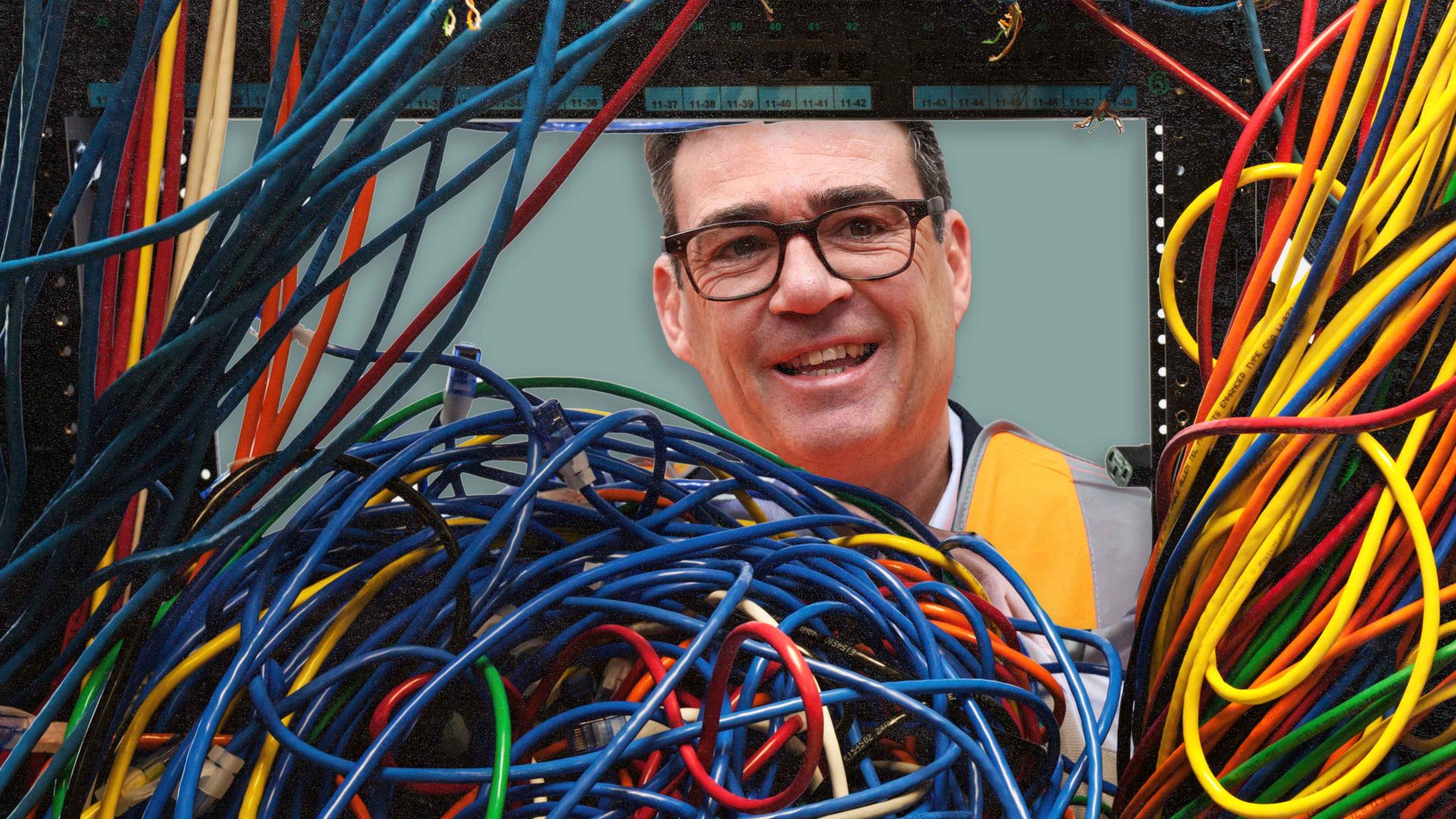
Send for the electricians! The government’s plans for “rewiring the state” have blown a fuse and left ministers fumbling in a murky gloom of wordy platitudes. But as their meaning becomes clearer, it seems the Burnham regime is less interested in extending democracy and curtailing the reach of Whitehall, and much keener on strengthening the hand of ministers and curbing the reach of the courts.
Last week, a hotly anticipated restructuring of local government had to be put off until some vague future date that’s unlikely to fall within this parliament. This would have been embarrassing at any time, but it was meant to be a key part of Andy Burnham’s much-trumpeted devolution agenda. The delay must have sparked fury in the PM’s team, as it did among the council leaders and officials who had been getting ready to carry out the plan.
The plan was launched in 2024 under Keir Starmer, with the aim of simplifying the deeply inefficient multi-tier structure of local government. “We must rewire England,” declared the then deputy prime minister, Angela Rayner, in her foreword to the White Paper. Apparently, this would “relight the fire of our economy and ignite growth in every region”.
Instead, it seems to have lit a bonfire of ministerial vanities. The exercise of doing away with some councils and creating more unitary authorities was presented as a way to improve the democratic process. But then the government ordered the cancellation of a set of local elections.
Suggested Reading


Can Burnham avoid an economic catastrophe?
With a fine sense of irony, Rayner wrote in that foreword: “The truth is that, for all the promises of levelling up… central government’s first instinct is all too often to hoard power and hold our economy back.”
There is sufficient coyness over the reasons why the reorganisation has been put on hold to fuel suspicions that legal advice may have played a crucial part. Demanding the abandonment of local elections is a highly “courageous” move.
People might also have been alarmed to read how the minister now in charge of rewiring the state defined the task. Louise Haigh, sacked from government by Starmer but now catapulted to new heights as minister for the Cabinet Office, explained that “the government will take power from Westminster and Whitehall”.
Her statement was issued while parliament was still in recess and MPs were enjoying the last days of summer relaxation. That comment made to a packed Commons chamber would have landed very differently. While she said that the intention was to put that power “back in the hands of the communities who are best placed to use it”, her remark seemed to imply that No 10 and, of course, No 10 North, might be better placed to control the levers of power.
“We are rewiring the machinery of government so that the prime minister has the resources and levers he needs to deliver on his priorities,” she wrote. And it seems that he does not want obstacles in his way. Consultation processes, for instance, can be long-winded and are not even guaranteed to produce the result intended by those who commission them. To avoid that inconvenience, we are promised new methods of “public deliberation into policy development”.


Haigh has also said that “the way decisions are made will be scrutinised in parliament and not in the courts.” Given the record of the House of Commons for scrutinising legislation, often little more than a cursory glance, this comes close to a free pass. In anticipation of that, it seems ministers are to be encouraged not to be cowed by legal advice warning against any particular course of action, but to be “bold and ambitious”.
Altogether, apparently, “this will end the warm bath of constructive ambiguity which politics has been too happy to soak in for too long.”
The prospect feels distinctly chilly.