Kateryna walks with her husband Fedir and their son Luka up to the 19th floor to their abandoned apartment in the Sviatoshynskyi district of Kyiv. Two months ago, the remains of a downed drone damaged their building, affecting the heating and water supply on their floor and two neighbouring ones.
“Every room, where the blast wave blew the doors open and dumped debris inside, was covered with the shattered glass here,” Kateryna says. After that, the family moved to the suburbs, where their dacha had been completely destroyed by an artillery strike in 2022 but its bathhouse was still intact. Currently, they live in that.
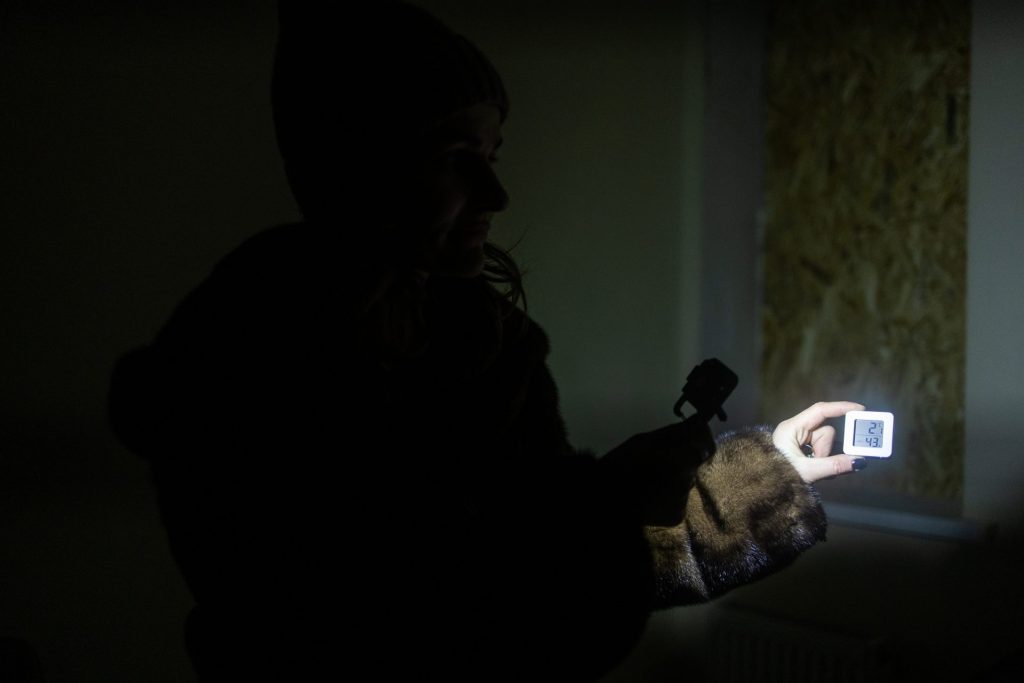
Today, Luka, aged four, is playing in his old room while his parents check radiators and heating pipes for signs of frost, which might wreck them beyond repair. There are cracks in the walls, so the room temperature is 2 degrees Celsius.
“It’s physically impossible to live here with a little child, it is impossible to sleep with this temperature,” says Kateryna. In the aftermath of the massive Russian attack on the capital’s power infrastructure, the building has had no electricity for 20 hours in a row.
Another high-rise block, functioning entirely on electricity, has been cut off from power for 40 hours so far. “The inverter has shut down – it needs at least two hours of electricity to recharge,” says Zoya, a 50-year-old HR specialist who needs the internet to do her job. “You can’t cook anything, the lifts aren’t working, the radiators are barely warm, there’s been no hot water for ages, the cold water pressure is very low, and there’s no internet.”
IT specialist Yulia, whose working day involves calls to other countries for up to 10hours a day, also needs to be online for her job. She’s currently staying with friends who have heating, but the electricity is on for only four hours a day.
By contrast, after the recent strikes, Yulia’s own flat has had no heating for the fifth day in a row, but electricity is available for 4–5 hours twice a day. That is why Yulia goes home every day to work. “Right now I’m sitting here in two pairs of socks, thermal underwear, and thick trousers on top. It’s very cold. The kitchen is small – I close the door and it warms up a bit,” she says.
Every day Yulia takes a taxi and brings a 20 kg EcoFlow power station to her flat to recharge it. “There’s almost never any power at my friends’ place, so it allows me to plug in two desk lamps and a few portable lanterns there.”
The moment the power comes back on, everyone rushes to charge all their devices (power banks, phones, batteries), start the washing machine and dishwasher, and cook food. Anyone who has an electric cooker bakes something in the oven – that way the flat gets a bit of extra heat too, Yulia adds.
Darkness affects mental health, many people say. During the ongoing power outages, especially in winter, they describe this subtle, oppressive feeling: the combination of prolonged darkness, the unnatural quality of artificial light, and the resulting fatigue and sense of isolation, says Bohdana, a Ukrainian poet. “When I work in the dark for a long time, even with a battery-powered lamp, I get tired much sooner. It genuinely feels like I’m working inside a cave.”
A writer and a literary scholar, Olesya, who returned from Krakow to Kyiv two months ago, marks the change in her usual thinking. “I’ve lost all sense of time and control. I’m a very reflective person who thinks deeply about things, but now all my energy goes into the simplest movements. In this ‘supersurvival; mode, I completely lose the ability to reflect and think about whether there’s any depression there or not. You just mechanically respond to the challenge,” she says.

Olesya and her two daughters, 15 and 20 years old, had severe flu for 10 days, and before the day we talked, the electricity had been out 24 hours. The elevators were not working, and their dog needed to be walked out twice a day. “He has weak joints, but we don’t have the strength to carry him, so he stops on every floor,” Olesya says.
Without an elevator, grocery shopping is also a problem. “Yesterday, we ran out of food, and there was no bread in any of the nearby shops. But we still had hot water in the thermos, so we ate instant oatmeal, homemade cottage cheese and tomatoes,” she adds.
Most of all, Olesya is afraid of losing the heating in her building. During the 24-hour-long power cut, the generators stopped working, and the radiators cooled down. “In my condition, that’s one step closer to pneumonia. I needed to drink warm tea, but I was just drinking plain water. I keep hearing explosions, but I’ve stopped reacting to them now. I’m very afraid the electricity will disappear again,” she adds.
She could potentially come back to Krakow, where she spent four years and still has a job open. But in this frost and darkness, she realised she won’t go there again.
“It’s not that I was unhappy in Poland. I integrated there, I had local friends, a good job, I spoke the language well. But I always felt like an outsider,” she says. “I just want to live somewhere I understand completely, right down to the bones – where my childhood and youth took place”.
Zoya’s daughter lives in Berlin and has offered her parents a place to wait out the cold winter. ”I reassure her (and myself): we can order takeaway food, keep warm with hugs, washing with cold water is even good for the skin, and as an extra bonus – it’s great for building muscle by climbing 18 flights of stairs carrying our old dog in our arms,” says Zoya.
This stubborn insistence on staying alive and keeping routines and habits normal is a form of civil resistance: holding on to the normality of life, says Yulia: “We are not giving the enemy our little everyday life, our ability to feel.”
Zoya says: “They’re trying to break us, freeze us, scare us into agreeing to end the war on any terms. We are the opposite. We’re becoming more united, more resilient, stronger, and very, very angry. It feels like we can endure absolutely anything, as long as we live to see the fall of Mordor and our victory,” says Zoya.
Nina Kuryata is the Observer’s Ukraine and defence editor