
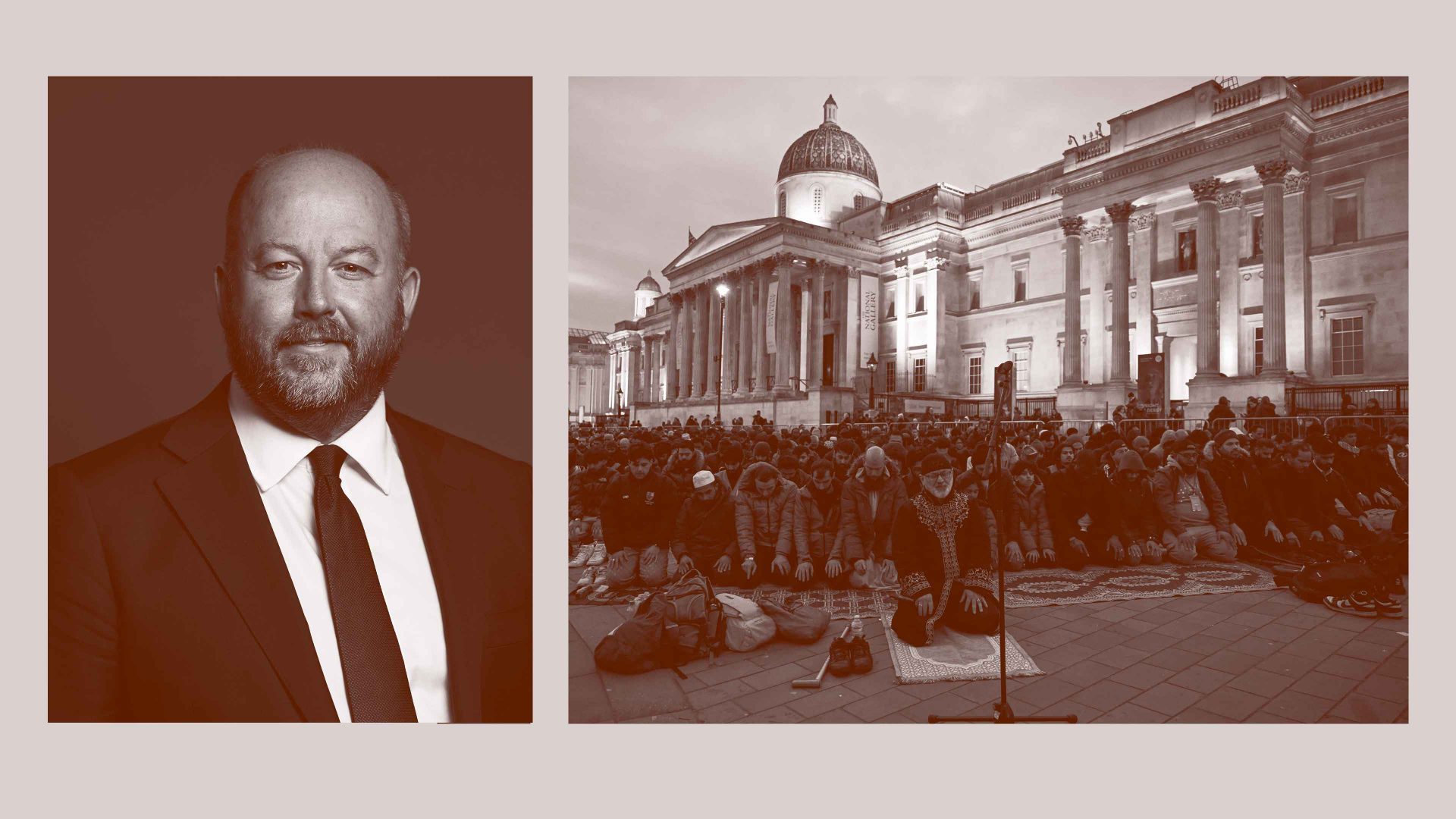
Is it intimidating and un-British to hold an Islamic mass prayer session in Trafalgar Square? Though British Muslims are not the only religious group to have used the square for prayers under Nelson’s watchful eye, Conservative shadow lord chancellor Nick Timothy triggered a polarised debate on this issue when he posted on X that the open iftar celebrating the end of fasting for Ramadan was “an act of domination and division”.
The repercussions of that comment, which Timothy has not retracted, are still being felt. Rather than sacking him, Kemi Badenoch came out on his side, claiming he was defending British values, and that a key issue was that women were held back from joining the event, something Timothy hadn’t actually drawn attention to and is disputed by the organisers.
Here, I’ll focus on his claim about domination. What are we to make of it from a philosophical angle?
There are several things to be considered. First, the response to Timothy that public prayer by Muslims should be treated the same way as public prayer by other religions is a “tu quoque” move (from the Latin for “you too”). This is a form of “companions in guilt” argument where you point out that the case in question is far from unique and that consistency demands equal treatment for a range of similar cases.
Either tolerate public prayer for all legal religions (and non- and anti-religious groups too), or identify what’s special about Islam. If prayer in a public place by Muslims is an act of domination, what about all the other examples of religious groups using the same space for their prayer? Why aren’t they acts of domination too?
Timothy has tried to spell out why he thinks Islam is different from other religions. He has focused on the adhan, which declares there is no God but Allah and that Muhammad is his messenger. He’s also revealed his hand by claiming that “domination of public places is straight from the Islamist playbook”.
Suggested Reading

Jürgen Habermas – brilliant, influential and stupefyingly tedious
Here, there is a second critical thinking point. Timothy seems to be using an implied slippery slope argument: begin with public prayer and the call to prayer expressed in public, and end up with Islam eclipsing other religions, and perhaps even with Sharia law for the whole country. But Timothy will need to explain why he believes descent is inevitable, and why we can’t dig our heels in and stop a bit further down the hill, thus maintaining the great British value of religious toleration.
Timothy also seems to have attributed a kind of mens rea, or intention, to those praying, one that is inconsistent with the given reason for the prayer meeting. Calling something an act of domination implies that those participating meant it and weren’t just accidentally giving that impression to someone passing by who was primed to see Muslims as threatening and didn’t understand the context or tradition.
What’s at stake is the meaning of this group prayer in public. According to those involved, this was simply ritual worship, prearranged, legal, and well-organised; according to Timothy, it was that and more. He felt they had occupied a symbolic public space in the heart of London and used that to send a message of ascendancy.
The philosopher HP Grice had some interesting insights about the meaning of utterances and actions. When we speak, what we mean by our words is determined by a communicative act that involves intentions, including intentions that our intentions be recognised.
Suggested Reading


The man bringing full-blown extremism back to the Tory party
A sentence’s meaning is partly a matter of what the speaker intended and doesn’t just turn on the dictionary definitions of the words used. I can say “Nice day!” and mean that the weather is terrible.
What allows you to grasp this is not only my intention to mean this, it’s also that you recognise my intention to communicate that meaning. You have to recognise that I want to be understood in this way.
Timothy’s claim seems to be that what the Muslims meant by praying was to communicate a belief about their dominance, and actually wanted this intention to be recognised. Put that way, that claim seems unlikely to be true.
This makes me wonder what Timothy himself meant by his intervention. I’m not alone in wondering this. Was he defending British values?
Or was there a more sinister intended and deniable meaning – one that a group of people following him would have recognised as such, and which he intended that they recognise?