
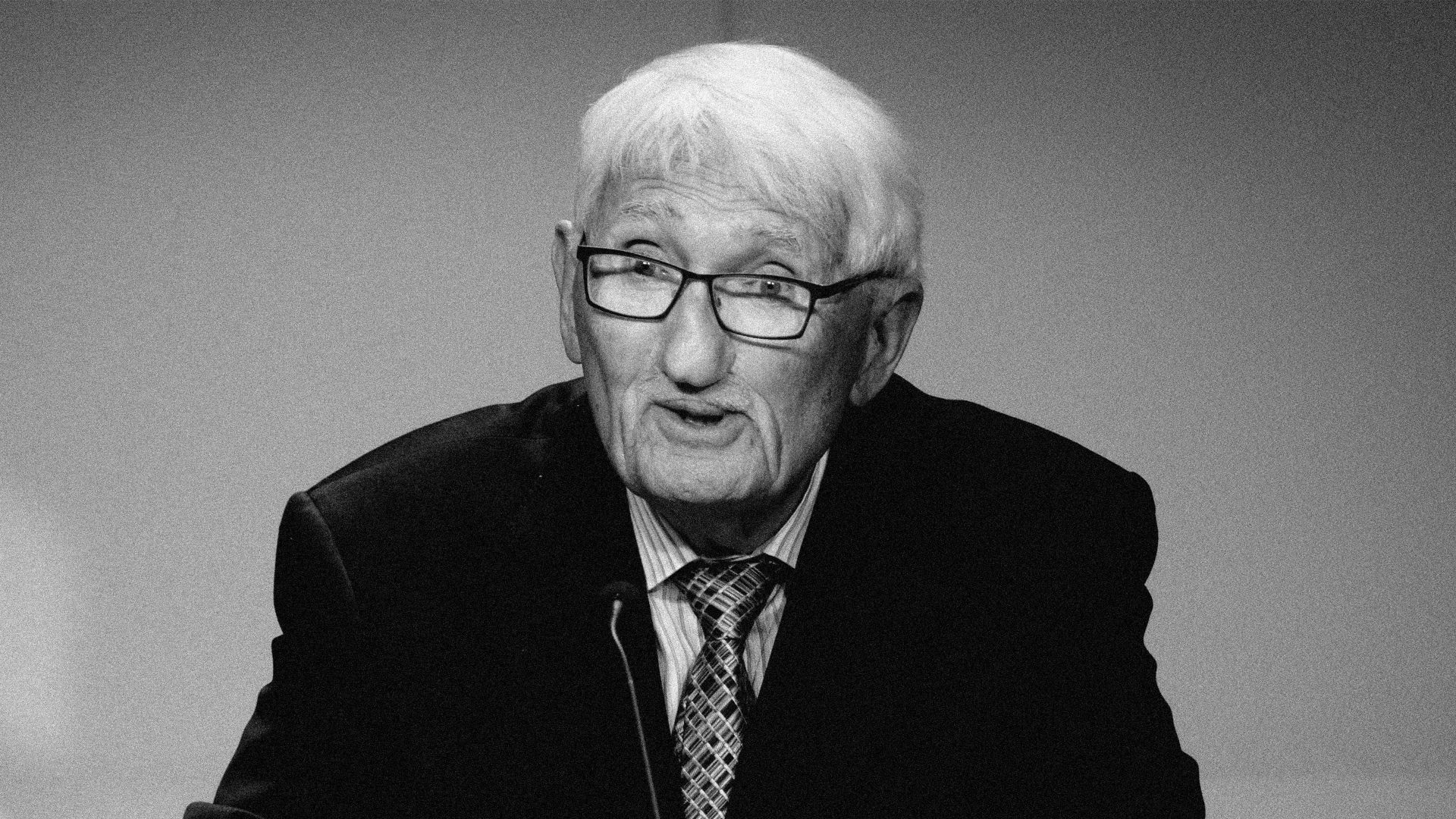
Obituaries for the German philosopher Jürgen Habermas appeared very swiftly after his death last Saturday. That’s not surprising. He was 96 and many newspapers had well-crafted summaries of his life ready on file. Most agree that he was a major thinker of the postwar period, galvanised by his early experience of Nazism.
As well as publishing long works on the nature of communication and on democracy, he contributed to public debate through numerous newspaper articles written from a broadly liberal perspective. In the UK his work is more often studied within the social sciences (where there’s a higher toleration of jargon and multi-volume tracts) than in philosophy departments. His name is linked with a bold attempt to preserve humane Enlightenment values in the face of post-modern relativism.
Born in Düsseldorf in 1929, he grew up in Cologne. Like most German boys, he joined the junior version of the Hitler Youth, aged 10, and then the full-blown Hitlerjugend at 14. Aged 15, he narrowly missed being sent to the Western front as the war ended. He described his father, who had joined the Nazi Party in 1933, as a “passive sympathiser” rather than someone who asked questions. Not so Jürgen, whose early experiences under authoritarianism, together with the atrocities of Auschwitz, drove his intellectual development.
In 1953, the young Habermas took Martin Heidegger, then the grand figure of German philosophy, to task for republishing his lectures on metaphysics from the 1930s without removing a reference to “the inner truth and greatness” of National Socialism. This was more than half a century before Heidegger’s “Black Notebooks” were published in which the depths of his antisemitism were revealed, and from which his reputation will never recover. Notoriously, Heidegger failed to apologise for his support for Nazism.
In contrast, Habermas became a central figure in the conscience of postwar Germany and was tireless in his championing of deliberative democracy and what he called “communicative rationality”. For Habermas, the ideal of deliberative democracy is achieved in the public sphere when everyone contributes on an equal footing in the activity of seeking understanding.
In this perfect situation no one is manipulating arguments for personal or political gain, no one is motivated by a quest for power. Political consensus is then achieved as a result of the “unforced force of the better argument”.
This is close to the situation imagined in John Stuart Mill’s classic liberal text On Liberty, where debate is enriched by the collision between truth and error. Neither Mill nor Habermas were naive enough to imagine that in real situations the better argument always wins, but both expressed a commitment to deliberation and disagreement and their importance in society. Habermas’s utopian picture was intended to motivate, not describe the way things are.
Suggested Reading


The moral minefield of water cremation
His approach was grounded on the human tendency to seek explanations. The question “Why?” is an invitation to give reasons that others can appreciate. We are in an important sense reason-seeking beings and we recognise the power of a good argument or good evidence. Given appropriate rules of engagement, this trait can play the key role in achieving political consensus-building, despite the tendency for it to be lost in a cloud of rhetoric or distorted by self-interested manipulation.
Habermas was not without his critics. Even his most loyal defenders concede that his longer works are turgid. Cass Sunstein, who knew and admired him, admitted in a review of his 631-page book Between Facts and Norms that it was “not fun to read”. Roger Scruton put it more directly: “The critical-theory writings of Jürgen Habermas achieved a dominant place in the curriculum in the social sciences, despite their stupefying tediousness.”
This inaccessibility seems at odds with the central role communication played in Habermas’s thought. An ideal version of Habermas would, one might think, have been better written, clearer, less jargon-ridden.
The philosopher Raymond Geuss raised a very different sort of objection. He dared to question whether public deliberation is all it’s cracked up to be. He used the example of how discussion of Brexit ended up splitting the country. Sometimes not having an open debate might lead to better outcomes. As he put it: “Discussions, even discussions that take place under reasonably favourable conditions, are not necessarily enlightening, clarifying or conducive to fostering consensus. In fact, they just as often foster polemics, and generate further bitterness, rancour and division…”
Discuss. Or maybe don’t.