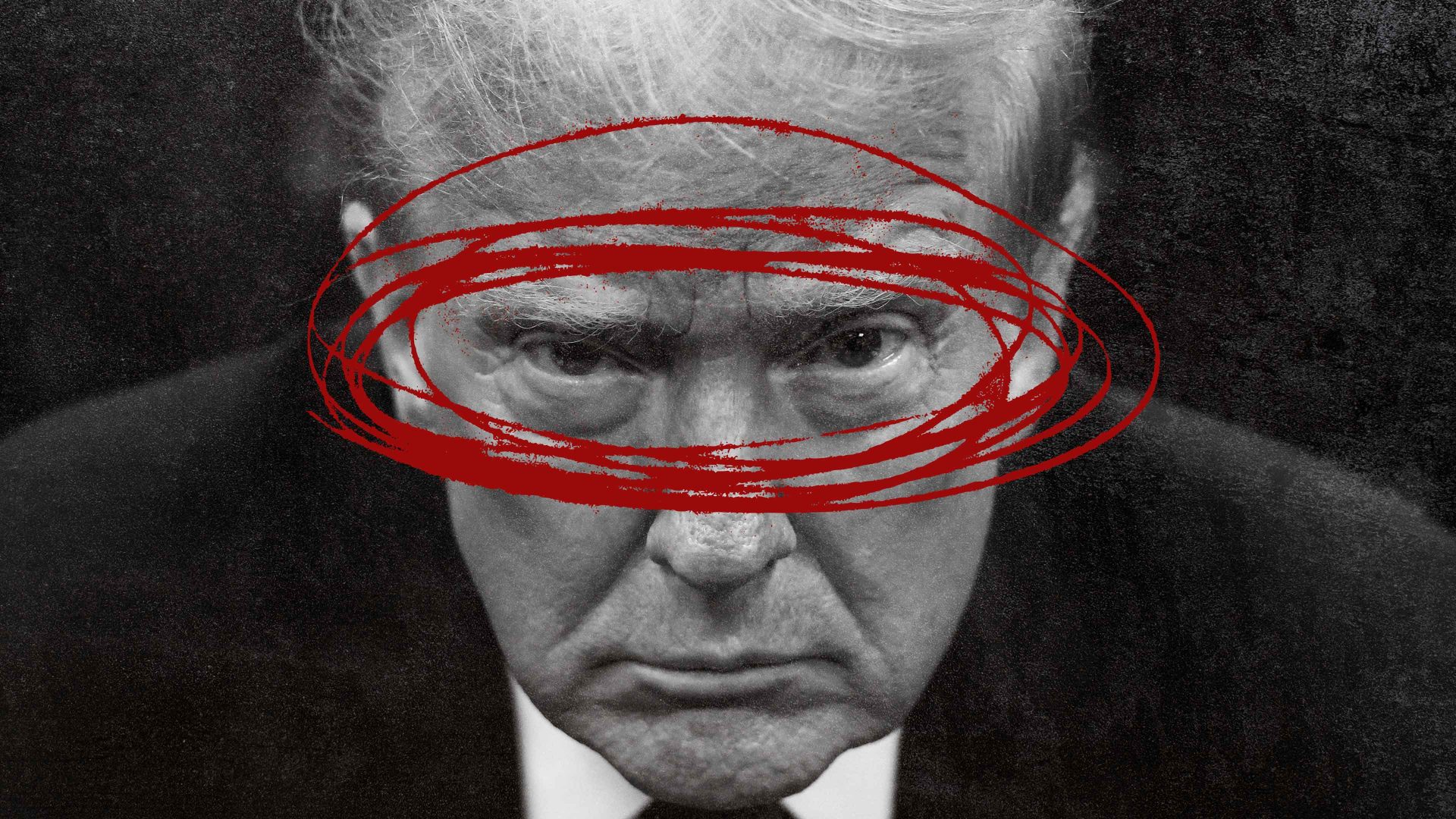
“I’m helping Europe. I’m helping Nato.” Trump is addressing the World Economic Forum in Davos in January. He continues, his voice a little hoarse. “Until the last few days when I told them about Iceland, they loved me. They called me Daddy.”
The president doesn’t seem to notice that he named the wrong country – he has spent the previous month threatening to use military force to take over Greenland, not Iceland. But he keeps going, oblivious. Nato is “not there for us on Iceland, that I can tell you,” he says. “Our stock market took the first dip yesterday because of Iceland, so Iceland’s already cost us a lot of money.”
I’ve covered Trump since he first launched his 2016 campaign, and while his speech was always rambling to the point of word-salad, it’s only recently I’ve noticed a change in his ability to land a point back on the runway after a digression.
He falls back more on non-sequiturs now, hopping aimlessly from rote phrase to rote phrase. You could never take the things he said as true, but these days he’s all over the place. “No one knows what magnets are,” from November 11, for example. There is a noticeable lack of something he used to have, which was, if not message discipline, then at least direction.
“Confusing Greenland and Iceland is an example of what we call phonemic paraphasia,” Adam James tells me. “He’s having difficulty referring to things as what they actually are.”
A therapist from Augusta, Georgia who specialises in providing care to patients in a state of neurological decline, James has been watching Trump closely for a while now. He believes the president is showing signs of a particular kind of degenerative brain disorder. “ It’s called a frontotemporal dementia,” he says.
James makes videos on Instagram under the name EpistemicCrisis, where he unpacks and analyses Trump’s public signs of failing health. He also presents the Poisoner’s Almanac, a medical history podcast.
He explains that while Alzheimer’s presents strictly as forgetfulness, where memory just leaves and there’s nothing to replace it, with frontotemporal dementia the brain fills the gaps with plausible replacements – hence the Greenland/Iceland swap.
There are other signs. “ The forward lean posture that he displays, his standing posture, is a characteristic of frontotemporal dementia.”
And then there’s a tricky one. “ Frontal lobe dysfunction, a person is going to completely lose their filter,” James says. That means they will increasingly do or say things that are “not simply inappropriate, but shocking, socially shocking”.
Long-distance diagnosis of this sort is always open to challenge. But Robert Fico, the prime minister of Slovakia, had a much more close-up view recently when he visited Mar-a-Lago for a face-to-face meeting with the president. At an event soon after, Fico discussed Trump’s “psychological state” with fellow European leaders, calling it “dangerous” – a remarkable comment from Fico, who is regarded as solidly pro-Trump. He has since denied making the comments.
Covering up the declining health of a US president is nothing new. It is now widely acknowledged that Ronald Reagan was suffering from Alzheimer’s while in office, a claim that was even made in a book by Reagan’s own son. When questioned on his suspected Alzheimer’s by a New York Times reporter in 1980, Reagan said he would resign if diagnosed. He did not.
More recently, Joe Biden came under scrutiny for his declining cognitive condition. A book on Biden’s presidency, Original Sin, by CNN’s Jake Tapper and Alex Thompson of Axios, stated that “Biden’s physical deterioration – most apparent in his halting walk – had become so severe that there were internal discussions about putting the president in a wheelchair, but they couldn’t do so until after the election.” Biden’s representatives strongly denied this account, along with any suggestion that there had been an attempt to conceal his declining health. But it was impossible to miss Biden’s physical decline. Everyone could see it.
In the same way, it is hard to overlook the deranged screed that Trump posted after the murder of Rob Reiner, saying the director “was known to have driven people CRAZY by his raging obsession of President Donald J. Trump”. And then there was the grim moment, where Trump extemporised about the White House press secretary, Karoline Leavitt, who is 28: “…That beautiful face and those lips that don’t stop, bap bap bap bap like a little machine gun.”
Then there was the time, during a White House meeting with oil executives, when Trump suddenly stood up from the table and drifted over to the window. “In fact, if you look, come to think of it,” Trump mumbled vaguely, “I’ve gotta look at this.” He was staring out at the construction site where the new White House ballroom was being built. As the president’s mind seemed to drift off in a haze, Marco Rubio and JD Vance smiled nervously at one another.
Suggested Reading
Trump at Davos: A ‘New Yorker’ profile
Trump is 79. By the end of this term he will be 82, the oldest man ever to hold the office of president, and having spent last year mocking Joe Biden for his age, Trump now seems to feel this keenly. The fact of his failure to control speculation about his own health clearly bothers him, because the more rumours gather steam, the more he obsesses over them.
On his social network, Truth Social, his posts have been getting more rambling and unhinged – which is really saying something – so much so that the White House stopped posting transcripts of Trump’s speeches on its site last year. A poll by Data for Progress found 49% of respondents said Trump was “too old” to be president, up by 10 points on the year before.
In July 2025, White House physician Sean Barbabella announced that the president had complained of swelling in his ankles and been sent for vascular testing and an ultrasound, leading to a diagnosis of “chronic venous insufficiency,” a common condition in the over-70s linked to varicose veins.
Videos have spread showing Trump appearing to be fully asleep at public events and dozing at press briefings. Others have spread showing the president stumbling on the steps to Air Force One, or unable to walk in a straight line, or with his face drooping at the podium – all of which have encouraged speculation that the White House is covering up a serious health condition.
This is mostly cope. The stumble he took was a perfectly normal stumble. His strange meandering walking style is a normal walk for someone Trump’s age. I’m pretty sure the droop in his face is just him scowling. But last August this speculation boiled over into a full Social Media Moment when the president went 48 hours without appearing in public. The hashtags “whereistrump” and “trumpisdead” started trending on Twitter, Instagram, and TikTok.
“There has been a big viral trend over the weekend… how did you find out you were dead?” Fox News’s Steve Doocy, in an apparent attempt at humour, asked Trump the following Tuesday, when the president held a press conference. “Did you see that?”
“No.” Trump replied, chagrined. “Really?” Doocy followed up. “1.3 million user engagements about your demise.”
“You know, I didn’t see that,” Trump says, “I have heard. It’s sort of crazy, but last week, I did numerous news conferences. All successful, they went very well like this is going very well. And then I didn’t do any for two days, and they said, ‘There must be something wrong with him’.”
Trump was back at Walter Reed hospital again in October, for what the White House at first referred to as a “routine yearly checkup” – until it was pointed out that he had already undertaken his annual physical back in April. Trump then called it a “semiannual physical”. Later, Barbabella called it a “scheduled follow-up evaluation” that was “part of his ongoing health maintenance plan”.
In mid-November, Leavitt cut short a press conference after being asked about rumours the president had undergone an MRI. A little humiliatingly for Leavitt, Trump immediately confirmed it himself during a press gaggle on Air Force One, saying “I got an MRI, it was perfect.” Asked the reason for the scan, Trump said: “I have no idea… whatever they analyse, they analysed it well and they said that I had as good a result as they’ve ever seen.”
On November 25, the New York Times published an article that analysed Trump’s work-day schedule, finding that in his second term he started on average around 12:08pm, vs 10:31am in his first term. Mentioning the increasingly common moments the president had been caught visibly falling asleep, they concluded he was showing signs of fatigue – an outrage the president called “seditious, perhaps even treasonous”.
“I go out of my way to do long, thorough, and very boring Medical Examinations at the Great Walter Reed National Military Medical Center, seen and supervised by top doctors, all of whom have given me PERFECT Marks,” he posted in response. “Some have even said they have never seen such Strong Results.”
“In addition to the Medical, I have done something that no other President has done, on three separate occasions, the last one being recently, by taking what is known as a Cognitive Examination, something which few people would be able to do very well,” the president wrote, “and I ACED all three of them in front of large numbers of doctors and experts, most of whom I do not know.”
Unfortunately, admitting to taking no fewer than three cognitive tests for dementia in the space of six months did not, as he’d perhaps hoped, quell the idea he might have dementia.
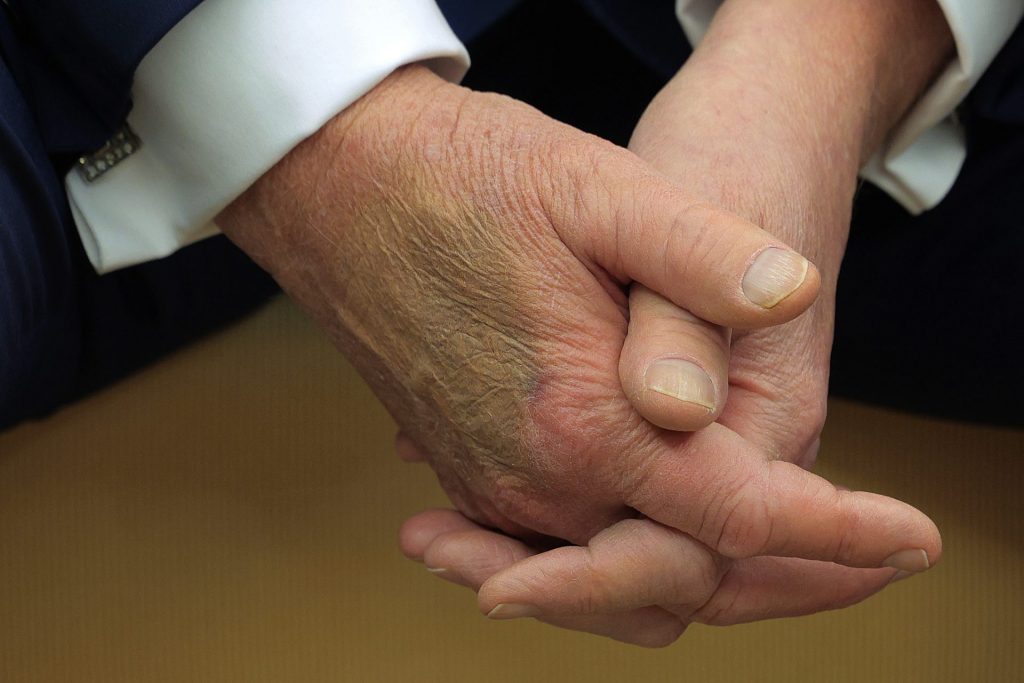
In February 2024, a photo (verified, it’s on Getty Images) went viral. A close-up of Trump’s hands, it showed a disturbing, deep grey colour or bruise on the back, apparently inexpertly covered with makeup.
This discolouration has reappeared in photographs and videos on and off ever since. It was there when the White House hosted the French president, Emmanuel Macron. It has been spotted at museum visits and ceremonial balls. It has been spotted without makeup as a large, dark, painful-looking bruised patch. It has been spotted with the addition of bandages.
It was there when he mixed up Greenland and Iceland in Davos – and on his left hand this time, which seriously undermines the explanation Trump and the White House have maintained that the bruising is “from shaking hands with thousands of people”.
I ran the pictures by two doctors who both spoke on condition of anonymity (it’s frowned-upon in the medical field to publicly diagnose celebrities or politicians). The handshake explanation, the first doctor said, “is rubbish, completely ridiculous”.
Online, many have suggested the marks might be caused by the insertion of a cannula – an intravenous drip. That was what the doctor I spoke to initially thought as well, but close inspection of the pictures changed their mind; the mark doesn’t line up with where a cannula would be on the hand. “It doesn’t look like a venous access bruise in the position, given his vein anatomy,” they concluded.
“[It] would be unlikely a cannula if it’s persistent and recurrent,” the second doctor also said. “Nasty putting cannulas in the back of the hand unless you really have to – if they have shit veins everywhere else.” But you do, they added, “often see that kind of thing” – ie bruising – in the elderly “if they’re on blood-thinners.”
And on blood-thinners, Trump certainly is – he told the Wall Street Journal in January that he had been taking 325mg of aspirin for 25 years now. That’s a very high dose, the first doctor said. “We give 300mg if someone is having an acute heart attack.”
Suggested Reading
The polls have spoken: middle America now hates Trump
Trump was always concerned with the tchotchkes of office. But in the past year he has become more obsessed with physical legacy, like the White House ballroom, the Oval Office gold makeover, and the DC “Arc de Trump” arch, as well as fixating on the Nobel peace prize.
He’s also started to ruminate out loud on the idea of death itself. “I want to try and get to heaven, if possible,” Trump said on Fox and Friends in August. The thought came as part of an answer to a question, asked several minutes earlier, about Ukraine peace negotiations. “I’m hearing I’m not doing well, but if I can get to heaven, this will be one of the reasons.”
Leavitt was asked about it at the following White House briefing. “The president was serious,” she said. “I think the president wants to get to heaven, as I hope we all do in this room as well.”
“I don’t think there’s anything going to get me in heaven. I think I’m not maybe heaven-bound,” Trump mused again to reporters on Air Force One in October. “I’m not sure I’m going to be able to make heaven.” In November, at a wedding at his Mar-a-Lago resort, Trump saw Christian conservative radio host Eric Metaxas, pointed at him, and said: “He’s going to get me into heaven!”
His rambling diversions increasingly have a tinge of melancholy. In September, addressing the UN general assembly, he took a three-minute stroll down memory lane about having bid to redevelop the building. “I used to talk about ‘I’m going to give you marble floors. They’re going to give you terazza. I’m going to give you the best of everything. You’re going to have mahogany walls. They’re going to give you plastic.’ But they decided to go in another direction.”
Or in his commencement address at West Point in May last year, when he went on an almost six-minute voyage about meeting William Levitt, a property developer Trump knew who died in 1994, at a party in New York in the 80s. “I went over and talked to him because he was in the real estate business and I love real estate. I said ‘Hello, Mr Levitt. How are you?’ He said, ‘Hello, Don. It’s nice to meet you.’ He knew me from being in the business.”
“I said, ‘So, how’s it going?’ He goes, ‘Not well. It’s really not going well as you probably read. It’s been a very, very tough period for me.’ I said, ‘So what happened, is there anything you can do?’ He goes, ‘No there’s not a thing I can do,” the president told the hall of confused cadets.
He dwells on this, as if almost on the edge of self-awareness for the briefest of moments. “He said, I’ll never forget, he said… ‘I’ve lost my momentum’.”
Suggested Reading
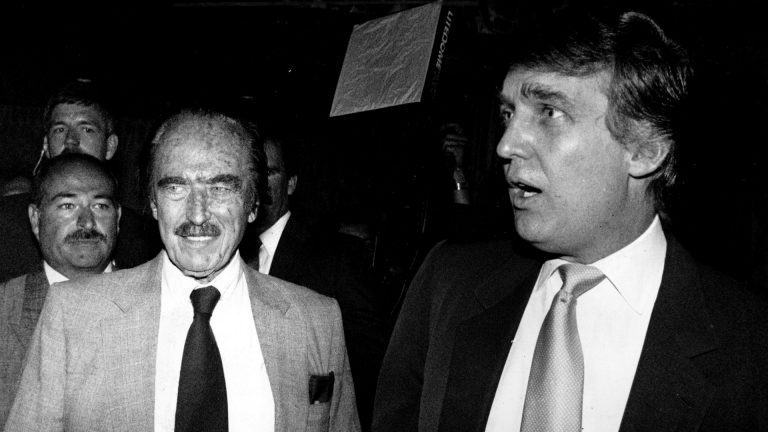
When Fred Trump lost his mind
By the end of his life, Trump’s father, Fred, a property developer I profiled last year for this magazine, was a pitiable figure. Ravaged by Alzheimer’s, he died in his office, which had been turned into a fiction – concocted by a circle of people all pretending he was still in charge. Even as his memory dissolved, what remained was pure habit – and the inability to understand he was no longer in a position of control.
In a recent interview in New York magazine, Trump spoke about his father’s mental decline:
“‘He had one problem,’ Trump said. ‘At a certain age, about 86, 87, he started getting, what do they call it?’ He pointed to his forehead and looked to his press secretary for the word that escaped him.
‘Alzheimer’s,’ Leavitt said.
‘Like an Alzheimer’s thing,’ Trump said. ‘Well, I don’t have it.’”
It’s a remarkable exchange, and suggests Trump is aware of what the consequences would be if he did undergo the same mental decline as his father. But if a similar thing were now happening to Trump, what would it look like? In the same interview, Mary Trump, the president’s niece, recalls the decline of Trump’s father, Fred, and particularly “this deer-in-the-headlights look, like he had no idea where he was”.
Now, when she looks at her uncle Donald, Mary said, “sometimes it does not seem like he’s oriented to time and place,” adding that “on occasion, I do see that deer-in-the-headlights look.”
It’s easy to imagine that his need for power could combine with declining cognition and impulse-control, leading to increasingly erratic and dangerous diversions like Greenland or, as Trump has already mentioned more than once, the annexation of Canada. In other words, if he were in a period of mental decline, his current behaviour is exactly what we would expect to see.
People worry a lot about talk of Trump trying to run for a third term. But even if Trump’s obvious decline is just normal ageing rather than a degenerative brain condition, it’s progressing so fast that my money’s on him not even finishing this one.