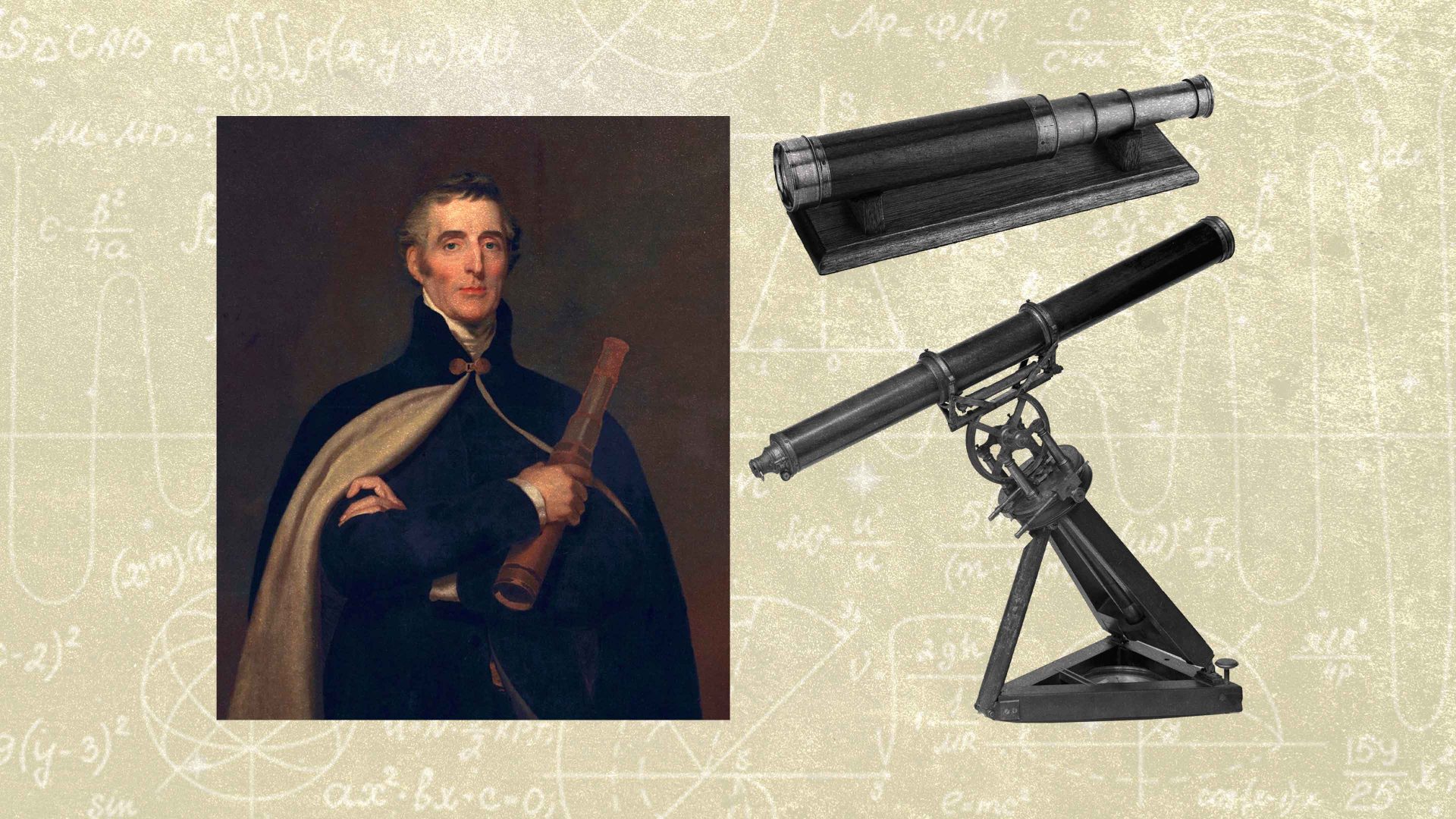
The French artillery was waiting for the June sun to dry out the fields, so their cannonballs would skip across the ground into the ranks of their waiting enemy. From the low ridge in front of them, the Duke of Wellington surveyed the landscape through his telescope as the fields steamed. All his troops were in position. Then, at around 11am, the French artillerymen pushed quills of gunpowder into touchholes and the cannon hurled iron towards men. The carnage of what would become the Battle of Waterloo had begun.
The telescope that Wellington used that day was made by the famous Matthew Berge of London, and it cost the equivalent of a year’s wages for a skilled London tradesman. As well as fine craftsmanship, it incorporated advances in material science that greatly enhanced its performance. These innovations in optical science would not be bettered for over a century, and the telescope Wellington used was itself the result of progress in the understanding and use of minerals.
Those new minerals became astonishingly important, and changed our world, just as here in the 21st century, a range of rare earths is in the process of changing our global order. For all the current excitement over AI and other digital mechanisms, it is a reminder that the ultimate driver of human advancement and change is – and always has been – what we dig out of the ground.
The man who made the Duke of Wellington’s telescope was Matthew Berge. He had learned his craft as an apprentice to the renowned Jesse Ramsden, taking over his business in 1800 when Ramsden died. For the first years, his telescopes honoured his mentor with the engraving, “Berge late Ramsden”. Jesse Ramsden had married Sarah Dollond, the daughter of telescope maker John Dollond, who had filed a patent in 1758 for: “A new method of making the object-glasses of refracting telescopes.” This technological breakthrough solved the problem of chromatic aberration.
Before Dollond, telescopes suffered from an inability to focus all colours to the same point, as the different colour wavelengths refracted through the lens at slightly different angles. This chromatic aberration created coloured fringing around the edges of objects, a problem in all optical instruments. Dollond’s solution was to combine lenses of differing refractive indexes, making one convex and the other concave, creating the first apochromatic lens.
In Dollond’s telescopes, one lens was made of Crown Glass, which used alkali-lime silicates, calcium oxide and potassium oxide to produce a lower refractive index. The other lens was Flint Glass, which used lead oxide to create a higher refractive index and more colour separation. It was a brilliant innovation. Almost 270 years on from John Dollond’s innovation, we still combine lenses with differing refractive indexes to remove chromatic aberrations.
Not long after Dolland’s discoveries, Johan Gadolin was working on a newly discovered mineral, unearthed a few years earlier at Ytterby in Sweden. From this mineral he extracted an element called yttrium, taking its name from the place in which it was found. Six years later, the mineral that he had worked on was named gadolinite in honour of his research, though it took a hundred years for another element to be extracted from it, named gadolinium.
There are multiple applications for gadolinium, including adding it to glass to help improve the refractive index and reduce dispersion, however, there are many other elements used in optics that are also extracted from it. Neodymium can adjust colour and clarity, erbium is used in fibre optics and ytterbium can help to reduce atmospheric distortion in astronomical telescopes.
Finally, lanthanum oxide improves the chemical durability of glass, making it more resilient in harsher environments, as well as increasing the refractive index of camera, microscope and telescope lenses. When used in higher concentrations, the result is often referred to as lanthanum crown glass; a reference to the Crown Glass used by John Dollond in his telescopes.
But in order to see one of the most important substances in the creation of Wellington’s telescope, I drove with my friend Richard to the mountains north of Swansea. Here there is a steep walk up from Craig-y-nos to the open landscape of Cribarth in the Brecon Beacons. There was a cutting wind, so Richard and I sheltered in the lee of a tottering building and sipped coffee from a flask. The area is pocked and slashed by old quarries, now covered and softened by tough grass. Within this hacked land is a long, wide gulley with low grey limestone outcrops, rounded by the fierce weather.
These are the remains of the rottenstone works, the end of life for a process that began around 400 million years ago, when billions of sea creatures sank to the floor of an ocean and their calcium carbonate shells began the long process of turning into limestone. The movement of tectonic plates in the carboniferous period lifted the limestone and exposed it to chemical weathering, where slightly acidic rain reacted with the calcium carbonate to leave behind a porous, softer rock that could be easily broken from the ground by men. This was rottenstone.
Suggested Reading


Has politics driven us all insane?
Narrow tramways carried this rottenstone through the mountains to be ground into a soft, round-grained powder – ideal for the gentle polishing of telescope lenses. And so, as the Duke of Wellington fought his apocalyptic battle, in which 45% of all soldiers were killed or wounded, he planned his manoeuvres with a telescope whose lenses had been polished with rottenstone.
Lens manufacturers don’t use rottenstone these days, but a rare earth called Cerium, that is as common as copper – the oddity of the term “rare earths” is that they tend not to be rare at all. The complexity is in the extraction, a process requiring an additional chemical process of leaching with strong acids: a mirror of the natural creation of rottenstone through the falling of acidic rain.
The process is quite polluting, so facilities for processing cerium are rarely located close to residential areas, unless you live in China, in which case you don’t have much of a choice. Cerium is used in catalytic converters of cars: cerium oxide nanoparticles are added to diesel to reduce emissions. It is also used in LED screens, capacitors, as a catalyst in self-cleaning ovens, in flame retardant textiles and even in flints for lighters. It is also combined with spectacle lenses to absorb UV, to absorb radiation in space telescopes and decolourise lenses to create clearer images.
Cerium is also hard enough to polish glass lenses, without being so hard that it scratches them. Its particles are ground finely to produce very smooth finishes, and it reacts with glass to form a thin layer of cerium silicate on the surface, smoothing microscopic imperfections.
John Dollond’s breakthrough of combining glass of different refractive qualities, was the precursor to the idea of using rare earths in lenses to improve their optical characteristics. His patent of 1758 was used by his son-in-law, Jesse Ramsden, and in turn by the maker of Wellington’s telescope, Matthew Berge. All of them polished their lenses with rottenstone.
Napoleon’s journey to Waterloo had begun on the Mediterranean island of Elba, where he had been exiled after the fall of Paris in 1814. The British government appointed a liaison officer to keep an eye on him, the soldier Colonel Sir Neil Campbell. He had been seriously wounded fighting alongside the Russians in 1814, so looking after the new Emperor of Elba was both work and convalescence.
In late February 1815, Campbell sailed from Elba to Leghorn to see his doctor, and probably his mistress too. When he returned to the island he was shocked to find that all the ships, 900 soldiers, 100 Polish lancers, one baron, four generals and one Emperor had completely disappeared. Left behind were the civilians, Napoleon’s implacable mother, his sister Pauline … and his small folding telescope.
Napoleon re-took Paris – and also France – and prepared to face his enemies once again, at Waterloo. The Duke of Wellington was devastated by the casualties at that battle, weeping at “the loss of so many of one’s friends”, and appalled by the horrors that lay in the fields. He wrote to a friend to say that he would never fight another battle, and afterwards gave his telescope to Sir Robert Peel, the prime minister and founder of the modern police force.
It would have been impossible for him to command such numbers of men without the ability to track their movements on the battlefield and this was only made possible by his telescope, its lenses polished by rottenstone. At the same time, Britain was establishing itself as a dominant naval power, its capacity to negotiate the seas and identify enemy vessels at a distance greatly enhanced by the new generation of optical technology.
That relationship, between technology, minerals and raw power can be read in the progress of human civilisation, from the stone age, to the bronze age to the iron age, all the way up past the age of coal to the present era of the silicon chip and the lithium-ion battery. The technologies may change, but beneath it all, that fundamental relationship remains.
 Most popular

‘Operation Epic Fury – as it happened’

Is Star Wars dead?

Morrissey returns.. and heaven knows he’s mythical now

Iran War: Trump has now sealed his own fate