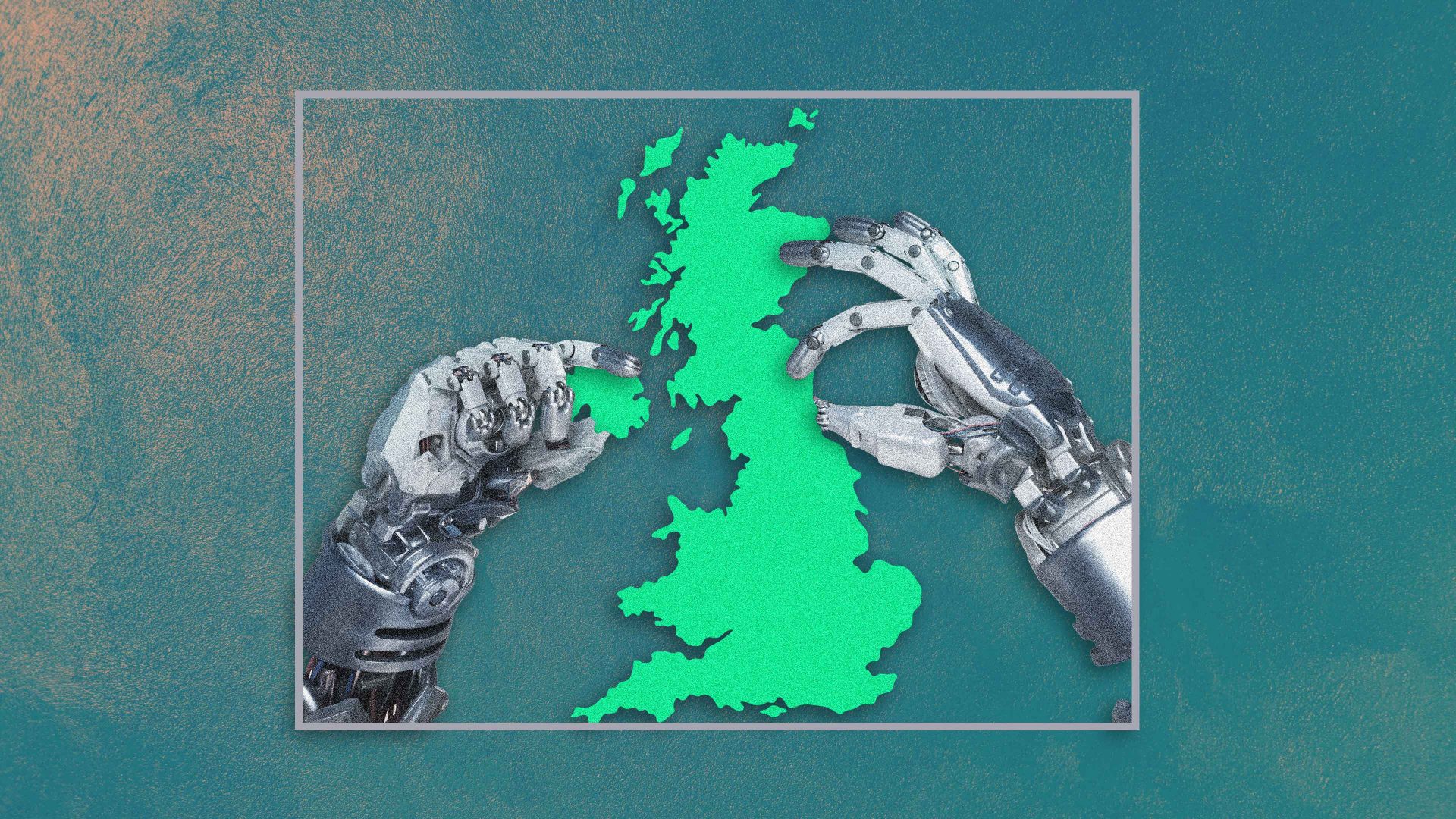
Last summer, the fresh-in-power Labour government shelved a Conservative plan to spend £1.3bn on UK tech and AI infrastructure – saying the Tories hadn’t budgeted properly. But ministers claimed to be “absolutely committed” to building out UK tech. The question was how?
The answer was the promise of £150bn in US tech investment to expand UK AI capacity – bringing data centres stuffed with specialised chips (GPUs) that can handle AI operations – alongside promises of modular nuclear energy to power them, the first reactor to be built on Ynys Môn (Anglesey). Big benefits for UK AI, quantum computing and life sciences was the government’s pledge.
But AI’s inescapable thirst for energy looms over the deal like a dirty black cloud – forcing the government to bet on two risky technologies: small modular nuclear reactors and AI itself.
Rolled out during president Trump’s second UK state visit, the UK-US “Tech Prosperity Deal” was dominated by a pledge of £90bn from US private equity firm Blackstone over a decade (on top of an existing £10bn) – likely for data centre financing.
The next biggest chunk is £22 billion from Microsoft over four years, half to build the UK’s largest supercomputer in Loughton with AI chip giant Nvidia.
Other pledges include £5 billion from Google to expand an existing UK data centre, £1.4 billion from Salesforce, and up to £1.5 billion from Palantir for “defence innovation”. The latter was one of the few pledges to mention job creation (tied to up to 350 new UK jobs).
Overall, the government claimed 7,600+ “high-quality” jobs would bubble up as US money flowed into UK clean energy, life sciences, and “advanced manufacturing” – a very modest projection vs the multi-billion investment.
This isn’t surprising: data centres create very few permanent jobs. What’s more surprising is Labour believing voters can be sold on such an abstract definition of prosperity.
Since the US dominates AI infrastructure – largely due to Nvidia’s kingmaker role – the bulk of this investment looks set to fly back over the Atlantic. So this is certainly a Big US Tech prosperity deal. Even as questions are increasingly being asked whether the heavily leveraged AI industry is itself a vast economic bubble that could be on the verge of popping?
Nonetheless, Labour was jubilant. Sitting alongside Trump in the Chequers garden marquee where the deal was inked, a stiffly quaffed Keir Starmer told tech CEOs it’s “a blueprint to win this new era, together.”
A government-commissioned “AI opportunities” report, led by UK entrepreneur Matt Clifford and endorsed by ministers in January, had stressed the need to expand AI infrastructure, including by attracting private capital. Starmer could therefore be forgiven for feeling like he’d delivered. (Clifford soon offered a public thumbs-up – posting on LinkedIn that it was “fantastic to see”.)
At Chequers, Trump looked like a miserable father of the bride until it was his time to speak. Then he warmed up, joking that AI companies are “taking over the world” – before adding, with a rakish tilt of the head at the UK PM, that “we both hope you’re right”.
The US president’s prepared remarks filleted from an accompanying MoU which nods to shared “pro-innovation legal and regulatory regimes” – underscoring how the UK, post Brexit, has already opted for lighter-touch US-style rules. The tech package cements that drift.
The surreal feeling that accompanies any Trump presser has only deepened since the pomp (and self-importance) of the “unprecedented” second Trump state visit has receded. Brits could be forgiven for wondering who actually prospers from US AI giants being invited in?
For all the ministerial spinning of the deal enabling “sovereign AI”, there’s no escaping that the UK is swallowing the US tech stack whole – becoming a taker of US AI, rather than choosing its own destiny at the infrastructure level.
Suggested Reading


Dr Bot will see you now
This was not the only choice, says Katja Bego, senior research fellow at Chatham House. The UK could have opted for a more selective approach to procuring AI infrastructure – hedging its bets and diversifying to avoid strategic risks of being locked in, including to national security.
“At a minimum, work[ing] with a more diverse set of trusted actors to see where you could have a role – maybe develop[ing] your own dependencies and capabilities – would have been more productive,” she suggests.
There’s a marked contrast with Europe, where debate has recently fired up about how to reduce reliance on US tech. A proper digital autonomy policy discussion simply hasn’t landed in the UK, per Bego, who posits that this “strategic vacuum” is another Brexit hangover.
Yet all the same concerns apply: the UK faces being subject to US leverage under an AI kill switch. While the security of UK data fed into this infrastructure rests with a handful of US companies – many of which have business models based on data exploitation.
Carissa Véliz, an Oxford associate professor in AI ethics, shares these concerns. “Much of the data being collected is extremely sensitive. Is it wise to allow a foreign power to access and control that data?”
“My best advice to the UK government is to champion innovation in tech… that better supports sovereignty and democracy,” she told The New World. “Always have alternative modes of running systems… and protect privacy, because without privacy there is no democracy.”
The scale of the US investment is itself a lock-in, too.
While £150 billion sounds huge, spending on AI infrastructure operates in another realm. Training runs for AI models can now cost upwards of a billion dollars, says Dr Keegan McBridge, a digital government and AI expert at the Oxford Internet Institute, so more financing will have to follow up. “In terms of the actual value there’s quite a lot there [in the deal]… The thing is… now the UK actually needs to build things.”
Spending big on AI also comes with no guarantees.
Betting on these cutting-edge technologies in the hopes of major economic gains is unproven. The costs of integrating AI into existing systems also don’t appear to be factored in. Nor is there discussion of any impact on jobs from the UK leaning into automation.
There are also huge uncertainties over whether the planned AI capacity uplift will materialise. Even if the companies follow through, it’s not certain the AI compute will be delivered on time and budget – especially with the parallel need for energy upgrades.
A painful history of failed government IT projects may have given Labour added incentive to go all in on private investment – that and the state of the public finances. But choosing dependency opens up the UK public sector to being locked into buying US AI services – at ever inflating rents once these companies move to claw back a return.
“The question of demand is the one overarching problem in the whole [AI] industry right now,” explained Leevi Saari, a PhD candidate at the University of Amsterdam. “There is a huge expansion of capacity and… if we exclude the needs of the largest technology companies, the demand is still pretty elusive.”
And then there is that worrying chatter about an AI bubble.
In the weeks since the UK-US deal was announced we’ve seen further major investments between AI players themselves – including Nvidia pledging to plough up to $100 billion into OpenAI, the US company that sparked the AI chatbot boom in the first place. That was soon dwarfed by the $300 billion OpenAI announced it would be spending with US tech giant Oracle to buy cloud computing.
The huge sums of money flying around the AI investment ouroboros are starting to look like the polar opposite of a vote of confidence in the underlying technology. The amounts being poured into AI infrastructure companies are now so large that some are wondering whether a return is even possible. And if this billions-heavy AI house of cards comes tumbling down, what else might it take down with it?
With a sizeable chunk of US GDP growth already tied to the AI industry any correction could have huge consequences for the US economy as a whole – and anyone else locked into this Big Tech-operated rollercoaster ride, including the UK…
The US-UK deal boils down to a bet by the Labour government that AI will steer everything in future – or even that whatever happens the risk of being left behind is too existential not to gamble.
What this scramble for AI means for the UK’s Net Zero goal is another burning question. The Trump administration is publicly hostile to green energy. AI investment looks like a handy tool to drag other countries back to fossil fuels.
Trump’s advice to Starmer was bald: reopen the North Sea and “drill baby, drill”. Nvidia’s CEO Jensen Huang chipped in with scepticism from business about relying on clean energy to fuel AI – urging the UK to invest in gas.
A DSIT spokesperson acknowledged the “energy challenge” attached to AI – but sidestepped questions, saying that the government is confident an industry-led AI Council it unveiled in January will ensure the AI boom “does not come at the expense of the climate”.
The British public is now locked into finding out.
 Most popular

‘Operation Epic Fury – as it happened’

Is Star Wars dead?

Morrissey returns.. and heaven knows he’s mythical now


Iran War: Trump has now sealed his own fate