
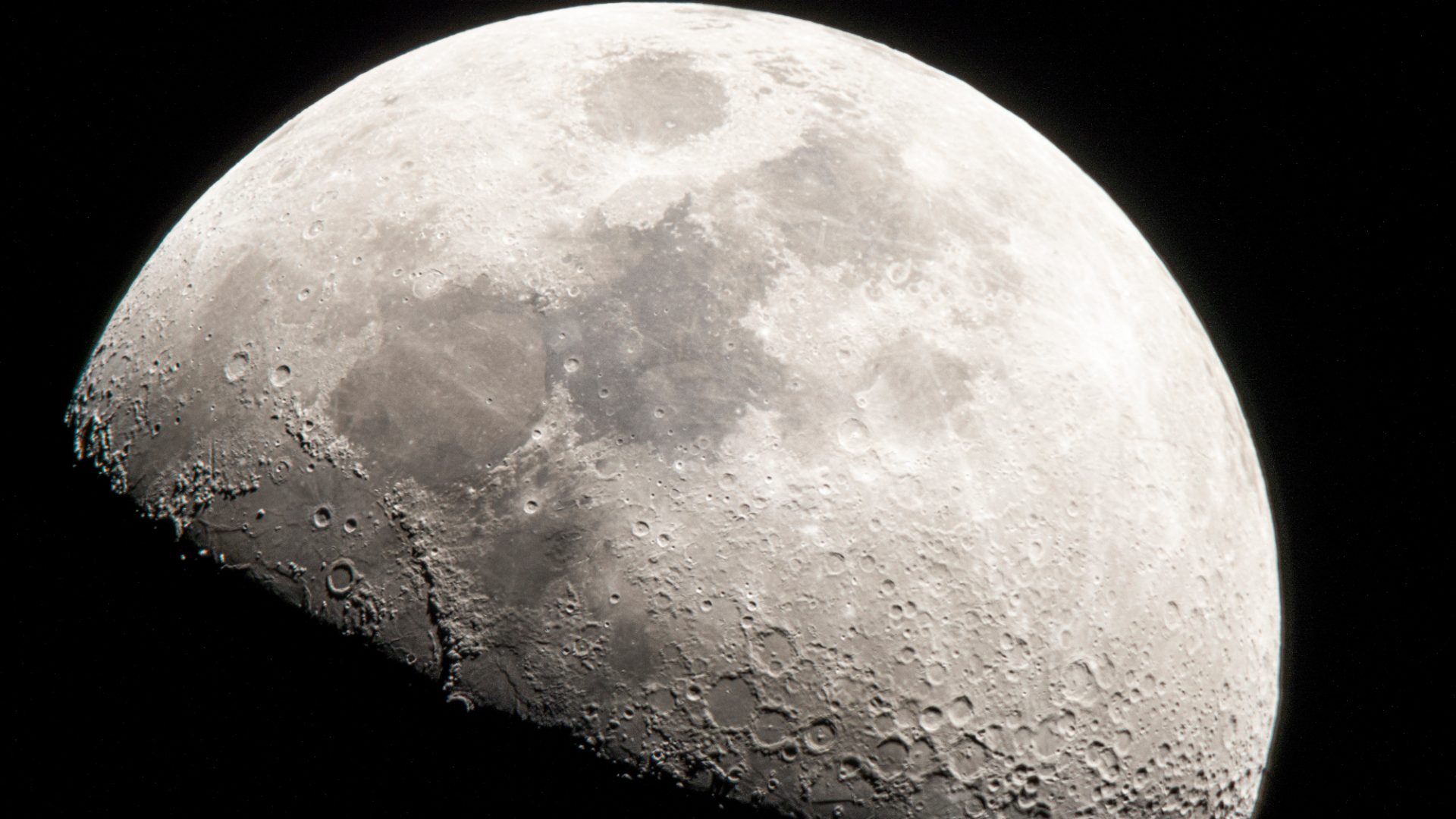
When it smashed into the moon at nearly 12,000km/hour, the Soviet Union’s Luna 2 probe became the first human-made object to reach the lunar surface. The high-speed collision on September 13, 1959 was intentional. It destroyed the spacecraft and scattered 72 pentagonal metal shields inscribed with the state emblem of the Soviet Union across the moonscape.
Days later, during his only visit to the United States, the Soviet premier, Nikita Khrushchev, was asked whether the act implied ownership of the moon on the part of his nation. Khrushchev derided the questioner, saying “ownership” was a capitalist construct. The shields symbolised the message that the moon was for all people, not a narrow economic or imperialist cohort.
Yet today, the standpoint of one of Khrushchev’s successors appears to have changed. Last year Russia’s state space corporation, Roscosmos, announced plans to build a power plant on the moon by 2036 and had signed a contract with the Lavochkin Association aerospace company to do it. The proposed plant would provide energy for Russia’s lunar exploration programme, an observatory and the infrastructure of a joint Russian-Chinese lunar research station.
Meanwhile, America’s Artemis II moon rocket is due for a much-delayed take-off later this year, paving the way for a lunar landing by astronauts in 2028. And the world’s richest man, the far right billionaire Elon Musk, announced in early February that he had shifted the focus of his SpaceX company from Mars to building a “self-growing city” on the moon in less than 10 years. “The overriding priority is securing the future of civilisation, and the moon is faster,” he said.
“Many people believe the moon should not be owned by anyone or anything,” says Teasel Muir-Harmony, historian of science and technology and curator of the Apollo spacecraft collection at Washington DC’s National Air and Space Museum. But the Russian plans and Musk’s ambitions mean that ownership of the moon – or more pertinently, its resources: from silicon for microchips to manganese for batteries and much more besides – is again a hot topic.
British philosopher AC Grayling, who addresses the issue in his book Who Owns the Moon? In Defence of Humanity’s Common Interests in Space, says the 1967 United Nations Outer Space Treaty (OST) regards space as terra nullius, or belonging to nobody. In effect it forbids public or private agencies from claiming exclusive rights to any region of space or celestial body, using grand but vague phrases such as “in the common interest of all mankind”.
And therein lies the problem. The treaty was deliberately mealy-mouthed to ensure that the principal participants – then the only two space-faring nations, the United States and the Soviet Union – agreed to it. So, although it suggested that common ownership benefited all of humanity, try telling that to Vladimir Putin, Xi Jinping or members of the MAGA-dominated US Congress in thrall to the rapacious instincts of corporate America.
“The world has become more dangerous,” says Doug Millard, senior space curator at the Science Museum in London. “China’s economy is ever-growing, the US is divisively politically divided, and we all know what Russia is about. Treaties that underpinned the old ‘gentlemen’s agreements’ are simply being ignored.”
Muir-Harmony adds: “In the 1960s, the fear was that space and the moon could be used militarily. The Outer Space Treaty was primarily an arms-control treaty. It sets out key principles, but is very broad. All sides wanted space to be used for peaceful activities – a major achievement – but it was written before humans ever went to the moon, so issues such as resources or even tourism aren’t covered.”
Grayling speaks of “the tragedy of the commons,” referring to how individuals or states can harm shared resources by appropriating more than their fair quota, be it agricultural land, oceans, minerals or rainforests, leading to food shortages, extinctions and other undesirable effects. Can we avert a similar situation on the moon?
“Five treaties cover ownership,” explains Muir-Harmony, “all administered by the United Nations’ Committee on the Peaceful Uses of Outer Space.” The OST was the first, but perhaps the most contested was the 1979 Moon Agreement.
Suggested Reading


MICK O’HARE: The Soviets who almost conquered the moon
Few nations have signed it; notably missing are the US, Russia and, intriguingly, Luxembourg. And it was written before many newly independent nations existed. These now express concerns over the history of exploitative colonisation, worried that what once happened in Africa and South America might happen on the moon.
Grayling fears that the Outer Space Treaty and the Moon Agreement simply aren’t fit for purpose, arguing that they are a list of aspirations that put no bar on national self-interest or economic imperatives. Space is not just a physical domain, he says, but one in which cybercrime and espionage can operate. As Grayling points out, the OST doesn’t even have a body to enforce it – treaties only work as long as all parties choose to observe them.
Yet although it would appear that the OST expressly forbids military action in space, including on the moon, it seems even this is open to interpretation. In 2019 the United States Space Force was established. “Well, there is a distinction between militarisation of space – which has always happened, think spy satellites – and weaponisation of space, especially weapons of mass destruction,” points out Muir-Harmony. “These are explicitly banned, but militarisation covers a lot. The military has always used space assets – GPS was originally intended for naval use. People think the Space Force is soldiers in rockets. More likely it’s geeks with computers.”
But meanwhile, the US, China and Russia have all designated space as a “war-fighting domain”. Russia and China have successfully destroyed defunct satellites using Earth-launched missiles. Closer to home, the UK’s Space Command plans to use lasers in defence of its assets in space. All argue they are protecting their citizens and critical infrastructure.
Add commerce into the orbital mix and it doesn’t take a diplomatic genius to see the potential for conflict as interests collide. And any conflict in space will have Earthbound repercussions. None of this was covered in detail in 1967.
To fill the gaps, in 2020 the United States proposed the Artemis Accords. Drafted by Nasa, they comprise non-binding, multilateral arrangements outlining the precepts expected of spacefaring nations and private companies. They lay out principles of private ownership of the moon’s resources, but not the moon itself, while maintaining peaceful use of both.
“The US still says the moon’s resources should be for all mankind and no one country should own them,” explains Muir-Harmony, “but it sees that through a private-enterprise perspective, arguing that profit incentivises exploration and innovation. It’s one reason the US didn’t sign the Moon Agreement, which made no provision for private enterprise.” Indeed, no spacefaring nation has signed it, meaning it has little legal relevancy.
Conversely, many nations have passed domestic laws granting them use of the moon’s resources. The US passed the Commercial Space Launch Competitiveness Act in 2015, and Luxembourg has similar laws. A large part of its economy derives from the space sector, with around 50 companies producing hardware and software. Hence non-spacefaring Luxembourg not signing the Moon Agreement. And Millard adds pragmatically: “If we’re to settle on the moon, it makes sense to use the resources to hand.”
Unsurprisingly both Russia and China refuse to sign the Artemis Accords, saying they are an attempt by the US to claim lunar resources, although last year’s Roscosmos announcement somewhat undermines that objection.
The European Space Agency, as befits an intergovernmental organisation, remains steadfastly neutral. However, Millard offers what is perhaps a European perspective. “Artemis presents the US vision and that of its allies, but I’ve yet to see any detailed how, why, who, what? Russia and China will probably never agree to its proposals. Nonetheless, it’s true the existing treaties are inadequate. We need to fill the yawning gap between the OST and the Artemis Accords.”
But how? Some conflict resolution strategists have suggested that the Antarctic Treaty System offers a framework. The ATS, signed in 1961, governs international relations in that continent, also deemed terra nullius. It ensures no nation has sovereignty, that Antarctica is demilitarised, free of nuclear tests and radioactive waste, and is used only for peaceful purposes via international scientific cooperation. It was the cold war’s first arms-control agreement.
“It’s regarded as relatively successful in preventing conflict,” agrees Muir-Harmony, “but it’s outside the UN’s auspices [as are the Artemis Accords] and is administered by nations with an Antarctic presence. It’s also modified pretty much annually. So it’s useful, but different to the OST. It’s often not just the principles that matter, but the process too.”
Other factors come into play. Grayling argues that the ATS has held because Antarctica is a harsh environment – mining and other exploitative practices are difficult. Also, the environmental lobby has stoutly protected it. Nations won’t risk international discord for minimal return. But he warns that a time will come when nations will choose to exploit it and that will be the true test of the ATS.
And even terra nullius still needs policing. During the “scramble for Africa” in the late 19th century, imperialist Europeans considered Africa terra nullius as they plundered its resources. The consequences of their unchecked actions are still playing out.
“And,” Grayling adds, “new technologies enabled it: railways, steamships for transport and – worse – the Maxim machine gun. Now new technologies are taking us into space, potentially creating a similar scenario.”
So, is profit likely to trump the common good? “It’s difficult to get Elon Musk out of your head at this point,” says Millard.
“Recently even the Japanese government mooted a challenge to the OST, contending that the old agreements only concerned weaponisation, barely touching on commercial activity. They argue that state signatories are responsible for non-state entities that need approval from their individual governments. This means the Japanese government could grant mining rights to a Japanese company. The relationship between nation state and commercial enterprise is already blurred.”
Suggested Reading
MICK O’HARE: On the other side of a polar tragedy
Muir-Harmony also has concerns about the lunar environment itself, pointing out that while mining and extraction could be damaging, potential conflict isn’t confined to resources. Article 7 of the Moon Agreement states that areas of special scientific interest shall be designated as international preserves.
“Different groups want different things, from cosmologists to geologists, businesses to tour operators,” she says. She identifies tourism as a particular problem. There are still astronaut footprints in the fragile lunar soil, and the hardware they arrived with: lunar module bases, scientific instruments, moon buggies and even human waste. Should tourists be allowed to get close to these?
The US passed the One Small Step Act in 2020 partially protecting the sites, but it’s only domestic law. The organisation For All Moonkind was established to preserve the Apollo landing sites. Co-founder Michelle Hanlon says: “We only get one chance to preserve the remnants of one of humanity’s finest achievements. We must get this right.”
“Some people hope to be buried on the moon or have their ashes spread there,” Muir-Harmomy adds. “But the Navajo nation has objected. They see the moon as sacred. And what about advertising or painting artworks or national flags on its surface?”
Which leads us back to the original question. Should anybody own the moon? “According to the OST, no,” replies Millard. “Or at least, ownership belongs to us all.”
Part of the problem is that few people care. There is little public awareness or political debate. The wider public must be involved rather than leaving it to governments or multinational corporations, argues Grayling. Yet as Millard notes: “An Earthbound public can’t see what’s going on in space. Does this stuff really bother the average person?”
Perhaps it should. Because although the argument that nobody should own the moon seems reasonable, humanity is largely responsible for it. In the same way that we don’t own whales, we are responsible for their wellbeing: protecting their environment and stopping poaching. We have a common responsibility, and partisan self-interest is a constant danger.
“We came in peace for all mankind,” says the plaque taken to the moon by the Apollo 11 astronauts, after which they promptly planted the American flag. Talk of hoisting the United Nations version was trumped by the propaganda value of seeing the stars and stripes beamed around the world on live TV.
There will need to be negotiation, diplomacy and, most probably, plenty of horse-trading if we are to avoid more metal shields and national flags littering the lunar landscape in the decades ahead. But try explaining that to Elon Musk.
Mick O’Hare is a freelance journalist, editor and author of books about science, history, sport and the universe