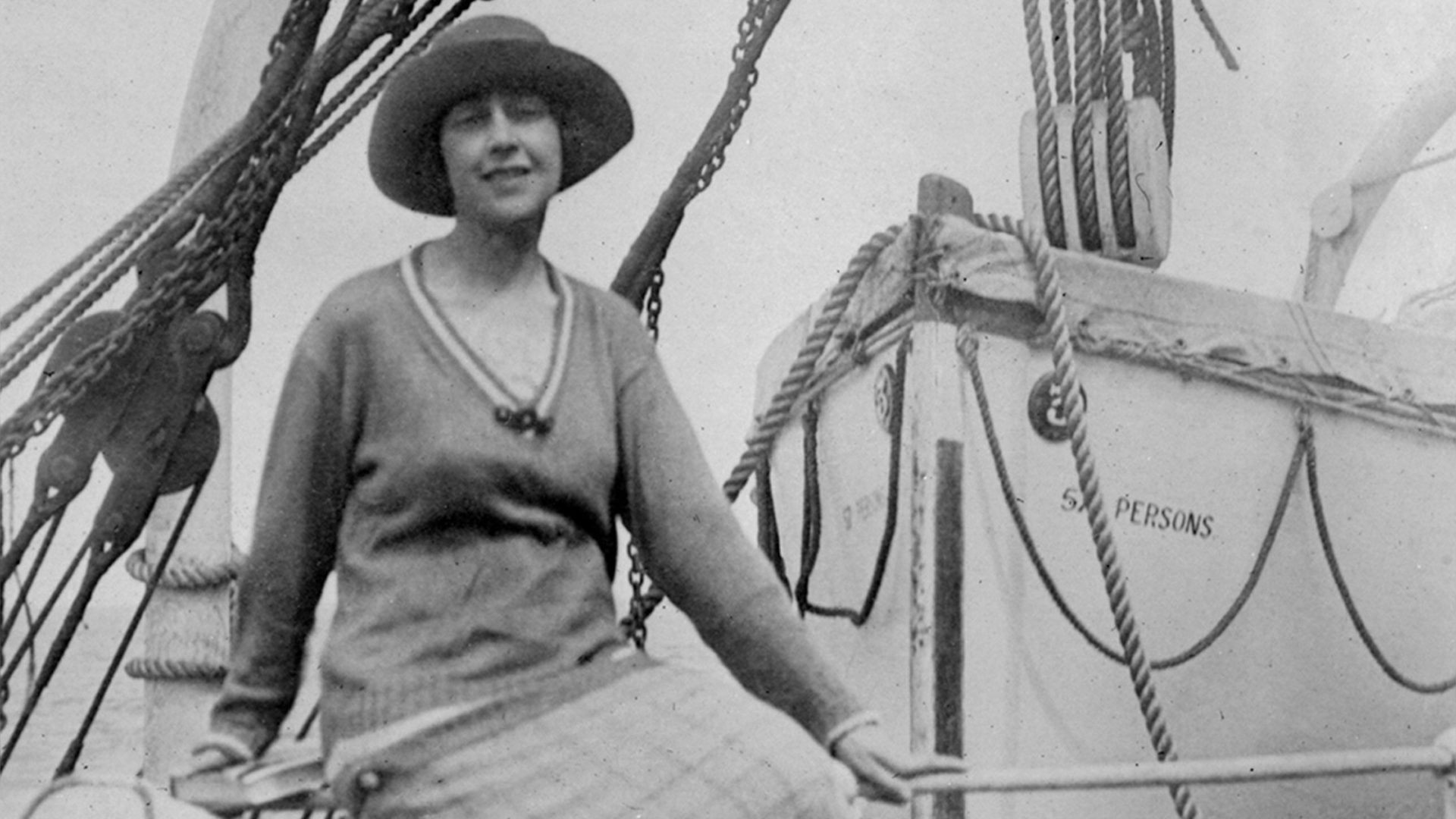
On January 12, it will be 50 years since the death of Agatha Christie, the biggest-selling author of all time, according to Guinness World Records. Other sources sometimes put Shakespeare ahead of her, but figures for previous centuries are difficult to estimate, and while the Bard has had over 400 years to clock up sales, Christie’s landmark debut novel, The Mysterious Affair at Styles, only appeared in 1921.
The book introduced her refugee Belgian detective, Hercule Poirot, and in the century since its immediate success, her popularity has grown exponentially, and she holds the record as the world’s most translated author. Her play The Mousetrap is in receipt of another record for the world’s longest initial run.
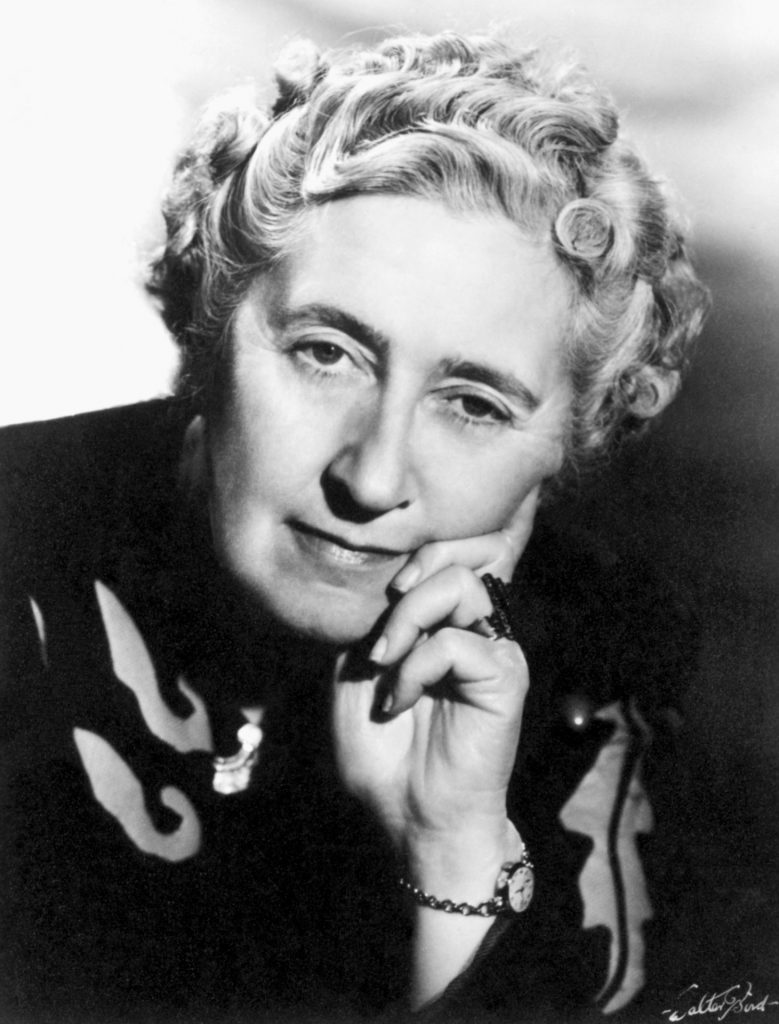
A very private individual, Christie gave few interviews, and when photographed in later life had the look of a smiling benevolent grandmother, leading some to mistake her for the Hollywood version of Miss Marple – a cosy, provincial Margaret Rutherford figure with a handy knack for prose, tucked away in a chocolate-box English village, tending the roses or gazing out from behind the net curtains. Not the kind of person you would expect to have found surfing in Hawaii in the 1920s, or going up in a flimsy stringbag of an aeroplane in 1911 during the pioneering days of aviation, when crashes were frequent.
Yet Christie did both, and much else that might not fit the profile – like spending months in the mid-1930s roughing it in a tent working on her second husband’s archaeological digs in Syria, trying to sleep each night in spite of mice scurrying across her face and through her hair, as she recalled:
“Horrible! The walls are covered in strange, pale, crawling cockroach-like creatures. A mouse is sitting on the foot of my bed attending to his whiskers! Horrible crawling things are everywhere!”
Not only was Christie a hard-working member of the archaeological team, she also found time to write some of her most successful novels and short stories while in the Middle East, the experience and the long journeys there and back sometimes directly inspiring the settings of her works, notably Murder on the Orient Express (1934), which begins on the platform at Aleppo railway station in Syria as Poirot is about to return to London by train via Istanbul, a journey she knew well.
In those days, many people distrusted anyone from another country as a matter of course, and the sleeping carriage where the murder takes place contains an uneasy mixture of suspects: English, American, Swedish, Russian, Italian, Hungarian, German and Greek. As ever, Christie’s readers are invited to follow the Belgian Poirot’s thought processes and worldview, himself a habitual outsider in his adopted country of England on account of his nationality and manner.
Poirot duly notes the British colonel regarding him with a suspicious gaze that means “Only some damned foreigner”, the young American who says “I don’t as a rule cotton to Britishers – they’re a stiff-necked lot”, or the Belgian senior official from the train company telling him plainly, “I do not like Italians”. Another suspect claims to distrust all Americans, but admits that he has never been to America.
By contrast, at the time she was writing that novel, Christie had already seen a great deal more of the world than most people from her home country. Born into a well-off family in Torquay in 1890, she taught herself to read at the age of four, but by 1897 her father’s reckless spending necessitated a move to France for a year where things were cheaper, after which they returned to Devon.
Then, after his early death, she attended school in Paris from 1905-7, and at the age of 18 lived for three months in Cairo with her mother among the ex-pat community, going to dances and social functions. The grand hotel where they stayed, not far from the pyramids, was situated on Gezira Island, encircled by the Nile flowing through Cairo. Three decades later, she would set one of her most famous novels, Death On The Nile, among a group of tourists exploring the ancient sites along the same river much further south.
As an adult, once her first book proved a hit with critics and the public alike in 1921, she began to travel widely. In that decade alone, as well as writing bestselling novels like The Murder of Roger Ackroyd (1926), with its game-changing plot twist, she also found time to visit such places as Switzerland, Corsica, the Pyrenees, Italy, the Canary Islands, Istanbul and Baghdad (via the Orient Express). All this, however, was a mere sideshow to the epic one-year, round-the-world trip that she and her first husband, Archie Christie, made in 1922.
Ahead of the British government’s planned British Empire Exhibition at Wembley, Archie’s friend Major Ernest Belcher had secured funding for the grandly named Dominion Mission, in which a group of interested parties would travel to various parts of the empire as ambassadors for the forthcoming event. Archie, who worked in the City, was hired as the team’s financial adviser, and the newly famous Agatha Christie joined him. “It’s our chance,” she said. “If we don’t do it we shall always be mad with ourselves.”
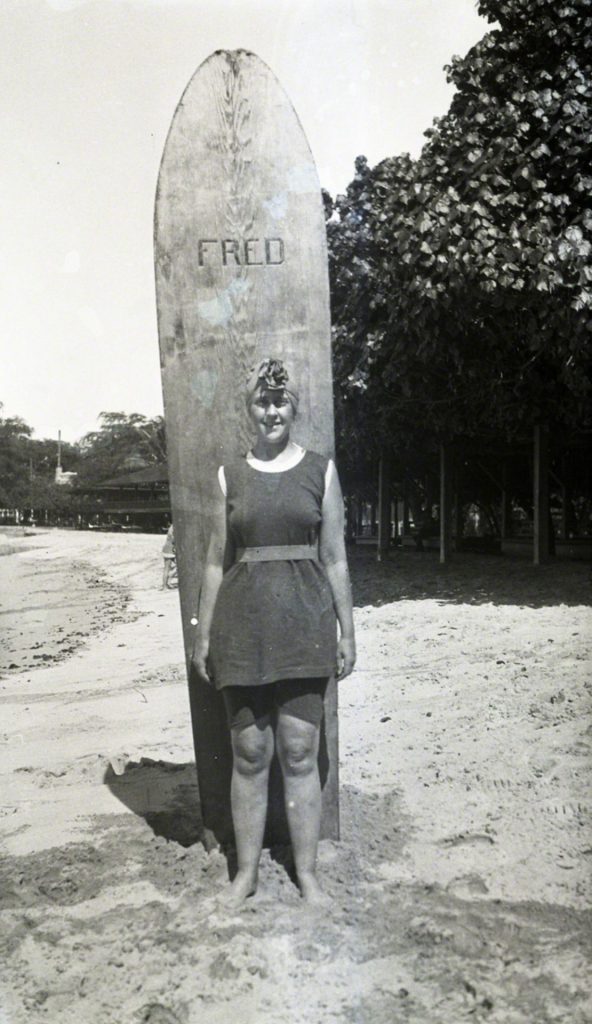
As a result, she discovered the delights of surfing. Already a keen swimmer, she took to it immediately, writing home to her mother from Cape Town having sampled the nearby beach: “In the afternoon, I met Archie at the station and we went to Muizenberg, and surf bathed with planks! Very difficult.”
In South Africa, they used short, flat boards, but when the couple reached Hawaii, they encountered surfboards at Waikiki beach that were considerably larger and much closer to the modern style.
“Nothing like it,” wrote Christie. “Nothing like that rushing through the water at what seems like a speed of about 200 miles an hour; all the way in from a far distant raft, until you arrived, gently slowing down, on the beach, and foundered among the soft flowing waves. It is one of the most perfect physical pleasures that I have known.”
Thinking of the possibility of trying a surfboard back home on one of her favoured beaches near Torquay, she wrote, “I believe one could have great fun with them at Paignton on a rough day” – a prescient comment, given that there is now a regular local surfing community who do just that.
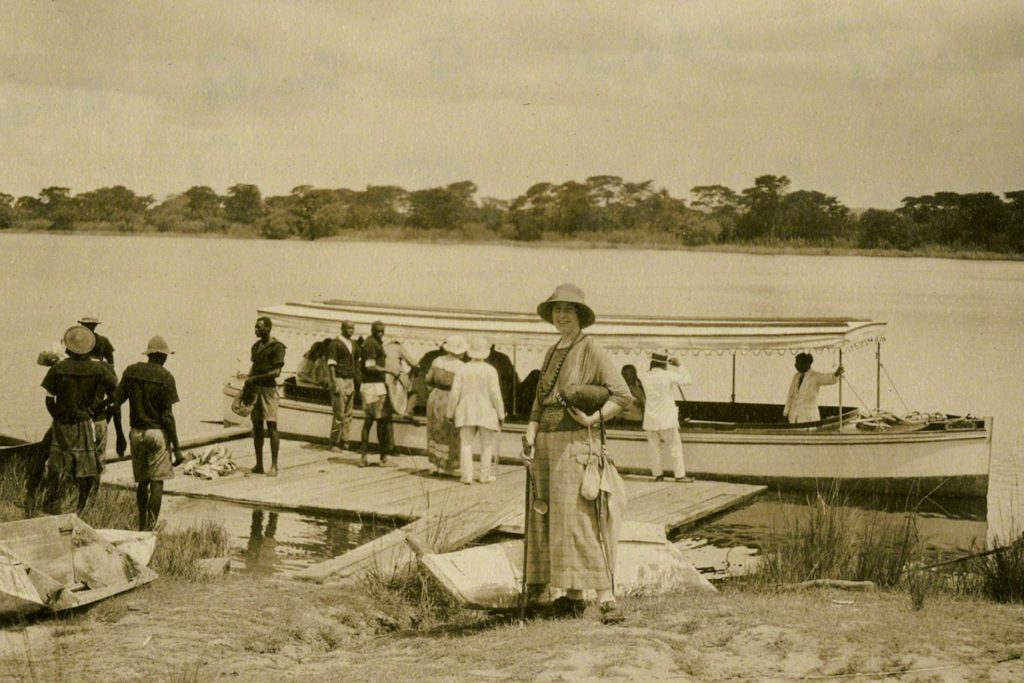
The seven members of the Dominion Mission embarked on their voyage by ship from Southampton on January 20 1922, returning on December 1. During that time, the couple visited Madeira, Cape Town, Rhodesia, Pretoria, Adelaide, Melbourne, Tasmania, Hobart, Sydney, Brisbane, Wellington, Nelson, Christchurch, Rotorua, Auckland, Honolulu, Victoria BC, Calgary, Banff, Edmonton, Regina, Winnipeg, Ottawa, Montreal, Toronto, Niagara Falls, and New York. Christie continued writing fiction regularly while she was away – South African background material appeared in her 1924 thriller, The Man in the Brown Suit – which was fortunate, since Archie’s boss in the City had failed to keep his job open for him, and money was now tight.
Suggested Reading

The town that Faust built
When her debut novel appeared, a year before her trip, the character of Poirot had immediately proved popular with both reviewers and the public: “The detective is a Belgian with original ideas and methods, and to watch his unravelling of a profoundly mysterious crime is extremely fascinating,” said the Swanage Times & Directory, while The Bystander’s extremely positive piece concluded with the words, “it is to be hoped that her Belgian detective will be heard from again”.
Always a hard worker, Christie now knuckled down, despite the double blow of the death of her much-loved mother and a traumatic divorce from Archie, becoming over the subsequent decades a publishing phenomenon, writing a series of crime novels, short stories and plays that brought her international fame, until the sheer scale of her success came to exceed that of virtually anyone who had ever picked up a pen.
Yet to this day, Christie is still sometimes dismissed out of hand by people who may only know her work at second-hand, via the considerable number of television, film and radio adaptations derived only very loosely from her characters and bearing little resemblance to the author’s original conception. For example, the first actor to portray Poirot on stage was the 29-year-old Yorkshire actor and future Hollywood star Charles Laughton, and then 34-year-old Austin Trevor was cast for the detective’s first appearance in a feature film, but in the original books, the Belgian is a retired detective aged around 60 when Christie introduces him, and nearing 90 by the time of his final appearance.
A similar fate befell her other much-loved character, Miss Jane Marple, partly based on the author’s grandmother, who made her novel debut in 1930 in The Murder at the Vicarage – where she is described as “elderly” – but the first woman to play the role was 35-year-old American-born actress Barbara Mullen. To further cloud the issue, some of Christie’s supremely well-devised plots have been mangled in the process of adaptation, presenting a misleading picture of her work, as she complained to MGM following their series of 1960s Marple films.
However, 50 years after her death, the works themselves continue to sell in prodigious quantities around the world, while remaining some of the most borrowed books in libraries, and it is within their pages that the true spirit of that adventurous and multi-talented woman on the surfboard can be found.
Max Décharné is a musician and author of 10 books including Capital Crimes: Seven Centuries of London Life and Murder