One hundred and fifty years ago, the London branch of Parisian firm L Hachette et Compagnie published Messieurs Richard and Quétin’s New English and French Dialogues, a helpful pocket volume for the British traveller. Alongside everyday phrases such as “ring the bell for the waiter” and “have you any spare rooms?”, the writers also envisaged circumstances in which it would be necessary to say “I believe I shall go mad with pleasure”, “the abomination has reached its height” and that perennial tourists’ favourite, “after so many misfortunes, it only remains for me to die”.
As LP Hartley wrote at the start of The Go-Between, “The past is a foreign country; they do things differently there”, and on this evidence, journeys overseas in those days could be very different indeed.
Then, as now, people travelled for a variety of reasons. Some guides were written for wealthy tourists or language students, others were aimed at emigrants seeking information about developing lands. Specialist publications were also produced by the military for their troops: in the aftermath of the Russian revolution, the US War Department issued a book entitled Russia: route zone A, Murman railway and Kola Peninsula, which considered the topography in purely strategic terms (“From Petrograd boats can cross Lagoda Lake, so that Petrozavodsk would be comparatively easy to attack”).
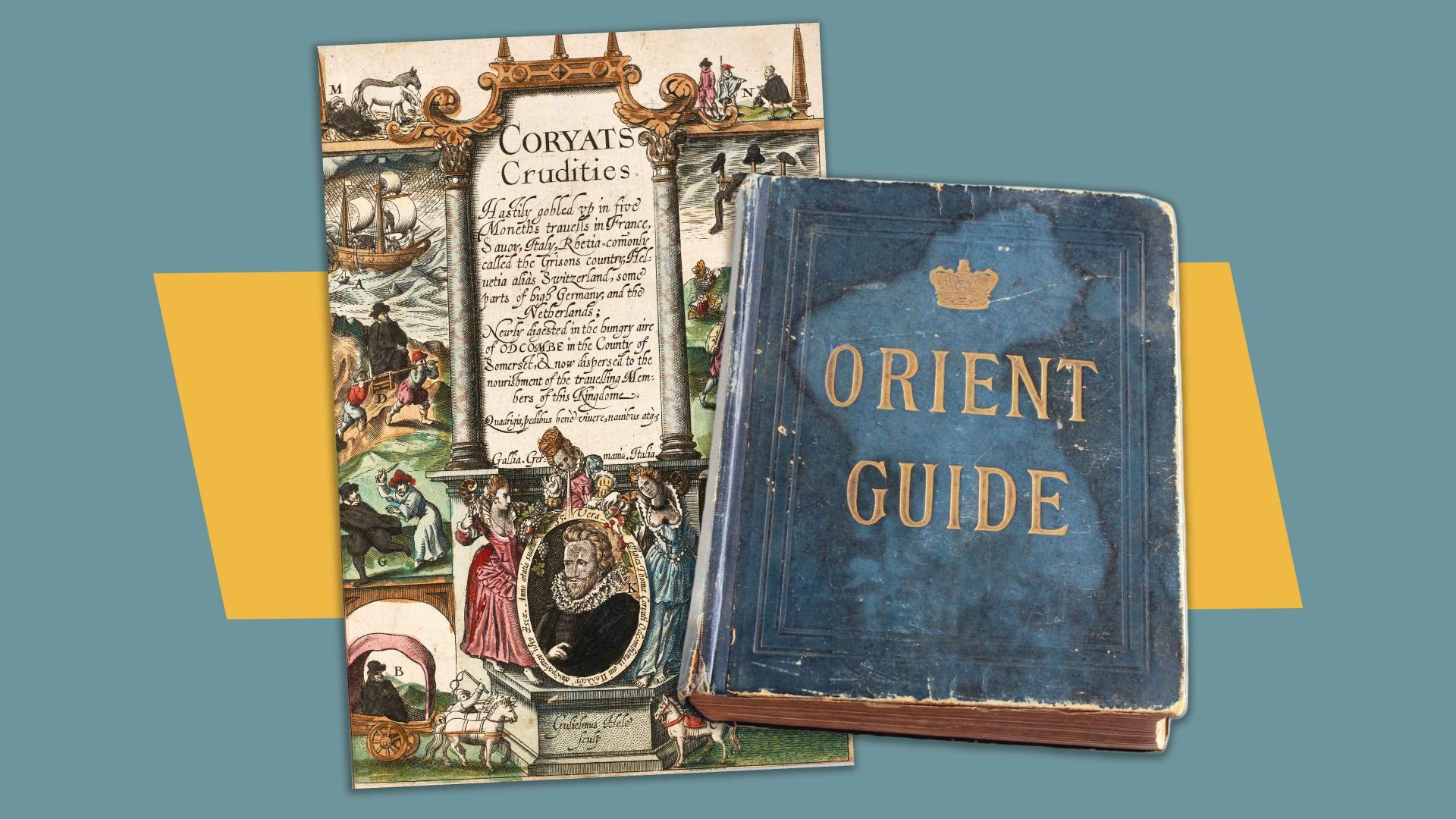
Some 19th-century guides for the general reader included advice about the best weapons to carry in dangerous regions, while WJ Loftie’s Orient Line Guide of 1888 featured an advert blithely recommending the health benefits of Lorimer’s Cocaine Lozenges for long ocean voyages, as praised by the Lancet (“a girl of 18 had been sea-sick 24 hours, and tried Cocaine, with ‘a truly magical effect’”). At times, simple possession of the volume itself might cause difficulties, hence the warning in the Baedeker Guide to Palestine and Syria (1906) advising caution approaching certain borders, as “the excessive zeal of the Turkish censorship sometimes even extends to the confiscation of guide books”.
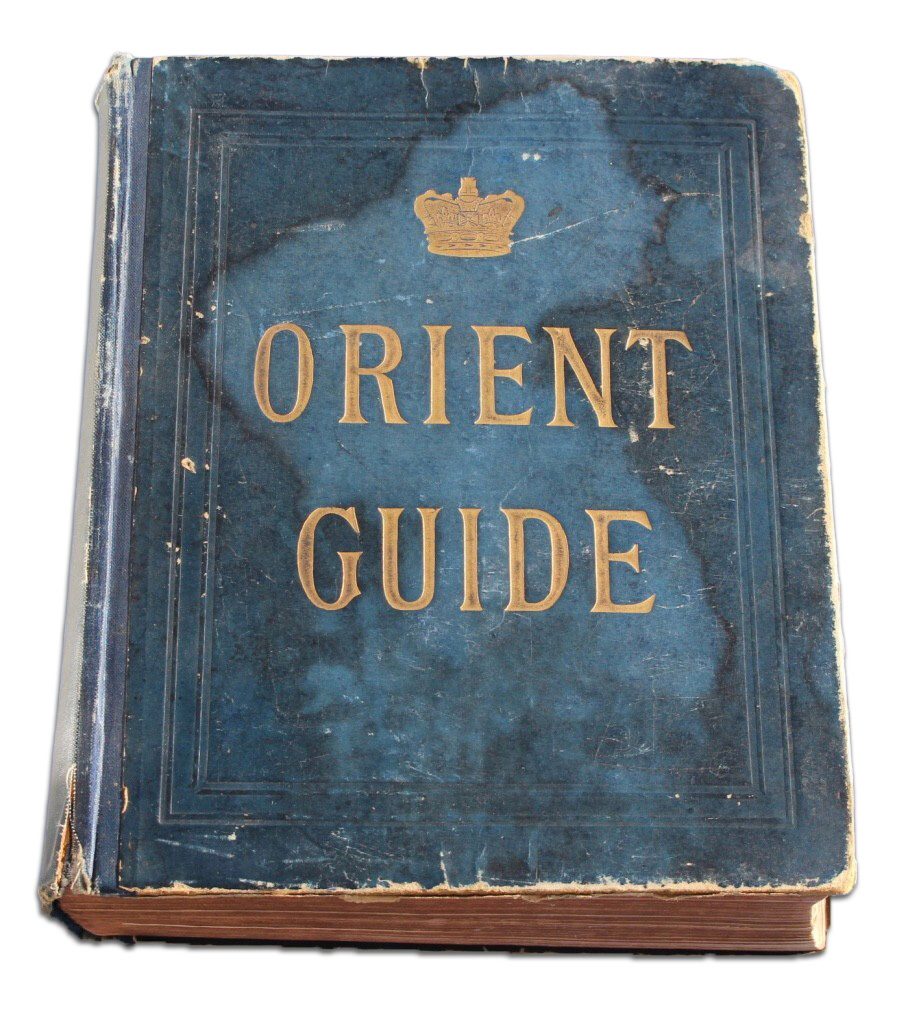
WJ Loftie’s Orient Line Guide of 1888 featured an advert blithely recommending the health benefits of Lorimer’s Cocaine Lozenges for long ocean voyages, as praised by the Lancet
The wealthy had long ventured abroad. Thomas Coryat, part of the inner circle at the court of James I, was a pioneer of English travel writing. In 1608 – around the time Shakespeare was writing Coriolanus – Coryat journeyed across Europe, largely on foot, then published an account of his trip in a landmark book, Coryat’s crudities: hastily gobled up in five moneths travells in France, Savoy, Italy, Rhetia commonly called the Grisons country, Helvetia alias Switzerland, some parts of high Germany and the Netherlands (1611).
His description of the rough seven-hour crossing from Dover to Calais suggests little has changed over the intervening 500 years, and he arrives in France “about five of the clocke in the afternoone, after I had varnished the exterior parts of the ship with the excrementall ebullitions of my tumultuous stomach, as desiring to satiate the gourmandising paunches of the hungry Haddocks”. Later, Coryat notes the “curious” habit of people in Italy to use a fork at meal times, “because the Italian cannot by any means indure to have his dish touched with fingers”, a reference that helped pave the way for the custom to be adopted here.
Over time, it became a rite of passage for young British aristocrats to set out on the Grand Tour – beginning in France and winding towards Italy with its many historical sites and artworks, supposedly acquiring a veneer of cultural polish along the way – but as they were generally accompanied by an experienced tutor, they had little need for guidebooks. The French revolution (1789-99), followed by the 12 years of Europe-wide chaos at the start of the 19th century caused by the Napoleonic wars, effectively prevented most Britons – apart from the military – journeying to those countries affected.
After Waterloo in 1815, however, everything changed. The renewed desire to venture abroad was accompanied and encouraged by an increasing number of travel-related books: British publisher John Murray’s Handbooks for Travellers series began appearing in 1836; Leicester firm Thomas Cook & Son organised their first European excursions in 1855; and in 1861, Germany’s Verlag Karl Baedeker began issuing English translations of its popular guides.
Anyone crossing over to France in the immediate aftermath of Napoleon’s defeat may have taken along the enlarged 1814 edition of Jean Perrin’s 1774 book, The elements of English conversation, with new, familiar and easy dialogues, each preceded by a suitable vocabulary in French, English, and Italian, which now enabled the carefree traveller to utter phrases like “wheedle your enemies”, “command obedience” and “bombard the city” in three languages. If heading further east, then Henry Robertson’s A concise grammar of the Modern Greek language (1818) offered a variety of possible greetings, ranging from “good day, sir” to “I salute you, handsome youth”.
Closer to home, the battlefield of Waterloo itself, south of Brussels in what was then the United Netherlands, became a tourist attraction for the curious and for souvenir hunters, despite being a mass grave where decomposing body parts protruded up through the soil. Indeed, there were those actively seeking human remains, harvesting teeth to supply the burgeoning demand for reliable dentures among the wealthy.
Whatever prompted the visit, some will have taken along Edmund Boyce’s 1819 publication, The Belgian traveller, or, A complete guide through the United Netherlands, which displayed a tendency common among early guide books to be less than flattering about the country under discussion, claiming that “in most of the towns of the Netherlands, the traveller must take care that he is not incommoded or half-drowned by the filth, which, in all, except the principal streets, and sometimes in them, the Belgic housewives throw without ceremony from their windows”.
Mariana Starke, an English writer who had spent time living in France and Italy between 1791 and 1798, returned to those countries in the wake of the peace. Her bestselling guide, Travels on the Continent: Written for the Use and Particular Information of Travellers, first published by John Murray in 1820, ran to multiple editions, and her familiarity with the territory lent an air of authority to her observations: “On revisiting Calais, in May 1817, after an absence of twenty years, I discovered no apparent change, either in the town or its inhabitants; except that the latter, at least the lower order of persons, have acquired a habit of smoking incessantly, like the Germans”.
As the century progressed, long-distance travel became more common. The maiden voyage in 1838 of Brunel’s 2,300-ton passenger steamship, SS Great Western, from Bristol to New York, significantly reduced existing journey times – welcome news for purchasers of George Henry’s The emigrant’s guide, or Canada as it is, published in Quebec in 1832.
The author warned prospective emigrants from Britain not to buy land sight unseen before travelling to the country, and also approvingly described how in 1827 the proprietors of three hotels overlooking Niagara Falls bought an old 400-ton sloop, loaded it with “two huge bears, two wolves, some raccoons, foxes, deer, pigs, geese, &c.” and sent the vessel crashing over the falls in order to drum up publicity and boost tourism – an unthinkable idea today. It certainly drew a crowd, with an estimated 10-12,000 people from all over Canada and the US witnessing what the author called “a very singular and interesting spectacle”. The two bears sensibly jumped ship before the boat went over, but all other animals except for a single goose perished. Different times indeed.
The Atlantic traffic naturally flowed both ways, and the anonymous author of a New York publication entitled London in 1838 by an American celebrated the advent of the fast new steam ships. He was less impressed, however, by the working-class drinking establishments he found upon arrival, claiming that “it would injure a young man’s character and standing in London, if it were known that he frequented a public house”. Such assertions are perhaps unsurprising given the rise of the US Temperance movement at that time, but would have met with open derision from any of those Londoners who happily visited these establishments to engage in what the author also termed “the depravities of the lower orders”.
Despite the occasional unhappy wanderer such as this, the later 19th century provided ever more opportunities for those eager to observe the supposed depravities of a range of other countries. There were guide books to South Africa (1875, which spoke of the “long-continued struggles of the settlers with hostile native tribes”), an English/Hawaiian phrase book (1881), and an emigrant’s guide to Western Australia (1898, alerting would-be farmers to “pests such as dingoes, boodie rats, opossums, eaglehawks &c.”).
Suggested Reading
The secret lives of Agatha Christie
Even faraway destinations like Japan began opening up to international tourism, building western-style establishments like the Club Hotel in Tokyo, which proudly proclaimed in John Murray’s Handbook for Travellers in Japan (1890) that “the ELECTRIC LIGHT is laid on in all rooms”. The book also included a glossary of useful phrases in English and Japanese, such as “I suppose you haven’t any bedsteads, have you?”, “Can you give us European food?”, and “Have you any beer?”
Clearly, the age of the world traveller was close at hand, one of the many eventual by-products of which was the 1970 Monty Python sketch about a mischievous Hungarian/English phrase book that leaves a hapless tourist uttering random statements like “I am no longer infected” and “my Hovercraft is full of eels” while trying to buy cigarettes. Countless rather more well-intentioned guides and glossaries than this have appeared since Thomas Coryat first crossed the Channel, but how their inherent assumptions and opinions will be viewed by future generations is impossible to say.
Max Décharné is a musician and author of 10 books including Capital Crimes: Seven Centuries of London Life and Murder