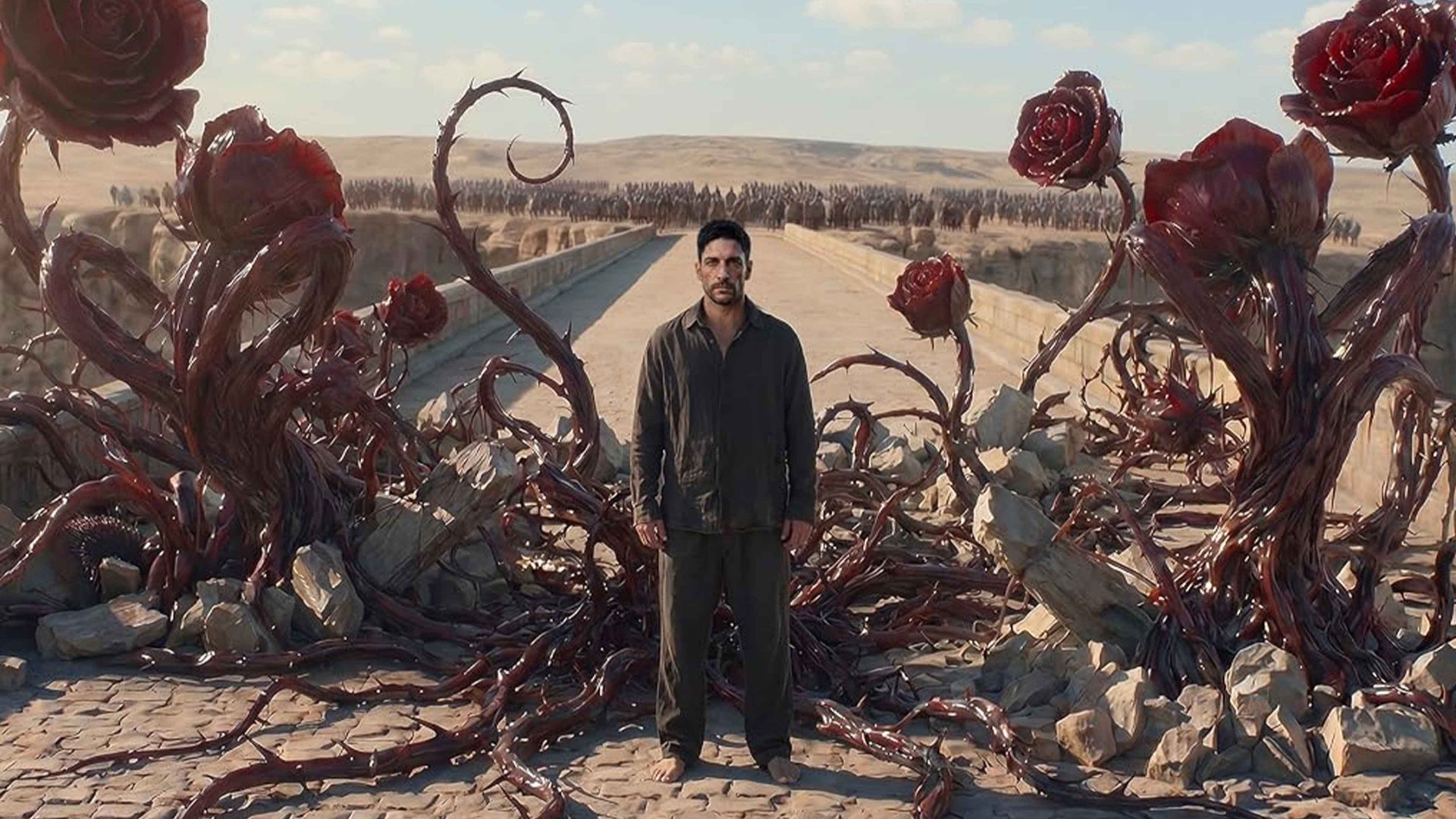
We open to a tight shot of a bird of prey, caged, staring into the camera lens as it bounces rhythmically against the flank of a horse in full gallop. It is, we are told, 1090AD, and we are in what is now Iran.
We cut to an aerial view, framing a narrow bridge connecting a mountaintop fortress to a high plateau, across which three horses bear their riders at speed towards the imposing citadel walls.
We cut again, now seeing the entrance to the fort as the riders trot through the gates. One, two, three mounts enter into shot. And then, inexplicably, a fourth one ambles after them, invisible in the previous scenes but now just sort of… there. Where did it come from? Why? Who cares, just drink in the visuals!
Welcome, then, to the exciting new world of fully-AI filmmaking, in the shape of Castle Walls, a Turkish production streaming on Amazon Prime which, in two 15-minute episodes (it calls itself a “series”, which feels generous), presents a thrilling historical story about real-life historical fortress Alamut Castle.
The project was written by Turkish television writers Kerem Deren and Çisil Hazal Tenim, but while the storyboarding and the dialogue is human-crafted, all the visuals are the product of generative AI.
Amazon is claiming this as a “world first”. It is being billed as “the first fully AI-generated long-form television production to premiere on a major global streaming platform with a worldwide release, including the US”. But, having dutifully sat through all 30 minutes of it, it’s hard not to feel that this is a novelty we could probably have done without.
Suggested Reading


AI has made a genuine breakthrough
It’s true, AI video is improving at a staggering pace. No longer must viewers contend with hands sporting non-standard quantities of fingers, or mouths that move like those of ravers four-pills deep. But still, there’s no disguising the issues with Castle Walls.
No shot lasts longer than 10 seconds, due to limits in AI’s ability to maintain consistency over longer durations. Everything has a vaguely-HDR sheen, like overprocessed photography. Armour is decorated with pommels and curlicues in one shot, unadorned in the next. Characters are incapable of looking directly at each other. Physical actions have no heft, no weight, and the whole thing looks slightly as thought it’s been shot in 95% gravity.
Also, a good 10% of scenes appear to be lifted directly from the Assassin’s Creed videogame franchise (a recent instalment, “AC: Mirage”, features scenes set in Alamut). At least one principal character looks like a beauty-filtered version of Sean Connery who’s really gotten into beard treatments.
The main issue, though, isn’t the AI so much as the fact that the plot, dialogue and shot selection – all of which are the responsibility of the humans in the loop – just completely suck. The plot is, to this viewer at least, incoherent. There’s a mass suicide. The whole thing ends with some sort of weird blood triffids. The dialogue is risible, eg: “I can’t stop loving you just because you have become an evil man!” and the shot selection is very clichéd.
It doesn’t make huge amounts of sense. I am willing to concede that there may be huge swathes of history and mythology which I am missing, but it seems unlikely, in short, that Castle Walls is set to trouble the Emmys come 2027.
Suggested Reading


The tech bros’ wager on AI doesn’t make any sense
Still, it’s also not hard to shift the feeling that we might not be able to laugh at AI-generated films for that much longer. While the “thinking and coding” part of the AI arms race is (this week, at least) being dominated by Western models, AI video is pretty much the preserve of the Chinese at this point.
Models such as Kling, Seedance and Hailuo are all astonishingly good and can now render up to 30 seconds of video with incredible fidelity, and, thanks to China’s unique interpretation of western copyright laws can spin up pretty much anything you like in minutes if you have access to enough processing power to run them.
Which is how last month saw an actual, full, AI-generated feature film appear in the wild. Part of a promotion by San Francisco company Higgsfield (which lets users seamlessly switch between the aforementioned Chinese video models within a single interface), “The Cully Hill Boys” is a sub-Guy Ritchie gangster caper starring a couple of influencers and an MMA fighter, and while it’s equally unlikely to come away from awards season festooned with gongs, it’s also not bad.
Made by taking the influencers’ real likenesses and voices and using them as source material, with dialogue written by someone who has at least a passing acquaintance with how cinematic pacing is supposed to function, the resulting 110-minute feature is a reasonably-diverting knockabout caper that is certainly no worse than what you’ll find lurking three scrolls into Netflix – and while it’s hardly as simply as “type in prompt, get film”, the fact it was made in under four weeks by a team of just 28 people feels significant.
Elsewhere, a creator called Gossip Goblin is branching into short films with 20-30 minute efforts exploring a strange, cyberpunk-horror future with a very particular (and effectively unpleasant) aesthetic, but with human scriptwriters and voice actors still underpinning the outputs.
Meanwhile, someone has for a couple of years now been developing a surreal, comic universe of characters and sketches based around pink-haired musician Trisha Code, which channels the spirit of the sort of variety programmes you used to watch in the 90s and features original (human) music and sketchwriting performed by a cast of AI-generated characters.
In the hands of people who can write dialogue, craft scenes and tell stories, AI video is now good enough to produce stuff worth watching, and not just through your fingers. While questions of what the models are trained on and how ethical their use is are unlikely to go away, it’s also clear from recent legal filings that the copyright question is unlikely to come out in favour of artists anytime soon.
In the meantime, anyone with an idea, a script and a few grand to burn on Chinese AI credits can make something which as little as twelve months ago would have been impossible without significant training, nine months of work and five figures of budget. Castle Walls might be the world’s first slop series – but someone else is going to make something great soon, and then we’re really going to have to take notice.