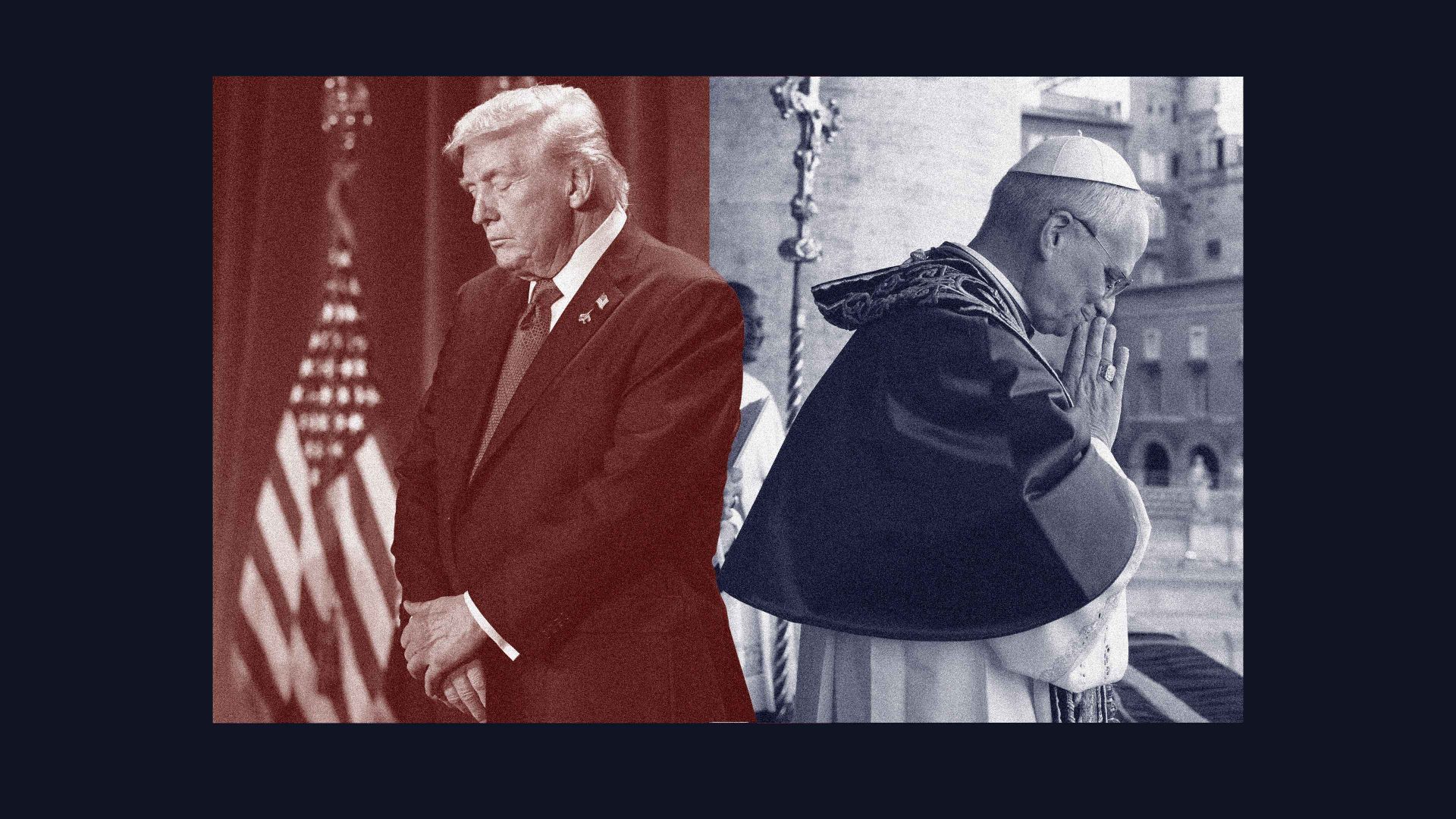
For many rational human beings, watching the news at Easter 2026 felt like surviving a bad acid trip: a US president who claimed divine patronage for the threatened annihilation of an entire civilisation; his Catholic VP’s dark hints of a nuclear Armageddon and his evangelical secretary of war’s new spin on the rescue of an F-15 pilot as a Resurrection parable linked directly to Jesus Christ.
These scenarios were surreal even by Trumpian standards.
And yet the reality is that Donald Trump’s incendiary warning to Iran was the culmination of an extraordinary few months in which religion has been invoked with increasing and unprecedented ferocity in American political life, the scriptures used to sanction violence and even to boost troop morale.
Pete Hegseth, boss of the renamed department of war, used a Christian worship service in the Pentagon to pray for “overwhelming violence of action against those who deserve no mercy” and that “every bullet hit its target”. His tattoos, a Jerusalem cross on his chest and Deus Vult, (“God wills it”) on the right bicep are both associated with battle cries from the Crusades. (The ink on his right, inner forearm – “kafir”, meaning “infidel” or “nonbeliever” in Arabic – is an insult to Muslims and is seen publicly rather less than the others.)
Disturbing religious rhetoric also coloured the prayers of the motley group of evangelical pastors who enjoy Trump’s ear and confidence. At a White House event in the lead-up to Easter, Paula White-Cain, a TV evangelist and senior adviser to the ‘White House Faith Office’, likened Trump to Jesus Christ no less, suggesting both men had been “betrayed, arrested and falsely accused”.
Her colleague, Robert Jeffress, an influential conservative Texan pastor who was first among the group to lay hands on the president, later told media that he did not see the Iran conflict as a war against Muslims or Islam, but rather as a “spiritual war, between good and evil, between the Kingdom of God and the Kingdom of Satan”.
Donald Trump is, of course, not the only US president to have invoked the Christian faith at a time of war. From George Washington, who used religious practice to encourage his soldiers and attributed military success in the Revolutionary War to “providence”, to Eisenhower, who called the Soviet Union “godless” during the cold war, faith-based justification has played a part in political rhetoric in times of conflict.
However, according to an increasing phalanx of political and religious critics, the sheer savagery of the language used to justify policy and military decisions through a religious lens by the second Trump administration is truly unique in American history.
The American History professor, John Fea, author of Believe Me: The Evangelical road to Donald Trump, writes that this use of rhetoric aimed at framing political opponents and disagreement as battles between ‘good and evil’ – God and the Devil – has long been used to fan and nurture civilian fear.
However, what we have witnessed in the past weeks since the conflict with Iran, he told Reuters, is the language of the crusades of the Middle Ages: “You know, ‘stop the infidel, defeat the wicked’… we have never seen anything like this in American history”.
White evangelical voters provided crucial support for Trump in the election that won him his first term in 2016. Exit polls at the time suggested that more than 80% threw their weight behind him, seeing his presidency as an opportunity to defend their religious freedoms, appoint conservative judges and champion their values in the so-called ‘culture wars’. Trump was even portrayed openly by some highly influential pastors as divinely chosen, his populist, nationalist messages aimed squarely at those who felt most marginalised by traditional politics.
And while this group are still among his strongest supporters in the second term, Pew Research Centre has this year documented a measurable decline in white evangelicals’ positive views of Trump and a much smaller share – now 40% – say they are ‘extremely’ or ‘very confident’ that Trump acts ethically in office.
An Ipsos poll this month widened this disaffection to show that an overwhelming 66% of all American voters do not support the war in Iran and believe the Trump administration should work toward an immediate end to the conflict no matter whether it has achieved its goals.
Suggested Reading
The God delusions of Jeffrey Epstein’s secret brotherhood
This highlights the political reality for the Republican administration – that for voters, the downside risks of the conflict are much more salient than the potential benefits. And considering that less than one third of Americans are on Trump’s side over Iran now – and a big part of that constituency will be white evangelical Christians – it provides the most obvious explanation for why Trump and his cabinet are ramping up and embracing more and more a religious framing of the war.
Easter has also shown that Evangelical Christians are not the only thorn in Trump’s electoral side. Pope Leo XIV, who began his papacy nearly 12 months ago with a decidedly soft-spoken diplomacy toward his mother country, used Holy Week to make his most pointed, direct and robust criticisms of the Trump administration.
Quoting Isiah, he carefully singled out Hegseth’s inflammatory language and prayers: “Even though you make many prayers, I will not listen: Your hands are full of blood.”
And in his Urbi et Orbi sermon (“to the city of Rome and to the world”), Leo departed from Easter Sunday tradition and rather than listing the many places around the globe engulfed in war, he made a direct plea for peace.
“Let those who have weapons lay them down!” he implored. “Let those who have the power to unleash wars choose peace!”
As many commentators have pointed out in recent years, the relationship between Roman Catholicism and America has never been an easy one. The Pilgrim Fathers were Protestant Separatists; a radical faction of Puritans who believed the Church of England was too corrupt for reform and wanted to create a bible-based society in the New World.
An aversion to papal authority was also ingrained in the DNA of the freshly constituted United States, while the influx of Catholic migrants from Ireland and Europe in the 19th century increased tensions and at times also led to anti-Catholic violence. While diluted over the past century, Catholic Americans largely represented a working-class demographic, and it meant that ultimately, they wielded minimal political clout.
And yet this has slowly changed over the last 50 years. The ranks of conservative, elite America have steadily become more Catholic, and not just in the political class but also among its intellectual elite.
Six of the nine sitting Supreme Court justices are Catholic, and several of the so-called ‘post Liberal’ New Right thinkers who have helped reshape American conservatism from free-market orthodoxy to a state oriented toward the Catholic “common good” are Catholic. Among them, Patrick Deneen, author of the influential Why Liberalism Failed and Regime Change, and Ross Douhart, the New York Times columnist who consistently argues conservative, Catholic social views. Adrian Vermeule, the Harvard professor and advocate of Catholic social doctrine guiding the state, is another significant American Catholic voice.
In the White House, there is vice-president JD Vance, a baptised adult convert who calls himself a “baby Catholic” while secretary of state Marco Rubio was raised Catholic from infancy.
In 2024, poll analysis showed that Trump’s electoral showing among several religious voting blocs were pretty similar to that seen in 2020 when he lost to Joe Biden. The key difference lay with the Catholic vote, which Trump won by a margin of 54% to 44% over the Democrat nominee and Vice President, Kamala Harris. This was explained principally by the racial divide among Catholic voters with an estimated 60% of white Catholics supporting Trump and a similar percentage of Latino Catholics throwing their weight behind Harris.
The US scholar John Kenneth White observed in the wake of Trump’s election, that his “performance with Hispanics was the best [for a Republican] since George W. Bush in 2004”. A CNN exit poll also uncovered a gender gap among Latino voters, with Latino men favouring Trump 54% to 44%. This represented a big shift from 2020 when Joe Biden won that demographic by 59% to 36%.
This high level of Catholic voter unity despite the gender hiccups had not been seen since they elected John F Kennedy, America’s first Catholic president in 1960.
As a microcosm of the nation itself, Catholic voters count liberals, moderates, and conservatives among their ranks. But the steady rise of conservative Catholicism in the US is reflected starkly in the 12-year war waged against the late Pope Francis, who was targeted by traditionalist bishops and cardinals over his reforms on LGBTQ+ inclusion, for his restrictions on the traditional Latin Mass, church attitudes to divorced couples and a focus on social justice rather than pure theology and doctrine.
The Conclave’s election of Chicago-born Pope Leo XIV, the first American Pope in history, was also helped by the behind the scenes lobbying work of key, conservative American cardinals like New York’s Timothy Dolan who rallied support and threw their weight behind a pastoral candidate they believed would unite disparate factions and become a ‘bridge builder’ between the western and developing worlds.
Suggested Reading
God is back… and He’s trending
That said, Easter provided another powerful reminder that Hegseth’s brand of so-called muscular Christianity is wearing very thin when Archbishop Timothy Broglio, a well-known traditionalist with impeccable conservative credentials, chose to appear on CBS’s flagship Face the Nation show on Easter morning.
Now Pope Leo’s archbishop for the US military services and the cleric responsible for the spiritual welfare of the 200 or more priests who minister to Catholic American troops, Broglio did not mince words. “I do think that it’s hard to cast this war, you know, as something that would be sponsored by the Lord,” he said.
But perhaps the most extraordinary event of this bizarre Easter emerged via The Free Press, a right-leaning digital platform founded in 2022 by Bari Weiss, the former New York Times journalist who is now editor-in-chief of CBS News. In a detailed piece of reportage, Italian journalist Mattia Ferraresi reconstructed a meeting between Cardinal Christophe Pierre, Pope Leo’s ambassador to the US, who was summoned to the Pentagon by under-secretary of war for policy, Elbridge Colby in January.
Colby’s message to the Pope’s messenger – described as “pure Mob” by the Catholic commentator, Christopher Hale – was simple and to the point: America has the military power to do whatever it wants in the world – and the Catholic Church better take its side.
During the same meeting, astonishingly, Pierre was reminded by the US official of the Avignon Papacy – a bloody moment in the history of Catholicism when the French King Philip IV sent his troops to Anagni to bring back Pope Boniface VIII. The old Pontiff was humiliated, beaten and died weeks later of his injuries while the French forced the papacy into a 70-year captivity in Avignon.
Asked about the meeting and the implicit threat to the Catholic Church and the Pope while on his mission to Budapest to support Viktor Orbán, Vance did a House of Cards. “I think it’s always a bad idea to offer an opinion on stories that are unconfirmed and uncorroborated, so I’m not going to do that,” he said. In other words, “you might say that, but I could not possibly comment”.
The White House later denied The Free Press version of events, while the Vatican Press office confirmed that discussions had been held about “issues of mutual interest” but said, enigmatically, that some accounts of the meeting did not “correspond with the truth”.
For many religious commentators, Easter this year marks something of a miracle. Donald Trump, it seems, has achieved the impossible: a rapprochement between the conservative and progressive arms of the Catholic Church in America, a feat that even Pope Leo, tasked by the Conclave to build bridges, would not have dared to dream. The problem for the president is that they are all stacked against him.
The Throne and the Altar: the untold story of war in the Vatican by Paola Totaro and Maria Antonietta Calabrò will be published by Allen and Unwin in February 2027.
 Most popular
Trump has devastated Iran – and damaged himself
Here's what Zelensky really thinks of JD Vance
A Green wave is ready to wash away Labour London – and this is why

Exclusive: New Ofcom chair appointed – but will he fix Musk and GB News?