In his 1986 book, The Drowned and the Saved, Primo Levi wrote of how fellow Holocaust survivors remembered being plagued by recurring dreams during their imprisonment in concentration camps. In those dreams, they dared to imagine emerging from their living hell to tell all about what they had endured and witnessed. Their dreams then curdled into nightmares when they found themselves struggling not so much to be heard as to be believed, such was the enormity, and barbarity, of their ordeal. “In the most typical (and most cruel) form,” noted Levi, “the interlocutor turned and left in silence.”
One interlocutor who listened intently to the stories of survivors was the French film-maker and journalist Claude Lanzmann (1925-2018). A year before the publication of Levi’s book, Lanzmann’s documentary film Shoah was released. Twelve years in the making, more than nine hours long and composed of numerous interviews with victims, perpetrators and eyewitnesses, Lanzmann’s monumental work constituted an in-depth study of the Nazi genocide of six million Jews.
The film contained no distracting archival images. Lanzmann’s focus was on testimonies: allowing interviewees to speak out and their words to ring true.
To mark Lanzmann’s centenary, and to chime with the 40th anniversary of his groundbreaking film, the Jewish Museum Berlin made the audio archive of Shoah accessible to the public for the first time. Claude Lanzmann: The Recordings is a singular exhibition. Visitors use headphones and screens to explore a wide range of conversations Lanzmann and his team conducted and recorded on cassettes in various countries in the 1970s in preparation for the project the film-maker called “an inquiry about the Holocaust”. The audio accounts, each of them utterly absorbing, document both individual upheavals and collective trauma.
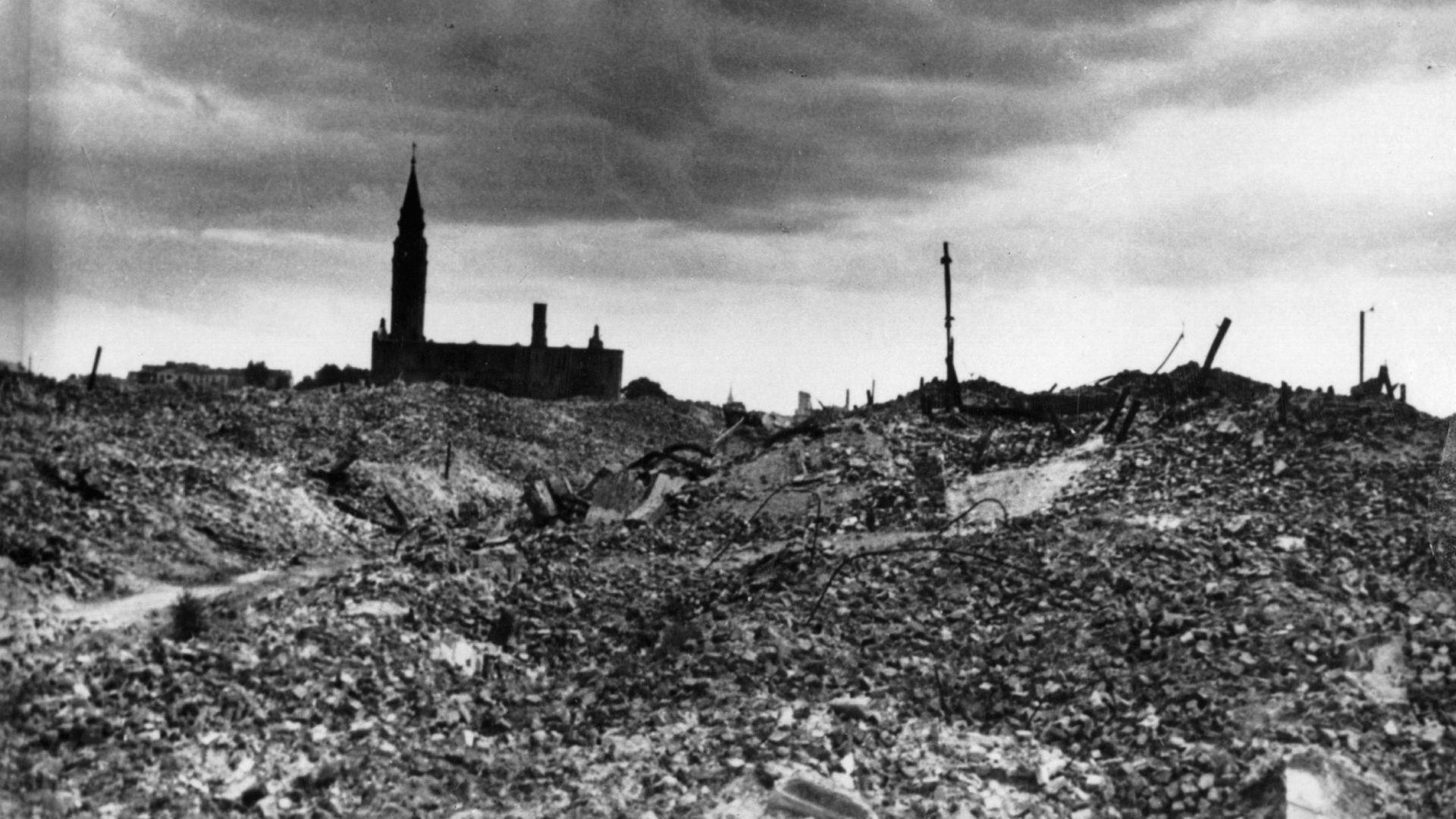
Several recordings concern life and death in ghettos. Wolf Pesachowitz, a doctor and inmate of the Šiauliai ghetto in Lithuania, recalls being forced to perform abortions there from 1942 when births were no longer permitted. He saw this as the Nazis pursuing an alternative means of solving the Jewish problem: “Instead to kill them, don’t let them to be born [sic].”
Władysław Janicki, a lawyer who became a member of the Polish underground, remembers the liquidation of the Siedlce ghetto, which lasted three days. Young boys who climbed on to roofs, believing they were scrambling to safety, were shot “like pigeons”.
Suggested Reading
My picks of the week: Sextortion, Trump and the world in chaos
Another Polish lawyer, Andrzej Modrzewski, describes a grim street scene.
“I was going to Lublin. I met a column of Jewish workers, dressed in the clothes that you got in Majdanek. A death march. And they were singing. They were probably forced to sing.” Modrzewski says that as the workers filed back to the camp, he noticed four of them carrying a shattered, half-dead man by his hands and feet. Modrzewski looked on, powerless. “We couldn’t do anything.”
But other individuals could and did. We learn about Hermann Gräbe, who was cast from the same mould as Oskar Schindler. After witnessing massacres by Einsatzgruppen, or mobile killing squads, in Nazi-occupied Ukraine, Gräbe hired Jews to work in his construction company, and in doing so saved many lives.
One woman he rescued, Maria Bobrow, speaks of her gratitude to Gräbe, but also about her altered mindset after her husband and hundreds of others were rounded up, killed and thrown into a mass grave. “This was the day when I stopped being afraid,” she says. “I went through the war without much fear after that one day.”
Some persecuted Jews who continued to live in terror were offered salvation when Bobrow recruited them. Those she couldn’t save were murdered 50 metres away from her workplace. She went on to be a key eyewitness at the Nuremberg trials of former Nazi leaders after the war.
After Gräbe gave his account of Nazi atrocities there, he was vilified and forced to emigrate to America. “The Germans hated him more than anyone else because he was the only German who testified at Nuremberg,” reveals Bobrow.
In one standout recording, Ilana Safran talks at length about her deportation from the Netherlands and her gruelling time in Sobibor extermination camp built by the Nazis in Poland. It is a miracle she lived to tell her tale: one that involved a three-day journey in cattle-wagons, the cruel selection process on the camp platform (“generally, they chose blonde girls”), back-breaking forced labour and a perilous escape following a prisoner uprising in 1943. She testified at the Sobibor trial, but it required considerable effort to look at the former camp guards to identify them.
Lanzmann, on the other hand, wanted to look these men in the eye and record their version of events for his film. A section devoted to the perpetrators proves both enthralling and frustrating. Lanzmann and his assistants visit war criminals at their homes but, perhaps unsurprisingly, many conversations end on the doorstep.
An ex-railway official is too busy to talk about his role in the transports to Auschwitz. A former SS corporal at Treblinka declares that that chapter of his life is over for him. Equally infuriating are the potted biographies that tell of acquittals, pardons and early prison releases.
However, Lothar Fendler, deputy commander of an Einsatzgruppe that carried out massacres in Ukraine, makes for a grimly fascinating character study. Instead of a tearful confession, his testimony is an artful blend of sly evasion and shallow justification.
“In this huge system, I am really just a very, very small man,” he whines. “For 37 years now, I’ve had to try to come to terms with these things somewhere deep inside that have traumatised me, too. So many people died, didn’t they? They died in horrible circumstances, yes? That’s just how it was. But it also robbed me of my livelihood. I have struggled.”
Claude Lanzmann: The Recordings is no substitute for actually watching Shoah. The exhibition only scratches the surface of what the film catalogues. However, it serves as a useful primer. It is also a valuable companion piece, as it contains interviews and covers topics that didn’t make it into the final film.
Suggested Reading
Locked up and written off: The prison photos of Jane Evelyn Atwood
Along with the audio recordings, the exhibition displays items from Lanzmann’s private archive – letters, lists, notes, photos, itineraries – which offer insight into his research methods. In a section on Lanzmann, the film-maker outlines his reasons for undertaking his mammoth project.
“If the people who were involved in this, if they refuse to talk, if they say ‘let’s forget it’, then in 20 years the whole story will become completely untrue. The people will say this never existed.”
Denial and disbelief were prevalent in Poland during the 1970s while Lanzmann was carrying out his interviews. Berek Rojzman, who escaped the gas chambers in Treblinka when an acquaintance hid him in a pile of clothes, tells Lanzmann: “People think that it’s a lie, that it’s not true.” His dreams are worse than those of the survivors in Levi’s book. “Even I sometimes, when I’m in bed, when I think about it… It must have been a nightmare. I don’t believe it myself any more.”
In one section, Bobrow discusses with Lanzmann the function and value of survivors’ testimonies. “It’s like a pile of stones and everybody brings a little pebble and puts it down. And I hope I brought a little pebble. And then from that stone you have to build a house,” Bobrow says. A grateful Lanzmann replies: “You help me to build the house. I don’t know what kind of house it will be.”
The end result was, for the most part, a house of horrors. But Shoah was also a momentous artistic endeavour that shone necessary light into unremitting darkness. The exhibition may be on a smaller scale to that of the film, but its subject matter is by no means diminished. Lanzmann’s interviewees articulate immense pain and suffering. We listen, rapt.
Claude Lanzmann: The Recordings is at the Jewish Museum Berlin until April 12
Malcolm Forbes is a writer and critic based in Edinburgh