“Congratulations darling, I am so happy I can’t stay still.”
I stared at Kasra’s message on my phone. Hours earlier, I had texted my best gay friend in Tehran as soon as I saw the news of the joint US–Israel attack on Iran. Later came the unthinkable: reports that Iran’s supreme leader, Ali Khamenei, was dead.
My “Are you OK?” message never delivered. Another internet blackout had descended. And then, his message came through.
“I paid for an expensive VPN, but not sure how long it will last,” he added.
To many outside Iran, celebrations at the news of war on the Islamic Regime may look grotesque. War is never clean. Bombs do not distinguish between the guilty and the innocent. Every civilian life lost is a tragedy.
But to understand why some Iranians are celebrating, you have to understand what came before.
For decades, the Islamic Republic justified itself as a moral correction to the monarchy it replaced, sanctified by Allah himself. The Shah was branded bloodthirsty for ordering open fire on protesters against him. Estimates suggest that between roughly 500 and 2,800 people were killed in the year leading up to the 1979 revolution.
Fast forward to the nationwide protests that began in late December 2025 and peaked in early January. By the government’s own figures, 3,117 people were killed in just two days. Independent reports placed the real number far higher, in the tens of thousands. Videos of rows of body bags flooded the internet.
Even if one accepts only the regime’s numbers, they killed more people in 48 hours than were killed in an entire year before the 1979 revolution. The breaking point did not come overnight. It was built over 46 years.
When Ayatollah Khomeini stepped off an Air France plane in February 1979 and returned from exile, he went straight to Tehran’s Behesht-e-Zahra cemetery. There, he promised free water, free electricity, free public transport.
Crowds shouted “Allahu Akbar” with hope. Few imagined that within a decade, many of their basic freedoms would be stripped away under a new theocratic order.
Women were forced to cover their hair. The morality police patrolled the streets. Gay men have been executed under Sharia law. A vast religious-legal system embedded itself into daily life, regulating dress, behaviour, relationships, and speech.
We tried to change things from within. We participated in carefully managed elections, choosing between “state-approved” candidates. When reformist Mohammad Khatami, a cleric, became president in 1997, a glimpse of hope appeared. Change felt possible.
But real power did not sit in the presidency. It sat with the supreme leader.
After Khomeini’s death in 1989, Ali Khamenei gradually upgraded the role. What once appeared symbolically austere became institutional and expansive.
His office grew into a network of loyal institutions intertwined with the Islamic Revolutionary Guard Corps (IRGC), which became both military force and economic empire. Authority was no longer merely spiritual; it was infrastructural.
Suggested Reading
Iran’s war strategy – to create chaos
In 2009, when Mahmoud Ahmadinejad was declared the winner of a disputed election for a second term, millions of us took to the streets. The Green Movement was born. I marched shoulder to shoulder with strangers who felt like family.
Then Khamenei appeared at Friday prayers, a keffiyeh draped over his shoulders. His voice broke as he spoke of his age and fragility. Some in the crowd wept with him. And then he delivered the warning: anyone who continued protesting would face consequences.
The crackdown followed. Neda Agha-Soltan was shot in the street. The video of her final moments spread across the world. Sohrab Aarabi, a young protester, became another name etched into national grief. Reports of torture and rape in detention emerged. The message was unmistakable: dissent would be crushed, and that crushing would be sanctified.
We tried again in 2022 after Mahsa Amini died in the custody of the morality police, detained for “improper hijab.” The slogan “Woman, Life, Freedom” echoed from city to city. Once again, arrests. Once again, executions. Once again, grief.
And then came December 2025. Economic collapse pushed even the poorest provinces into the streets. This time the regime did not calibrate its response. It annihilated.
Khamenei labelled protesters “rioters” and “enemies of religion,” framing their deaths as religiously justified. In two days, tens of thousands were gone.
When people have exhausted reform, endured massacre after massacre, and watched every peaceful avenue blocked, something inside them shifts. Fear gives way to exhaustion. Exhaustion turns into a quiet, desperate hope for rupture.
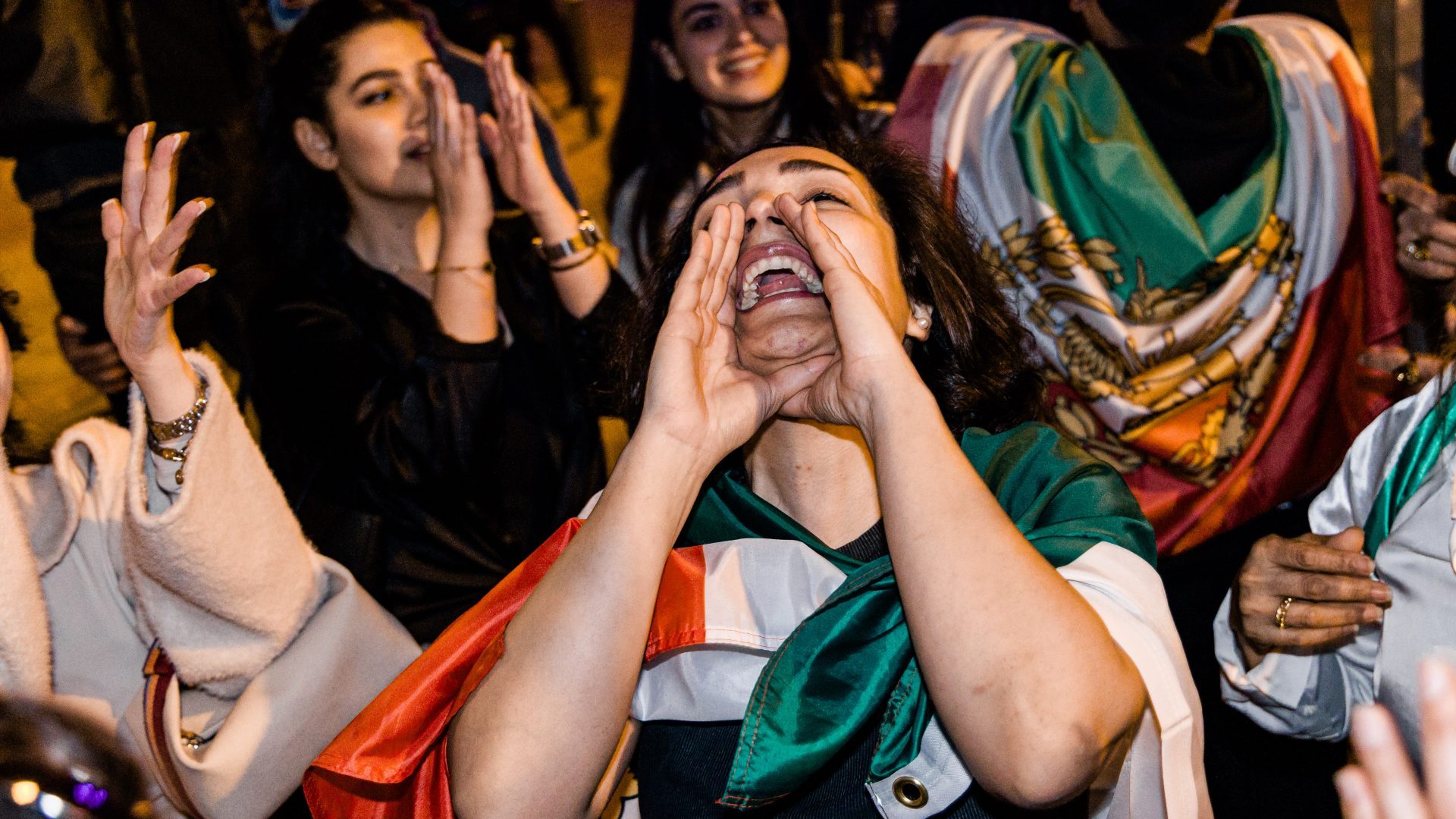
So when Kasra wrote, “Thank you Israel and America,” and told me he wanted to run into the streets and scream and dance, I believed him. I wanted to join him, even though I knew bombs were still falling.
He is not celebrating bombs. He is not celebrating death.
He is celebrating the possibility that women may choose how to dress. That being gay may no longer be punishable by execution. That protest may not be answered with bullets. That power may no longer be shielded by divine decree.
The future is uncertain. But for those who have lived under a system that answered chants of “freedom” with gunfire, the fall of that system does not feel abstract. It feels like air.
For the Nedas. For the Mahsas. For the Sohrabs. For the countless others whose names never reached headlines. I wish they lived to see the day where the headline “Khamenei is dead” flashed on TVs.
That is what some of us are celebrating. Not destruction, but the fragile possibility of something different.
The Ayatollah’s Gaze by Majid Parsa it out now (Wilton Square Books, £16.99)
 Most popular
‘Operation Epic Fury – as it happened’
Is Star Wars dead?
Morrissey returns.. and heaven knows he’s mythical now

Iran War: Trump has now sealed his own fate