When governments weaponise the law, first they come for the journalists. It is cheaper and quicker to silence the messenger than confront the message; media ranks are thinned through arrest, intimidation, violence and exile.
When that no longer works, attention shifts to the lawyers who represent journalists. The jailing of human rights lawyers marks the point at which the mechanisms designed to manage dissent are no longer sufficient.
It has been happening for years in Pakistan, in the case of journalists such as Asad Ali Toor, whose reporting brought him into conflict with a state that is unwilling to tolerate criticism.
By the time the lawyers themselves are targeted, however, the issue is no longer about individual cases, but institutional control. That transition – from journalist to lawyer, messenger to mechanism – is evidence of a state running out of room for manoeuvre, increasingly reliant on coercion and rejecting all oversight.
Physical attack, detention without charge, collective punishment of families, travel bans, frozen finances, disappearances, and sometimes worse, form the repertoire of repression.
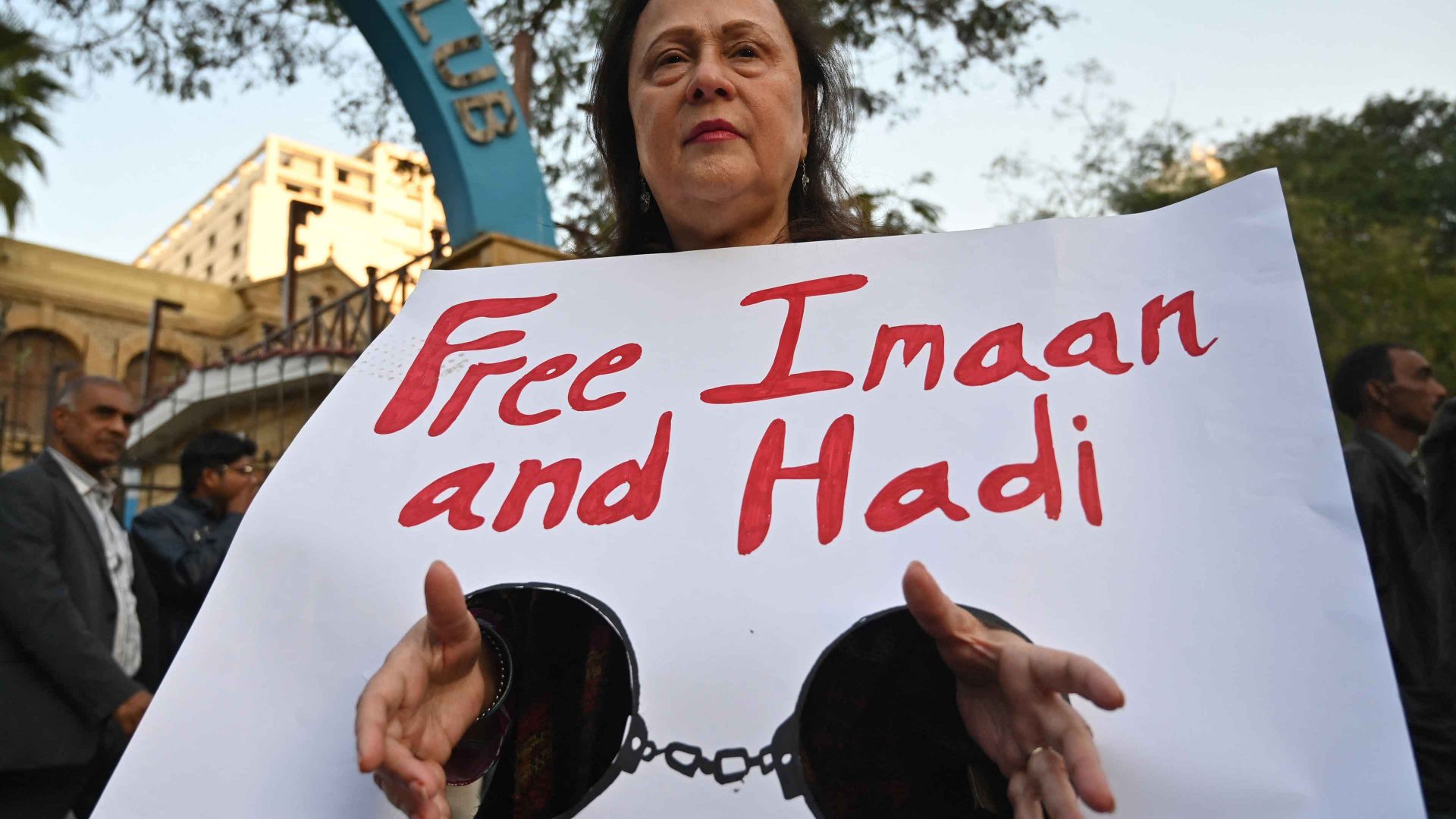
Pakistan has reached a point where courts no longer test and limit power according to the law, but act as extensions of the state. That is the context in which two human rights lawyers who for years represented journalists targeted by the state, including Asad Ali Toor, have been jailed. Imaan Zainab Mazari-Hazir and Hadi Ali Chattha were each sentenced to 17 years in prison for “anti-state” social media posts. Mazari-Hazir had brought legal challenges in cases involving enforced disappearances, custodial abuse, and extrajudicial killing.
Her husband, Chattha, who is a criminal law specialist, has defended people charged with blasphemy, and acted in cases involving sexual violence, enforced disappearance, and death-row appeals.
The charges against the couple were procedural in form but political in purpose, a familiar mechanism in cases where legal process is used to neutralise a challenge rather than adjudicate wrongdoing.
The Geneva-based International Commission of Jurists said the sentencing on January 24 reflected “a systematic strategy to intimidate, harass and silence lawyers who defend victims of state violence and advocate for accountability for human rights violations”.
This effort by Pakistan’s security-dominated establishment to silence the pair comes as journalists are also being arrested in the US while covering protests against state over-reach.
In Minnesota, the former CNN anchor Don Lemon and independent reporter Georgia Fort were detained while reporting on an anti-immigration enforcement protest at a church, despite Lemon repeatedly stating on a livestream that he was there as a journalist. A federal grand jury indicted them on charges linked to the alleged disruption of a religious service.
Suggested Reading
The message to Trump, Putin and Xi: big countries lose wars
Press advocates and rights groups including Amnesty International warned that the criminalisation of protest coverage, even in established democracies, signals a declining tolerance for the scrutiny of state power.
“Arresting journalists for their reporting is a clear example of an authoritarian practice,” Amnesty said. The arrests of Lemon and Fort followed “repeated attempts by senior officials to label people who record ICE activities as domestic terrorists”.
In Pakistan, however, this pattern is no longer confined to the margins; it is now embedded in the routine operation of the courts.
Asad Ali Toor wrote last year in the British Journalism Review of his own experience in Islamabad’s High Court where, as he challenged a government ban on international travel, he was told by the judge that he had no rights.
“Pakistan’s judiciary has long been influenced by the state, and the 26th constitutional amendment – passed in October 2024 to give the executive greater say over judicial appointments – had… brought the judiciary under the government’s control,” he wrote.
Mazari-Hazir’s mother, Shireen Mazari, served as federal minister for human rights from 2018 to 2022, in former prime minister Imran Khan’s cabinet. Khan remains in jail. The justice system, she told The New World, is being used to criminalise dissent and silence defenders of human rights.
Her daughter and son-in-law were charged under the contentious Prevention of Electronic Crimes Act (PECA), which treated language routinely used in court judgments as evidence of “anti-state” or “pro-terrorist” narrative and intention, she said. “The targeting of Imaan and Hadi under the PECA law sets a precedent where even human rights lawyers cannot speak on social media about the abuse of laws and authority by the government.”
Her daughter and son-in-law, she said, “represent the most vulnerable people, including families of the disappeared, people charged under the blasphemy laws, street vendors, and journalists charged under the same law they have been charged under.”
PECA was introduced by the government of Nawaz Sharif in 2016 and has been strengthened by successive administrations, including Imran Khan’s and that of the current prime minister, Shehbaz Sharif.
Framed as a cybercrime law, it has evolved into a broad instrument for policing speech, allowing prosecutors to treat criticism, legal argument and online commentary as criminal intent.
That continuity, lawyers say, is the point. “This just shows that all parties support these laws when they are in power,” said Osama Malik, a lawyer and political commentator. Civilian leaders had largely acquiesced as executive power moved to the military, a shift that accelerated after last May’s clash with India.
Since then, Malik said, the army has consolidated authority with the cooperation of politicians, civil servants and judges, while turning PECA on lawyers and online critics.
The imprisonment of Mazari-Hazir and Chattha does not stand apart from that trajectory; it completes it. Journalists were targeted first. Lawyers followed. The courts have adapted.
What remains is not the rule of law, but its administrative shell – intact in form, but emptied of function.
Lynne O’Donnell is a contributing editor at The New World