On a grand corner opposite Hyde Park, near the Royal Albert Hall and the museums of South Kensington, stands a mid-Victorian mansion that for more than 100 years has been Afghanistan’s embassy to the UK. But today no flag flies above it.
Boarded-up windows tell the story of a diplomatic mission suspended in the strange afterlife of Afghanistan’s collapsed republic.
Across much of the world, Afghanistan’s black-red-green tricolour has disappeared from embassy flagpoles, replaced in some capitals by the white banner of the Taliban, who now rule the country. The diplomats who once represented the republic have been replaced, stood down or simply disappeared.
Not everywhere. In Vienna, the republican flag still flies.
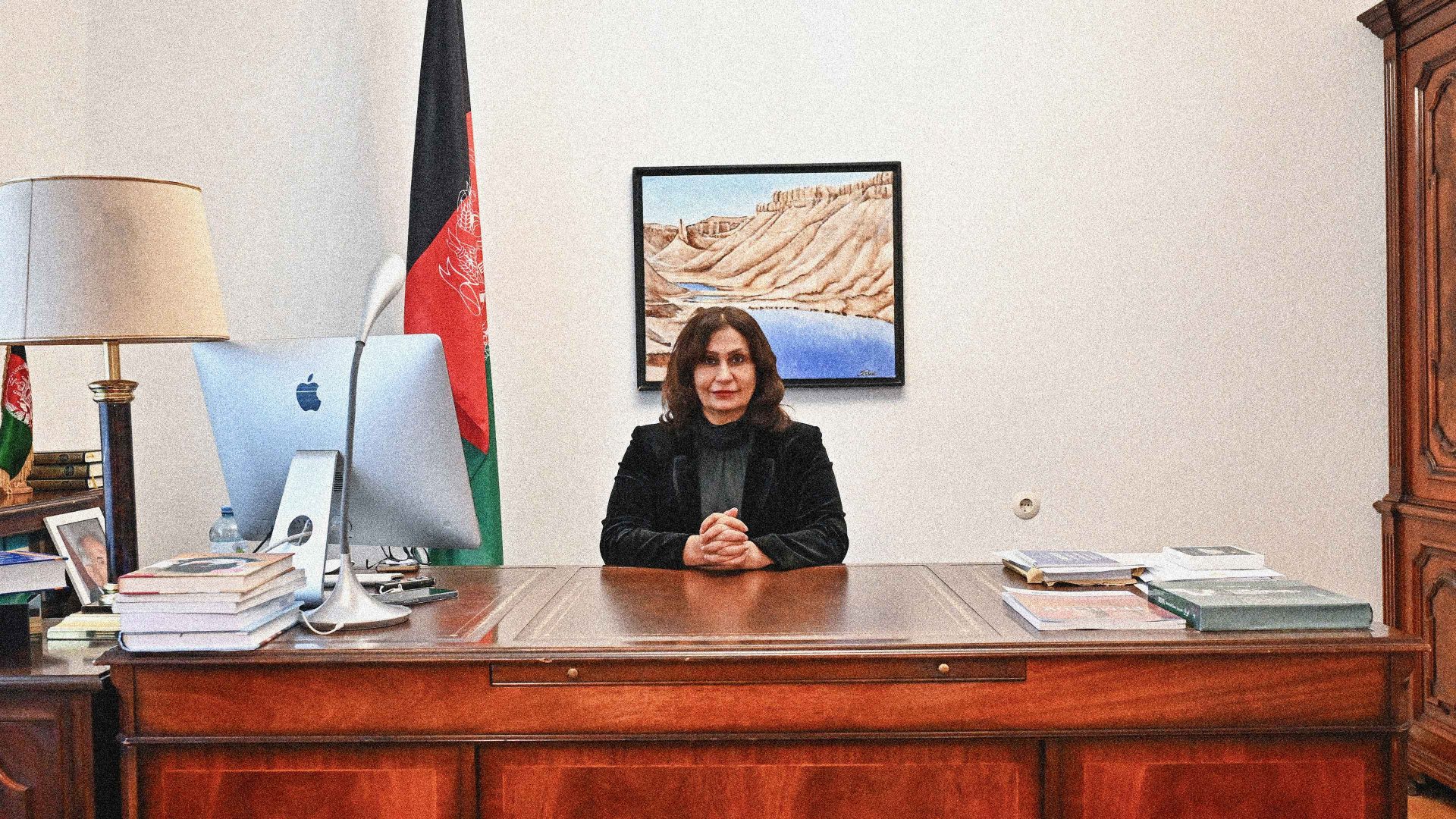
Inside the Afghan embassy in the Austrian capital, the ambassador, Manizha Bakhtari, continues to represent Afghanistan while refusing to recognise the Taliban.
“Our space is shrinking,” she told me during a recent visit to London. “It becomes smaller and smaller.”
Her position – part diplomat, part custodian of a vanished republic – is the subject of the documentary The Last Diplomat, by Austrian film-maker Natalie Halla.
It follows Bakhtari as the Taliban’s repression deepens, funding for her mission dries up, staff are let go, and the embassy moves to smaller, cheaper accommodation.
At one point she explains how she tries to preserve ambassadorial dignity – for instance, only putting her rubbish out at night so that people do not see the ambassador dragging the bins to the gate.
The film is about the diplomatic twilight that followed the collapse of her country, as the international community still struggles to decide what Afghanistan has become.
“Our neighbouring countries have already started working with the Taliban,” she said. “They do not call it recognition, but it is kind of de facto recognition.”
Almost five years since the Taliban returned to power following a deal signed with Donald Trump, the world lacks a coherent policy on Afghanistan. The movement, run by men long sanctioned as terrorists, controls the country, rules its ministries, signs contracts and collects taxes. It is also engaged in an intermittent war with its neighbour, Pakistan.
Yet Russia remains the only country to formally recognise the Taliban, even while accusing it of harbouring tens of thousands of transnational militants.
The larger international community has settled into an elaborate diplomatic limbo: meetings are held with Taliban figures, humanitarian aid continues to flow through carefully constructed channels, and Afghanistan’s embassies operate in a patchwork of arrangements that sidestep the world’s revulsion at Taliban rule.
Some – in Islamabad, where the Taliban flag flies, Beijing, New Delhi, Norway, Germany and, soon, Tokyo – are run by Taliban appointees. Others remain in the hands of diplomats of the former republic who now report to the Taliban’s foreign ministry. Many, like London and Washington DC, have closed.
These arrangements allow governments to avoid the political cost of recognising the Taliban as legitimate – and thus accepting the repression the group perpetrates on the people of Afghanistan, and their criminal networks, ranging from narcotics to arms trafficking, that extend beyond the country’s borders.
Bakhtari’s embassy in Vienna exists inside that queasy contradiction.
“I represent Afghanistan, not the Taliban,” she said. “The republic collapsed, but the country did not.”
A successful novelist and former journalist and academic, Bakhtari was appointed ambassador to Austria only months before the collapse in August 2021. Educated, multilingual and long active in Afghan civil society, she arrived in Vienna expecting to represent a government that was, undeniably, struggling but still intact.
But she soon found herself standing for a country that had vanished, almost overnight. The president who had appointed her, Ashraf Ghani, fled as the Taliban stormed in.
Institutions built by the US-led nation-building mission crumbled. Hundreds of thousands of people fled the country. The Taliban declared their own model of Islamic law that has forced women into silence and institutionalised racial, sectarian and sexual discrimination.
For Bakhtari, the Taliban’s return to power was not simply a geopolitical upheaval but a personal rupture.
Suggested Reading

The message to Trump, Putin and Xi: big countries lose wars
Much of what the republic had promised, such as education for girls, public roles for women and a place for Afghanistan in international institutions, was reversed within months.
“What is happening in Afghanistan is not a national tragedy,” she said. “It is a global tragedy.”
Bakhtari’s advocacy has centred largely on women’s rights and Afghanistan’s humanitarian crisis. She acknowledges that her unique position, supported by the Austrian government, provides her with a platform to campaign with a now-rare authority for Afghan women and human rights.
“Every day when I wake up, I know that my voice has a job,” she said. “And I use my voice.”
Yet the diplomatic conversations shaping Afghanistan’s future now rarely centre on those issues. The Taliban leadership responds to criticism by tightening its strictures on women and minority groups, recognising that the UN can do almost nothing but watch.
Instead, the narrative revolves around security concerns, migration, sanctions and the country’s vast untapped mineral resources. These issues increasingly draw governments into engagement with the Taliban, but are outside Bakhtari’s remit.
Austria continues to host her mission and treat her with diplomatic courtesy, but the country she represents no longer exists in the form that appointed her. Her reduced embassy compound – now surrounded by wire fencing after she received death threats – reflects the narrowing space she occupies.
“Sometimes in meetings I am just an irrelevant person,” she said.
Across much of the world, Afghanistan’s republican flag has already been lowered from embassy poles while the Taliban continues to agitate for recognition, and western governments dither about pragmatism.
But in Vienna, the tricolour still flies, a stubborn reminder of a country that once existed, and of the unresolved question of who now speaks for it.
Lynne O’Donnell was the Afghanistan bureau chief for AFP and AP 2009-2017