

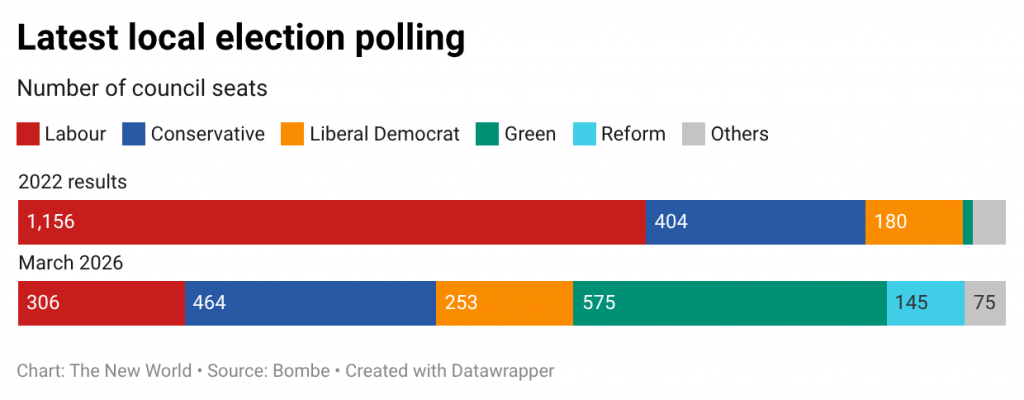
Something seismic is happening in the capital. Polling shows the Green Party stands to win the most council seats in London on May 7, with the vast majority of them taken from Labour, which has dominated the city’s politics for over a decade.
But it doesn’t stop at seats – the Greens are actively looking, and seem primed, to take over entire councils. They are currently zeroing in on the Hackney and Lewisham mayoral races, both areas with large renter populations, younger voters, and long-standing dissatisfaction with their Labour councils over housing and local services.
These are, of course, predictable targets: trendy, diverse, politically engaged parts of the city where the Greens have been building for years. But if they’re on course to gain over 500 seats – which is what current projections suggest – they won’t just be picking off the usual enclaves, they’ll be taking seats right across London.
And once they start winning councils, that becomes a headache for Sadiq Khan, who relies on holding together a pretty broad coalition to win in the next mayoral election. If they win a council like Hackney, it opens up the very real possibility of that turning into a parliamentary seat for their leader, Zack Polanski.
So what actually happens if this Green wave hits London? And more importantly – what does it mean for Labour?
“Pish posh”, I hear you say, “the Greens always do much better in local elections than in nationals, and they’re only a protest vote party anyway”. For now, scepticism is fair enough – even if the Greens do as well as pollsters suggest, it won’t necessarily translate into success at a general election.
Jonathan, a former Lib Dem and Labour voter in north west London, will be voting Green in this May’s elections. “I feel a strong need to send a message that status quo politics is not working for the majority of people right now,” he told me, “I sympathise with Starmer, Labour and the local Labour council, but feel they are all trapped in an outdated way of thinking”.
But he concedes that the Greens’ main problem in converting people like him – “middle-aged centre left folk who rejected Corbynism and who value competence” – is its ongoing battle to be seen as a serious party of power.
Suggested Reading

Have the Greens really forgotten about the environment?
“It’s cool that they are a punky upstart option, but would I trust them with more than a local council? No. Not right now. Their policies on Nato and foreign affairs are laughable and naive. I see a lot of ex Labour Corbynistas in the Greens now, and that worries me at the international level.”
However, for many younger voters, these locals may well be a precursor to how they vote in 2029. They have little loyalty to the party system as we know it and have just watched the Greens clinch the Gorton & Denton by-election, casting serious doubt on the old adage that a vote for the Greens is equivalent to putting your ballot in the bin (I’ll admit, I used to use that one a lot when I was a Labour canvasser).
And the real risk for Keir Starmer is this: it may not just be students motivated by Gaza or old hippies who hate Trident voting Green. It will be the people Labour need most to avoid total electoral annihilation.
For a while, it’s been comfortable to imagine a kind of split wherein Labour and the Greens divvy up the left – the latter take the more socially radical wing of Corbyn-era voters, students, activists, while the former holds onto middle-income, middle-class urban professionals: the very voters London is full of.
But this assumption can no longer be taken for granted.
To borrow from my colleague James Ball: the old idea of a “traditional Labour voter” – working class, northerner, union member – is effectively dead. Or at least, where it does exist, it’s ageing and will almost definitely vote Reform.
The voters Labour should be locking down are those middle-income urban professionals, and yet they keep getting it wrong on the things that matter to them – dragging their feet on student loans and missing housebuilding targets, while the Greens are advocating for rent controls and scrapping tuition fees altogether.
It is important to keep in mind, when considering this demographic, that something like tuition fees are no longer the policy bugbear of the very young, student voter – someone who went to university around the time of the big £9k increase is now in their 30s.
Alex, a working professional in his 20s who rents in East London, believes that “Zack Polanski recognises that things need to change radically, rather than insisting that the system is the right one and that it just needs a few tweaks, as Starmer does.”
“I’m heartened by the Greens’ commitment to properly help out graduates with loan debt, which is killing aspiration. Labour, as their announcement about capping interest on student loans shows, will do as little as possible without actually caring about this issue because they are addicted to the votes of pensioners.”
“I do have serious reservations about Polanski’s current policies on Nato and drugs, but I think – like with Reform – these will be ironed out as the Greens become serious contenders for government closer to the election.”
And, like it or not, the Greens are associated with something Labour currently isn’t: fun. London, increasingly, isn’t. Even when young working Londoners have the money to go out, they’re thwarted by outdated, joyless licensing laws that mean most pubs in places like Soho are shutting up shop by 11pm.
Then there’s the so-called “table tax” – the extra fees and bureaucracy councils slap on bars and restaurants for putting tables outside – which just kills off outdoor seating and stops London ever really having that European city feel. Not that the Greens will necessarily fix any of this – but if Labour want to win in London again, it’s exactly these sorts of everyday, quality-of-life things that make younger voters feel like someone is actually on their side.
Suggested Reading

Neither Farage or Polanski are the prime minister Britain needs
The BBC has predicted that London is set to become a political patchwork quilt, with the Conservatives and Reform picking up ground in outer boroughs, the Lib Dems competing all over, and of course, the Greens advancing heavily in inner London. The prognosis for Labour is the only one that looks terminal.
So will May be indicative of a wider voter realignment? Possibly. Because if Labour starts to lose London, then other young, urban, diverse cities will surely follow. And then the question becomes unavoidable: where does Labour have left to turn? What do they do to stop haemorrhaging voters to the Greens?
The answer, in theory, is to focus on that squeezed middle. And I do think, in their own way, the government is trying. But it mightn’t prove to be enough.
The middle-class London leftie should be Labour’s absolute home turf: Brompton bike riding, work from home, a soft spot for Have I Got News For You, and a deep, almost moral aversion to ever voting Reform. But they’re also saddled with student debt, stuck renting far longer than they expected, and probably despairing about the direction the world is heading in, climate-wise and geopolitically.
If Polanski can reach beyond the obvious base – not just the students and the activists, but also the centrist dads and white-collar pragmatists – the Green wave might not stop in London. It could sweep through parliament in 2029.
 Most popular

Exclusive: New Ofcom chair appointed – but will he fix Musk and GB News?

Screen scandal: How Ofcom lets GB News get away with it
Matt Goodwin’s new book: The missing chapter

I worked at BuzzFeed. Here’s the truth about why it’s on its last legs