Wedding is one of Berlin’s less touristy neighbourhoods. Proudly radical and working class, it was a stronghold of Communist resistance in the Weimar Republic and was nicknamed “Red Wedding”. Today it’s home to neon-lit Turkish supermarkets, digital start-ups and a growing cultural scene.
One of my favourite hangouts there is a concert hall in the chapel of an old crematorium, called Silent Green. Experimental films now flicker in the concrete tunnels of the former mortuary. Across the district, abandoned factories have been repurposed as creative spaces: Panke Hallen, which used to make safes and cash-registers, is now a sculpture workshop, while a 19th-century chemical works houses studios for 70 artists.
One factory, which used to make car parts, stands out. The Pierburg plant is being retooled – not for art, but for war. Its production line, which once specialised in environmentally friendly throttle valves, will soon be churning out artillery shells instead. It’s owned by the country’s biggest defence company, Rheinmetall, which has seen its share price surge as the German government pours billions into rearmament.
Nearly four years after Russia’s full-scale invasion of Ukraine, Europe is rearming at its fastest rate since the fall of the Berlin Wall. Germany is spearheading the effort and plans to spend around £190bn a year to build up its army. By 2029, the country’s overall defence budget will be about 3.5% of its GDP – double that of the UK. It is a huge jump from just 1.3% at the start of the decade. In his first speech to parliament after he was elected as chancellor last May, Friedrich Merz pledged to turn the Bundeswehr into “the strongest conventional army in Europe.”
The metal workers union at the Wedding plant have accepted the conversion and a new contract, which promises state of the art machinery and job security for the 350 employees. “It’s not the transformation we expected”, said Bernd Benninghaus, the chairman of the works council, “but there’s no alternative”.
Given Chinese competition in the car industry, he was preparing the workers for the phasing out of production and ultimately negotiations for a social plan leading to complete closure.
Yet many of the factory’s neighbours oppose the plan. Although Rheinmetall says no explosives will be used on site, some worry that weapons production in such a densely populated area could make the neighbourhood a target.
I met Niklas and his friend Eden in a nearby café. Both are members of the left-wing party Die Linke and told me their government had its priorities wrong. “Why does nobody care about child poverty or leaking school ceilings?” Eden asks. “Or that train fares are unaffordable?” Niklas adds: “We don’t want weapons mass-produced here just so capitalists can make a profit.”
We finished our coffee and walked over to the factory, with its saw-toothed roof, surrounded by spiked railings. As I took out my phone, a security guard in a glass booth waved his arms, warning me not to take pictures. The Berlin Alliance Against Arms Production – made up of some 30 grassroots groups – has already held protests outside the gates, with people holding signs saying “War Starts Here”, “Money for the Neighbourhood – Instead of Weapons for War” and “Disarm Rheinmetall”.
At a demonstration in October, Cem Ince, a member of the Bundestag from Salzgitter and a member of Die Linke in Lower Saxony was briefly arrested, allegedly for attacking police officers. The MP responded on social media, saying he was “forcibly dragged out of the demonstration” and punched in the face even though he was clearly identified as a parliamentary observer.
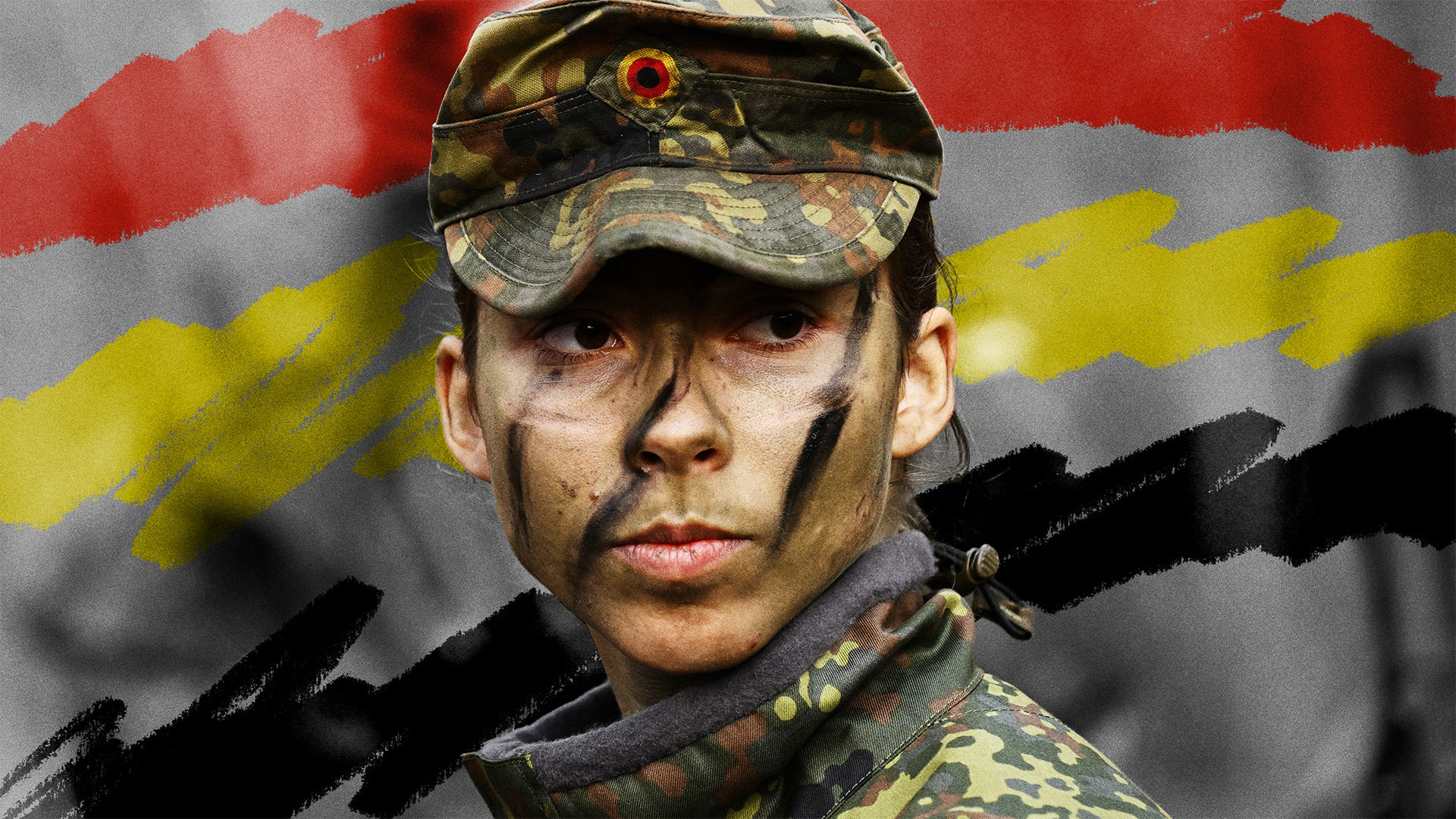
Tensions are running high, with many Germans alarmed by what they see as the country’s creeping militarisation. It is not just that civilian industries are being redirected toward arms production – the transformation involves people too. For forty years, west Berlin welcomed draft-dodgers. An island inside East Germany, the city came under the protective umbrella of the western allied forces.
Suggested Reading
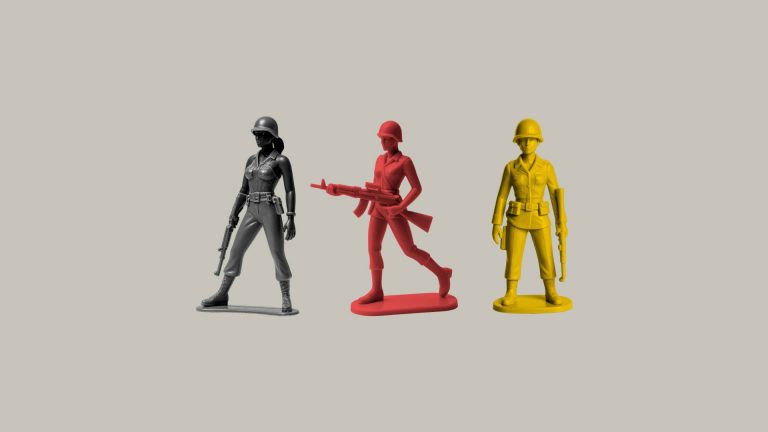

The German army’s women problem
A decade after reunification, military service was suspended but now a form of conscription is making a comeback. Pupils in schools in 90 German cities recently went on strike when the Bundestag voted to introduce voluntary military service.
Starting this month, all 18-year-olds in Germany will be sent a questionnaire asking if they are interested and willing to join the armed forces. If security deteriorates or too few people step up, the Bundestag could move to compulsory military service – a prospect that appalls young Germans like Niklas.
He suggests that with Germany’s dark past and the rise of the far right AfD party, having a powerful army is not a great idea. It’s a familiar argument. So is all the graffiti saying Nie Wieder (“Never Again!”) on walls and monuments. After the Second World War, Germany embraced pacifism as a form of atonement. But that was when the American troops stationed in barracks across the country guaranteed security. In today’s world, if Vladimir Putin decides to attack a Nato state, it is far from certain that a US president would ride to the rescue.
More guns, less butter is always a hard sell. I tell Niklas and Eden that I used to share their revulsion of the military industrial complex but the assurances we once relied on are gone. My three trips to Ukraine since the start of the full-scale invasion have changed me. There, I have seen for myself how men and women desperately trying to defend their land are dying needlessly because of diminishing supplies of ammunition.
“We want sovereignty for all people, but we are against weapons,” says Niklas. Walking back to the U-Bahn station, I think of the endless rows of blue and yellow flags, photos and candles next to freshly dug graves across Ukraine.
 Most popular


Face it: Trump’s going mad


Matt Goodwin, Zack Polanski and Lucifer: the fight for Gorton and Denton

The coercive control of Marco Rubio’s Munich doctrine

Am I still a friend of Peter Mandelson? It's complicated