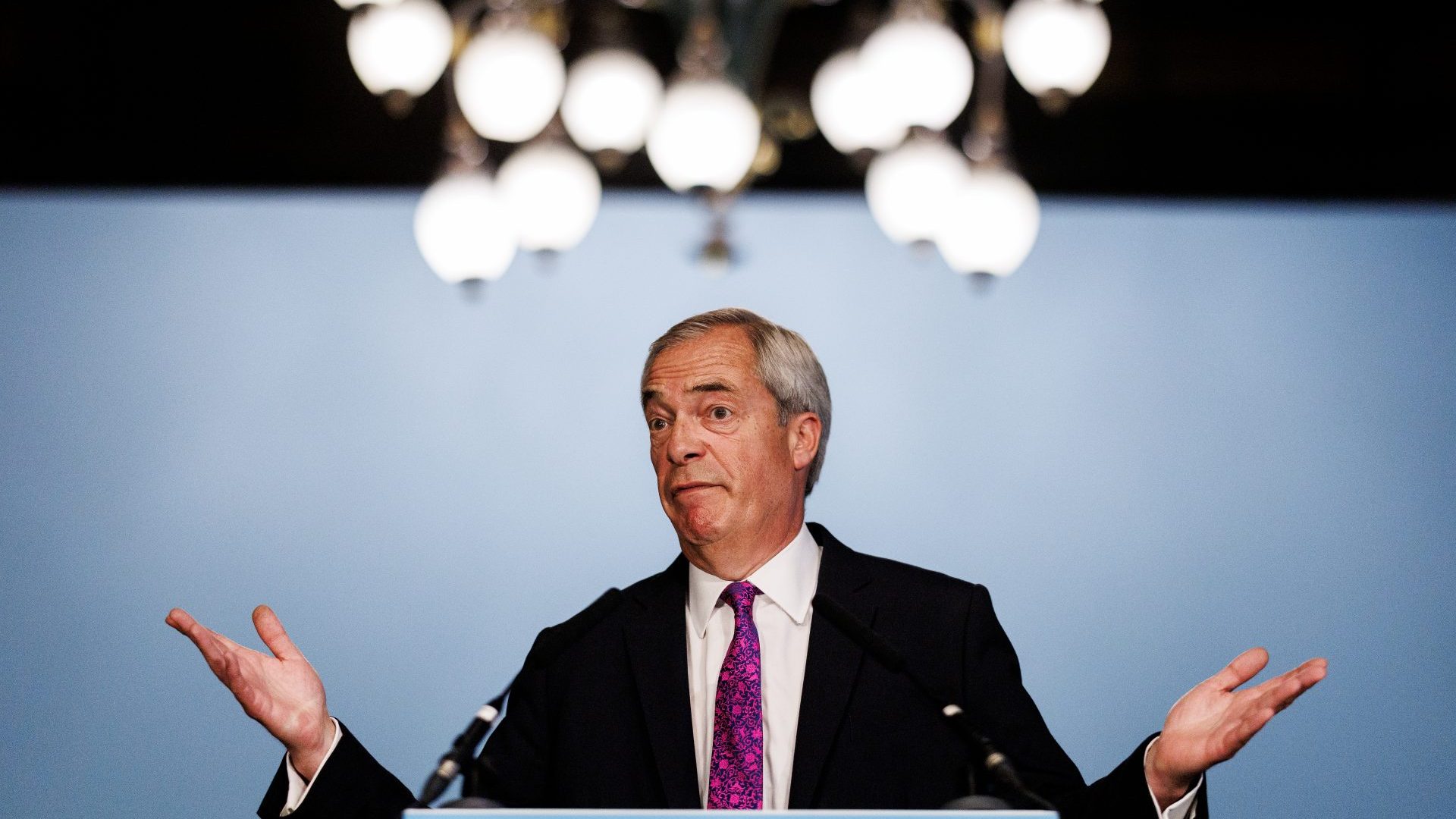
Re: “Unreformed” (TNW #462). The ongoing revelations about Nigel Farage’s racism have knocked Reform back into the mid-20s in credible opinion polls. Without being complacent, we may be witnessing the beginning of the end of his toxic influence on politics.
Yet the government’s own complacency about Farage is ridiculous. I do not understand why any leader of a political party in the House of Commons is allowed to broadcast on any channel for six hours of prime time per week, as Farage does on GB News. Nor why Labour does not clamp down now on cryptocurrency donations, the source of which are difficult to prove. And where is the limit on donations from non-Brits and non-doms?
Unless Labour acts to protect our democracy, Farage will drive a juggernaut through it as his mate Donald Trump has done.
Isobel Newton
Nigel Farage is huge on TikTok, with over 1 million followers and engagement rates that have hugely outperformed other UK political voices. The left and centre need to get cannier at getting their anti-fascist, anti-Farage messages across on social media.
Dino Maloney
Farage is a phoney, a fraud and a hypocrite; thin-skinned and tetchy. Could be why he’s so popular.
N Emery
Re: “Keir Starmer, the anger manager” by Tom Baldwin (TNW #462)
The absolute and relentless vortex of rage from the media about this government started almost immediately they were elected. Yes, they have made many mis-steps, but we are talking about something different here.
The current climate of public hatred, cynicism and utter disgust is remorselessly and deliberately stoked and fed by the media every day. I fear where it will take us.
John Hyder-Wilson
The level of vitriol levelled against the government seems over the top. I am not sure any of us would have wanted power after 14 years of Tory mismanagement, the disaster that was and is Brexit, and a mishandled Covid pandemic.
Starmer is certainly not the most dynamic or vibrant PM, but do you really want to return to a Johnson, Truss or Sunak?
Adam Primhak
Re: “The game they won’t let Labour win” by James Ball (TNW #462).
Labour appear to be banking on the hope that, come the election, if all the indicators are heading in the right direction, people will see Starmer as the patient, strategic genius he always knew he was, and vote accordingly.
Unfortunately, as James Ball shows, politics doesn’t work like that. It is not fair and it is not rational – Starmer needs a better story.
E Field
Labour have quietly confirmed one of the most shocking developments in modern British politics: the UK is now prepared to deport children born here.
This was not an accidental admission. It is part of a much larger shift towards a new deportation regime built on mass detention, weakened rights, blocked evidence from trauma survivors, and a fast-track removal system that undermines basic principles of justice.
Labour is expanding detention centres to over 2,500 places, restricting Article 8 family rights, replacing judges with “adjudicators”, pushing “voluntary returns” that look more like coercion than choice – all while dismissing evidence from torture, trafficking and LGBTQ+ asylum seekers as “spurious”.
This is not reform, nor pragmatism. It is a profound moral and legal collapse.
Joseph Culleton
Suggested Reading
Letter of the week: Do voters care about local government?
Tanit Koch writes in Germansplaining on Gaza counter-protesters (TNW #462) about the Hamas charter of 2017 and “from the river to the sea”. She doesn’t mention the Likud government original party platform of 1977, which starts: “The right of the Jewish people to the land of Israel is eternal and indisputable and is linked with the right to security and peace; therefore, Judea and Samaria will not be handed to any foreign administration; between the Sea and the Jordan there will only be Israeli sovereignty.”
In 2017, Hamas accepted that a Palestinian state would follow the 1967 boundaries.
Keith Tunstall
Chichester
Re: “Assisted dying dirty tricks could kill the Lords” by Patience Wheatcroft (TNW #462). I have watched the unfolding progress of the End of Life bill with increasing frustration. Now, a group of unelected peers are running their red pencils through it.
Meanwhile, the people for whom this bill is intended – people like me, with stage 4 metastatic bone cancer and very limited time left – are being shut out of the debate. Even if this bill becomes law in my lifetime (highly unlikely), I will be forced, in my final months and probably in great pain, to deal with piles of “death-min” as the various medical, social and legal authorities mull over my application.
Time that should be spent with family and friends will be taken up filling in forms and writing letters of appeal, all of which I will have to do myself, regardless of my health, to “prove” I am not being coerced.
I feel strongly that the current debate around this bill completely demeans and excludes those of us for whom it was intended.
Carol Hedges
I would like to see a second chamber that is appointed by committee/s of lay members of the public, with some support from professional advisers. It would contain leaders from business, science, defence, the religions and other areas, but absolutely NO politicians. The committees would be completely independent of government. What we don’t want is another party political talking shop with hustlers on the make.
Richard Robinson
Re: “Joan Armatrading’s sound of silence” by Ian Winwood (TNW #462)
I saw JA as a support act to Supertramp in Portsmouth in the mid-1970s. The support act in those days would get one song before the theatre emptied out to tank up in the bar. Almost no one left Joan’s session. I’m still a firm fan.
Peter Snowdon
Re: Great Lives: Sócrates, by John Osborne (TNW #462). Thanks for the memories. Those were the days when the love of the game and a culture of decency really meant something. Responsibility and wisdom for all to see.
Dermot Spooner
Re: “The truth about grief” by Nigel Warburton (TNW #462). After my beloved dad died this week, I opened TNW for a distraction. Full of sadness, this column was incredible. The sudden jabs of memory, absence being like the sky spread over everything… and all this being normal, and to be expected and endured.
Thank you for such a typically brilliant piece.
Mark Leese
Lincoln, Lincs
BELOW THE LINE
Re: “Leatherface and me” by John Bleasdale (TNW #462).
My own trauma at the hands of The Texas Chainsaw Massacre was in 1976. I was 16 and my girlfriend’s sister took us to a screening at the local university. I still recall the shock and fear I felt. But I couldn’t look away.
Is it the most scary movie ever, or was it the first time in our young lives we were exposed to such violence? It does have a grainy, realistic feel to it that subsequent horror films can’t match. Somewhat recovered 50 years later, my brother and I share our favourite line: ‘Look what your brother did to the damn door!’
ROBERT FERGUSON
Re: Alastair Campbell on theatre at the cinema (Diary, TNW #462).
Couldn’t agree more about filmed stage shows. Some years ago, I saw the National Theatre production of Stephen Sondheim’s Follies at the cinema and was so impressed that I have been often since. When you live in the north of England, it’s a lot less expensive than going to the actual NT.
DAVID ISAACS
Unwell and unable to go out, we are enjoying NT at home, noisily eating snacks, drinking wine and relaxing on the sofa.
NORMA SPARK