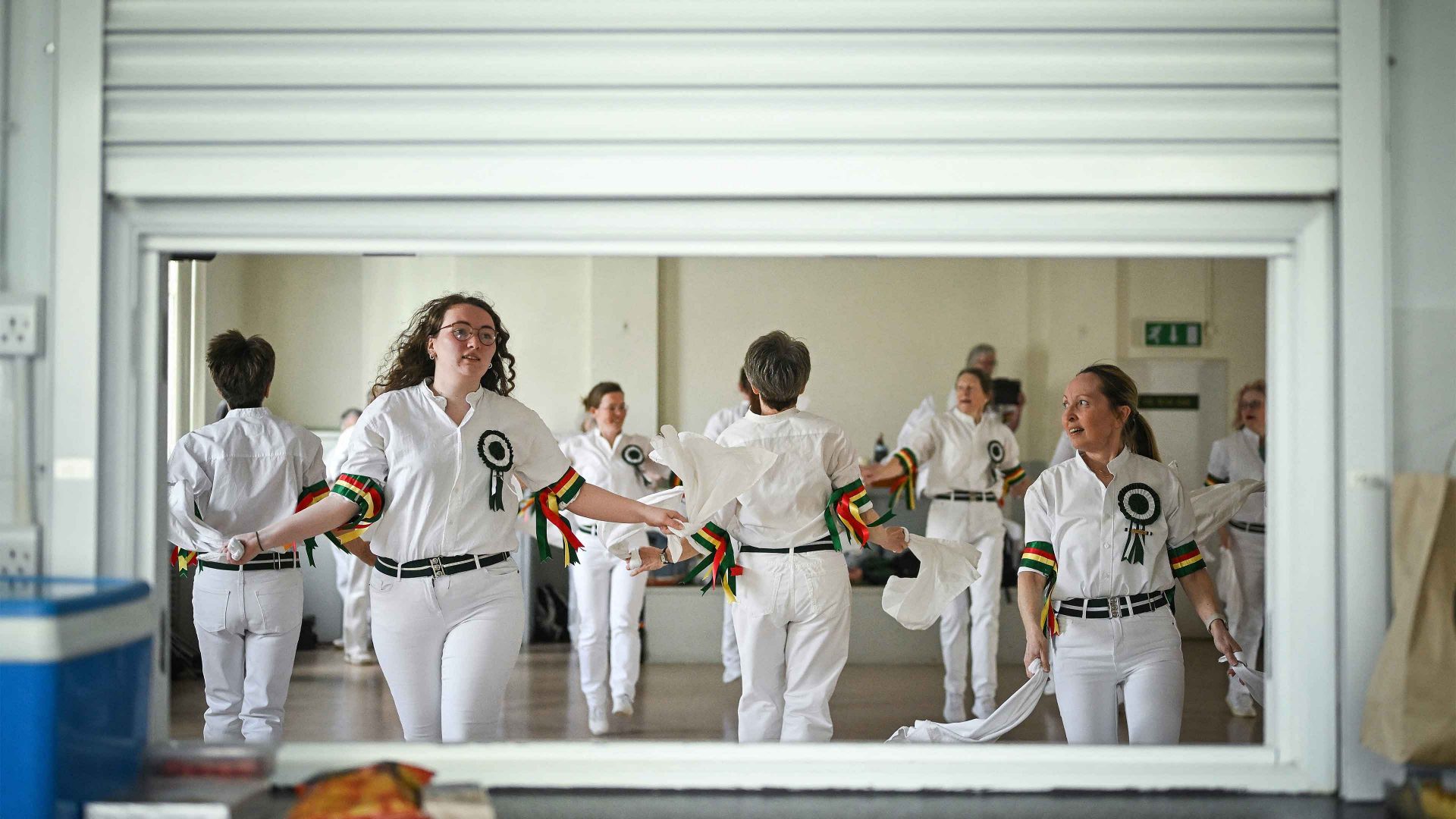
Above a bar in central Manchester, a lilting melodeon and clacking sticks intermingle with the hum of the city centre outside, as a morris dancing side rehearses.
Folk practices are becoming more popular in England, from pub music sessions and morris dancing to a widespread revival of the midwinter tradition of wassailing. Yet the renewed interest comes at a time of extreme tension for “Englishness” as an identity.
Those involved in the folk revival fear infiltration by far right extremists promoting an idea of England focused on exclusion and ethnicity. Meanwhile, for some on the scene, bloody colonial history makes identifying with Englishness uncomfortable.
Arthur Geoghegan, 26, is a member of Roots Morris, an inclusive morris team based in the city centre. “It’s very difficult to be proud of being English,” he told me, between bouts of leaping. “Englishness, at least for me, has been tied up so strongly with a veneration of the St George’s cross and ‘wasn’t the empire so great?’
“To be proud of being English now takes thought and deliberation, to think about English traditions that can be brought into the 21st century, rather than going ‘if it’s English, it’s good’.”
Jennifer Reid, a musician and activist exploring folk tradition in Lancashire, worries that newcomers might get the wrong end of the clacking stick: “People are too far removed from what Englishness is. A lot of the people who are susceptible to far right radicalisation are poor, and then they’re not going to go to Sidmouth Folk Festival for eight days to rediscover and connect with their folk heritage.”
England’s folk scene has faced the encroachment of far right politics before. In 2009, Folk Against Fascism formed to oppose the BNP promoting folk traditions. After lying dormant for over a decade, it has now restarted.
Musician and morris dancer Steve Bentley, 64, from Teesside, said: “It was started as a counteraction to the adoption of folk music and traditions being shown as ideals of Englishness, as part of this rose-tinted spectacle of a white nation,” he said. “It was a lot of musicians getting together and saying ‘we don’t support you’.”
Roots Morris member John Mitchell, 45, added: “Folk has been part of my whole life. I generally want to fight the far right, but I particularly didn’t want them co-opting something important to me.”
Far right groups might associate folk tradition with a ‘pure’ English culture, supposedly free from modernity and multiculturalism. Prof Fay Hield, a folk musician and ethnomusicologist at the University of Sheffield, called this idea of purity a “complete fallacy”, saying: “There is no ‘pure’ culture or tradition – people, ideas, music, culture have always moved and brought newness.”
Suggested Reading

Brexit is silencing British musicians
“Englishness” in modern folk is heavily influenced by a romanticised vision of pre-industrial England pushed by early 20th-century song collectors, who travelled around the country making recordings in rural villages and towns. “Some of the early collectors were trying to get the ‘essence’ of England,” said Hield. “They went in with a very clear remit for the kinds of songs and the kinds of people that they wanted to record. Their agendas cut through to where we are today.”
Parts of England’s folk scene can still put people off, and some practices continue despite being disavowed by official bodies. “Some of the core folk scene is not attractive to people as an alternative to the far right,” said Hield. “It’s not seen as explicitly far enough away from some questionable ideologies.”
But things may be changing, at least in some places. Lecturer Hunter Brueggemann, 38, is a session regular. “What makes this new revival really interesting is that it’s actively inclusive,” he said.
“It’s usually an emotional toll to be the first POC (person of colour) in a room, but seeing the scene and reflecting on how I’ve been treated, it was nothing but welcoming. I’m really happy to see so many young people there, people one may not expect to participate in folk, that’s really wonderful.”
Defining ‘traditional’ is also a complex question, and Hield shared an example of why. “Wassailing has become really popular, which is brilliant,” she said. “But imagine a new wassail sing happening on Boxing Day with people learning a song from Cornwall in Yorkshire. Their next-door neighbour goes to the football, which they do every year on Boxing Day, and sings all the songs they know with their grandad. One is seen as a ‘traditional’ thing and the other isn’t.”
So, is ‘English’ identity itself reductive? Traditions from Cumbria, the Cotswolds, and Cornwall are all distinct.
For ethno-nationalists, the culture of the host country may not even matter. Ideologies that claim to champion England often refuse to engage critically with “Englishness” beyond a superficial level, eroding unique tradition into cookie-cutter nationalism rooted in anger and white supremacy. So, could engaging critically with tradition inoculate someone against that influence?
“Once you know where you come from it becomes a lot easier to understand other cultures, which eradicates the far right’s hold over you,” Reid said.
But how can people learn traditions? For folk musician and organiser Alastair Warner, 26, there is a duty to get involved. “If you believe there’s an imperial past with Englishness that makes you disgusted and you want to engage with Englishness in a way that’s devoid of that, not only is folk culture the right thing to do, I think it’s actually your imperative to help with the folk revival,” he said. “You need to learn your own folk culture and traditions. Go to events, absorb it by osmosis and learn it by doing it.”
Kit Roberts is a freelance journalist based in Manchester