It’s raining heavily in Paris and the streets are dark and lonely. On my way to the Eurostar in that gently depressing part of town near the Gare du Nord, I pass men hunched over in betting shops and women smoking cigarettes with their espresso.
But then come the fuzzy lights of Bouillon Chartier – not the original, which opened in 1896, but enamouring all the same. Given that it’s 5pm, the grand room is less than half full, and I’m sitting down within a minute.
Sometime earlier, I’d tolerated a tiresome journey up from the Loire, punctuated by an omelette and a glass of wine. And so I scour the menu in a sort of half-hunger, mostly to avoid having to eat on the train.
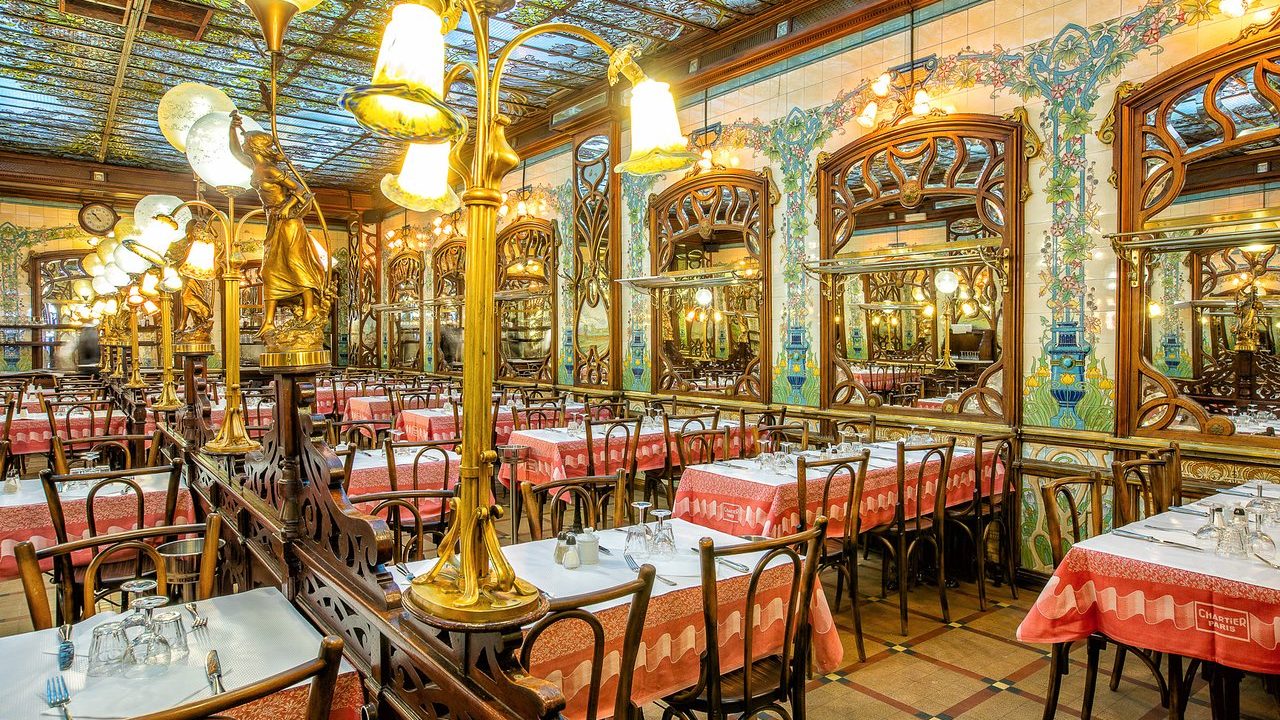
As with each Chartier, the place is lit well, neither gloomy nor zealously bright, and enlarged by precisely placed mirrors; pink linen tablecloths rest starched beneath their white paper coverings and polished brass rails run like railway tracks along panels of dark wood; 1950s prints hang on mustard walls and Merlot-coloured banquettes creak beneath buttocks.
I sit and admire it all, especially the nearby remnants of a long lunch, a table left with empty plates, morsels of bread and evaporating wine. It is cordoned off by a carefully placed chair.
The room is sporadically occupied by a handful of locals, maybe even regulars – a bus driver, two hairdressers, what looks to be a group of animated late schoolboys – together with tourists passing through. Some, like me, are directionless; others were clearly drawn, savvy and willing, towards the promise of vegetable soup for a single euro. Those aghast at such a modest sum, know that it’s a correct one – merely the entry point to the menu in my hand, one that also guarantees a well-sized portion of French fries for £2.60.
My intermediary dinner, washed down with a small carafe of serviceable white wine, costs little over 15 euros. Pitiful food, then? Not so. It is not exemplary but it is good, and of exceptional value.
I have a boiled egg, halved and sitting on tangy French mayonnaise; a large green salad mixed and dressed dapperly in the way the French do best; and a hefty slab of pork terrine not devoid of fat and flavour, tidied up with rich jelly and baked so that the bottom-to-middle is tender but the top is weighty, crackled, sweet.
Suggested Reading
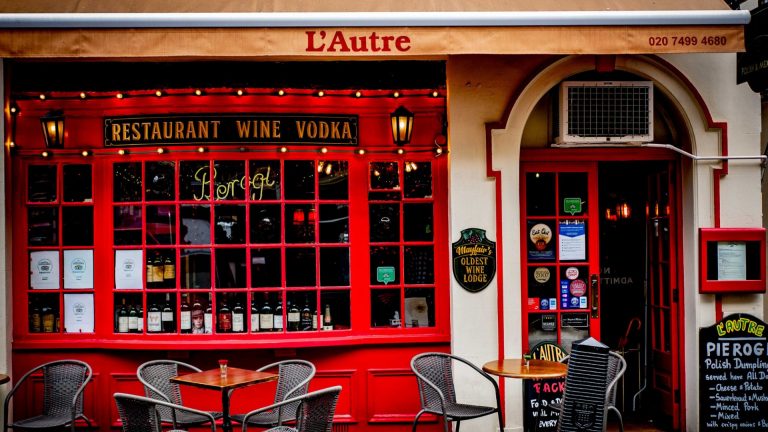

L’Autre, London’s most unexpected restaurant
It all arrived within five minutes after a basket of sliced baguette – three sturdy pieces, two of which I used to boat terrine into my mouth – and I was out in under 30(ish), my waiter having written my desired dining time on the table so that everybody knew I’d a train to catch.
In 1900, there were nearly 250 Bouillons – restaurants serving traditional French menus, including the stocky soup that gives them their name – across Paris. One was the first Bouillon Chartier, founded by brothers Frédéric and Camille Chartier in the 9th arrondissement and classified as a monument historique just over a century later, in 1989. At conception, the founders resolved to build a cheap workers’ eatery in a grandiose environment. It served simple but proficient meat stews in the centre of town.
The three Bouillon Chartier venues in Paris remain now as the first one ever was: reminiscent of the Belle Époque, romantic and beautiful. The waiters wear rondin, or black waistcoats and long white aprons; there is ever a garrulous freneticism, a pace and energy; and like Diporto in Athens, which brings a similar joy in its simplicity, tables are frequently shared, queues aren’t uncommon, and bills are totalled up directly on to the disposable tablecloths.
Budgetary suppositions aside, dishes are supremely practised. Chartier is a place for traditional French dishes comparable to a brasserie, though with no suggestion of pretence or fanfare.
Prized is the beef bourguignon, which comes as it should with coquillettes (a pasta with close ties to macaroni). So too prawns with mayonnaise, roast chicken and fries, white fish with sauce vierge, roast sea bream alongside vegetables, chitterlings, tongue, black pudding and mashed potato, various preparations of sausage from changing French regions and alongside mustard, and steak in pepper sauce.
Any and all of these might be enjoyed with French beans, boiled potatoes, or whatever is available. The menu changes, albeit irregularly, but always remains, at its core, classic, accessible, and French (bar perhaps the relatively recent addition of spaghetti bolognese).
Though famous in Paris, Chartier has never seemed to ascend to global stardom. The bohemians of the 1920s scene, whether writer or artist, musician or actor, don’t tend to mention the establishment because they were, almost always, too wealthy, or at least of a different class than those it was originally intended to serve. And they mostly hung out in Saint-Germain – or some similarly chic part of town – which had its own cafes and institutions.
The far sprightlier Bouillon today, as Paris flirts with a revival, is Bouillon Pigalle, which is marginally pricier but is no. 1 on my list as soon as I get back on the Eurostar, which will be soon indeed. It might just be cheaper to go to Paris and dine there than have French food in London.
Josh Barrie is a food and drink writer