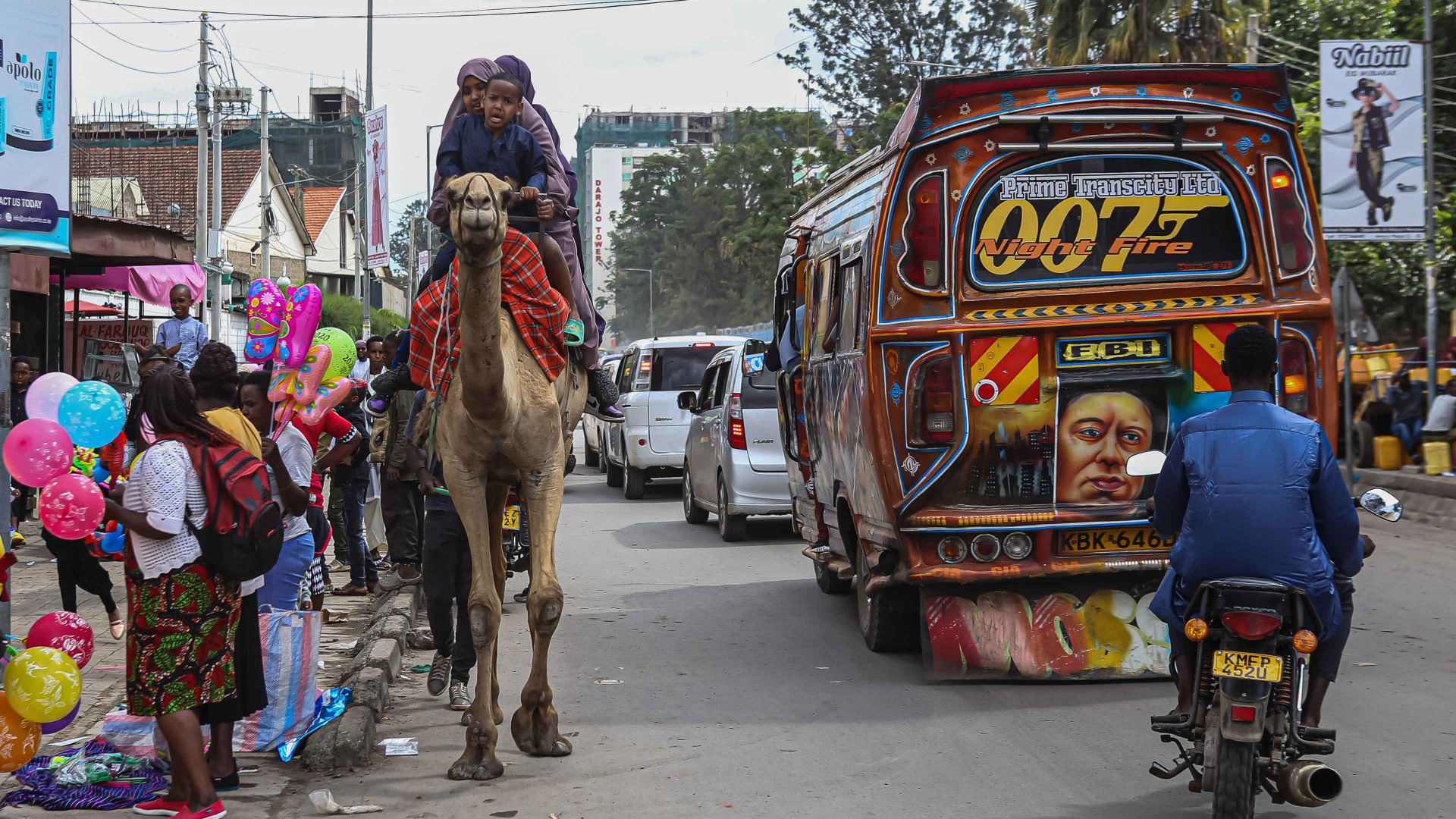
The matatu is a kind of shared taxi bus we have round here, and it drops me at the edge of Mohammed Yusuf Haji Avenue, just as the afternoon sun begins to soften. This is the Eastleigh neighbourhood of Nairobi, where the air is thick with frying mandazi bread, diesel fumes, and the sharp sweetness of burning incense from a nearby stall. Hawkers call out in rapid Somali, Swahili, and English, their voices overlapping like competing radio stations.
“Fresh juice! Mango, passion, pineapple!” A young man balances a tray of neon-orange liquid in plastic cups.
I start walking. The pavement is uneven and cracked. On my left, a row of clothing stalls spills on to the street. There are glittering hijabs in electric pink and green, neatly folded bales of Ankara fabric, men’s suits hanging. A woman in a flowing abaya haggles over a pair of sequinned sandals, laughing as the seller pretends to be wounded by her lowball offer.
Further along, a shop window displays knock-off designer bags stacked floor to ceiling, their logos slightly off-kilter. It’s a quiet rebellion against the genuine articles, which are locked away in the malls downtown.
Those new malls rise sharply between the older, low-slung buildings. I walk towards Amal Shopping Centre, its glass facade reflecting the chaos below. Inside, escalators carry families past perfume counters and electronics shops blasting out Somali music videos.
Outside, a man grills mishkaki – skewers of spiced beef – over glowing charcoal, the smoke curling upwards. Nearby, another vendor pours steaming chai into tiny glasses, the cardamom scent cutting through the smoke. People pause, sip, then melt back into the flow.
Eastleigh is nicknamed “Little Mogadishu” for good reason. Somali traders dominate here; many of them arrived in waves after the civil war in the 1990s and early 2000s. In his book, Little Mogadishu: Eastleigh, Nairobi’s Global Somali Hub, the anthropologist Neil Carrier has described this quarter as a trading hub held together by Somali networks that link Nairobi to Dubai, even Guangzhou.
Suggested Reading
To bee, or not to bee? The African elephant question
It’s a major economic zone for Nairobi, and the changing skyline, with all those new malls and high-rises, is a visual reflection of the new commercial expansion.
I turn down a side street, this one much narrower. Here the hawkers are younger, more insistent. “Brother, good phone! Original Samsung!” A boy no older than 16 demonstrates a cracked-screen model, his smile wide and practised.
Around the corner, a woman sells samosas filled with minced meat and peas, the pastry golden and crisp. I buy two, which she produces fresh from her steaming pot, and eat them as I walk, the oil slicking my fingers. A group of men sit on plastic chairs outside a cafe, chewing khat as they watch the football on a small television. They shout at the screen in Somali, then laugh at a missed penalty, as the TV crowd groans.
The sensory overload is relentless – but there is order beneath this chaos. In 2021, formal employment in Kenya was only 15.9%. In comparison with that national average, Eastleigh stands as a self-made economic powerhouse, built on the networks of globalisation.
Yes the rapid growth here has brought strain, particularly traffic congestion, which is now terrible, strained infrastructure, and occasional tension over space and resources. But more than anything the neighbourhood’s success is a rebuke to the Kenyan state’s failure to deliver any real development. Eastleigh has gone ahead and done this all itself. It thrives despite, not because of, official planning.
Back on Mohammed Yusuf Haji Avenue, the sun is dipping low and casting long shadows across the malls. Eastleigh is a refutation of the idea that African cities are places of deprivation and struggle. It was once a segregated railway town, named after a sleepy English village. Now it’s a regional trade hub.
Joseph Maina is a freelance journalist based in Naivasha, Kenya