April 7, 1890 – January 27, 1979
Victoria Ocampo slides back her sunglasses and reclines in her chair, surveying the cubist perfection of her Modernist villa. It’s January 1, 1931 and the first copies of her magazine, Sur, are appearing on newsstands across Buenos Aires.
A prolific writer, Ocampo has already attracted attention as a cosmopolitan and influential presence. Her friends have been warning her against the project. Literary journals are always short-lived and never make any money, they remind her – but to no avail. Sur is her calling card, a self-funded statement of intent.
Her home, like her magazine, is her own creation: modernist, radical expressionist architecture, built at her request by one of Argentina’s most prominent architects as a space for ideas, an influential literary salon with the stylish, provocative and talented Ocampo at its centre. Guests stay here for days, for weeks, debating poetry and politics, life and love.
As the first pages of the first edition are opened not just by intellectuals in Argentina but in Paris and Madrid, Ocampo is already planning the next issue: who to collaborate with, whose work to translate, how best to provoke discussion. At a time when women in Argentina do not yet have the vote, Ocampo is a publisher not afraid to have her voice heard.
The 13 articles of Sur’s first edition include her close friend Waldo Frank’s warning for the future – humans are becoming dehumanised by technology; human judgment is being replaced by the efficiency and speed of machines. These are the avant-garde ideas that Sur is created for and which Ocampo espouses at her regular parties and salons at Casa Victoria Ocampo. She credits Frank, an American intellectual with a love of Latin America as being the catalyst for Sur’s creation and although his encouragement may have helped, the scale of it, the literary audacity, is all Ocampo’s.
Behind the creation is loss. Months before the launch of Sur, Ocampo’s father died, and shortly after Sur’s first edition she lost her mother, Angélica. With a new literary empire and a new home, life was dramatically different: Ocampo was now an institution, a publisher, someone whose company was being sought.
Suggested Reading
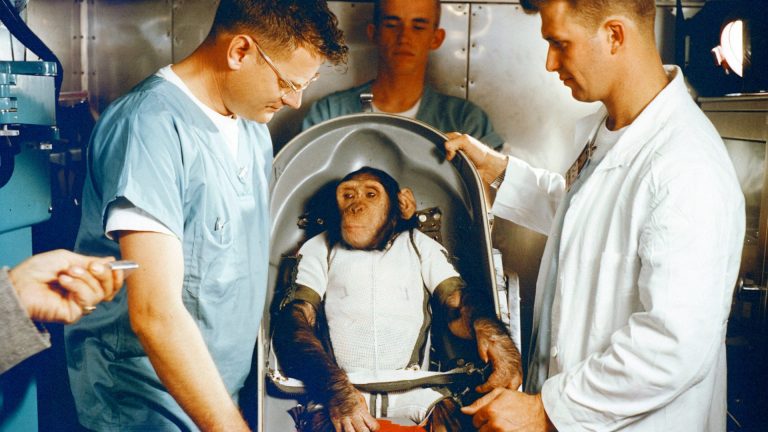
Ham, the chimp that launched the space age
Glamorous and tenacious, Ocampo made friends with literary firebrands across the world; intellectuals interested in ideas, art and politics. She regularly exchanged letters with Virginia Woolf, whose work she translated and published in Sur. Ocampo devoured Woolf’s work, although Woolf was slightly more aloof, finding her “a fabulous character from a strange and distant land she knew nothing about”.
This was a view many took of Ocampo, with her glamour, wealth and intellect, all of which she had in endless supply. In their correspondence they shared their frustrations of the male-dominated literary world, Woolf encouraging her to write as a woman rather than trying to conform. In return for her encouragement, Ocampo showered her new mentor with gifts and told her: “If there is anyone in the world who can give me courage and hope, it is you.” The two had a flirtatious and volatile relationship, intrigued by each other’s uniqueness, Ocampo writing “Virginia’s face is beautiful, not just because of its expression but because of its architecture, because of its scaffolding.”
Ocampo dived head-first into the political and artistic movements of the 1930s, flirting with futurism and even fascism. When Sur contributor Pierre Drieu La Rochelle became openly fascist, Ocampo wanted to learn more. In 1935, she interviewed Mussolini in Italy and hailed him as a genius.
Ocampo soon renounced this view, and made sure to express liberal messages at every opportunity, announcing Sur firmly as part of the anti-fascist movement. Ocampo had the platform to give a space to exiled writers, to publish anti-fascist essays, to give hope to people who were increasingly in despair at what was happening with the world. She started co-editing and translating Les Lettres Françaises, an anti-Nazi magazine, and attended the Nuremberg Trials, the only Argentinian to do so.
As well as publishing translations of writers such as Woolf, Joyce and Kerouac, Sur also gave Ocampo an opportunity for sibling rivalry. When reviewing her sister Silvina’s new collection of short stories, Victoria accused her of making up some of her childhood memories, putting their rivalry into print for the world to see.
Ocampo founded PEN Argentina – the international writers’ network based in the UK which campaigns for free expression. Always international in her sensibilities, her work with PEN established South America’s reputation as a place of literary vibrancy.
Sur’s stand against fascism and Ocampo’s commitment to campaigning for free speech and free expression placed her in danger when authoritarianism came to Argentina. She was imprisoned for openly opposing the government of Juan Domingo Perón. This led to international protest, and she spent 26 days in prison before being released, with the help of PEN Argentina, the organisation she had founded.
Towards the end of her life she gifted Villa Ocampo to Unesco, the home where she had dedicated her life to literature. Today, exhibitions, readings and literary events take place in her honour, her spirit still evident within its walls. Her personal archive remains in the villa, alongside that of Sur and her vast private collection of literary and cultural magazines.
Sur ran for over 60 years, becoming the most prestigious and long-lived Spanish-language literary magazine of the 20th century, the final edition published in 1992. “Sur was designed to bring literature’s best to Argentina and ended up being Argentina’s own best literary mouthpiece,” Time magazine wrote about its influence. The journalist Tomás Eloy Martínez wrote: “No woman received so much love and so much hate in Argentina.”
It was Virginia Woolf to whom Ocampo was perhaps most indebted. She regularly shared her mentor’s advice, words she hoped would inspire others: “So long as you write what you wish to write, that is all that matters.”