People crowd around the stands at the Internationale Funkausstellung in Berlin, one of the world’s most important electronics trade fairs. The talk is of intrepid new inventions such as car radios, remote controls for television sets and the push-button telephone. But in a corner of the exhibition hall, at the Philips stand, engineers have something the whole trade fair will soon be discussing.
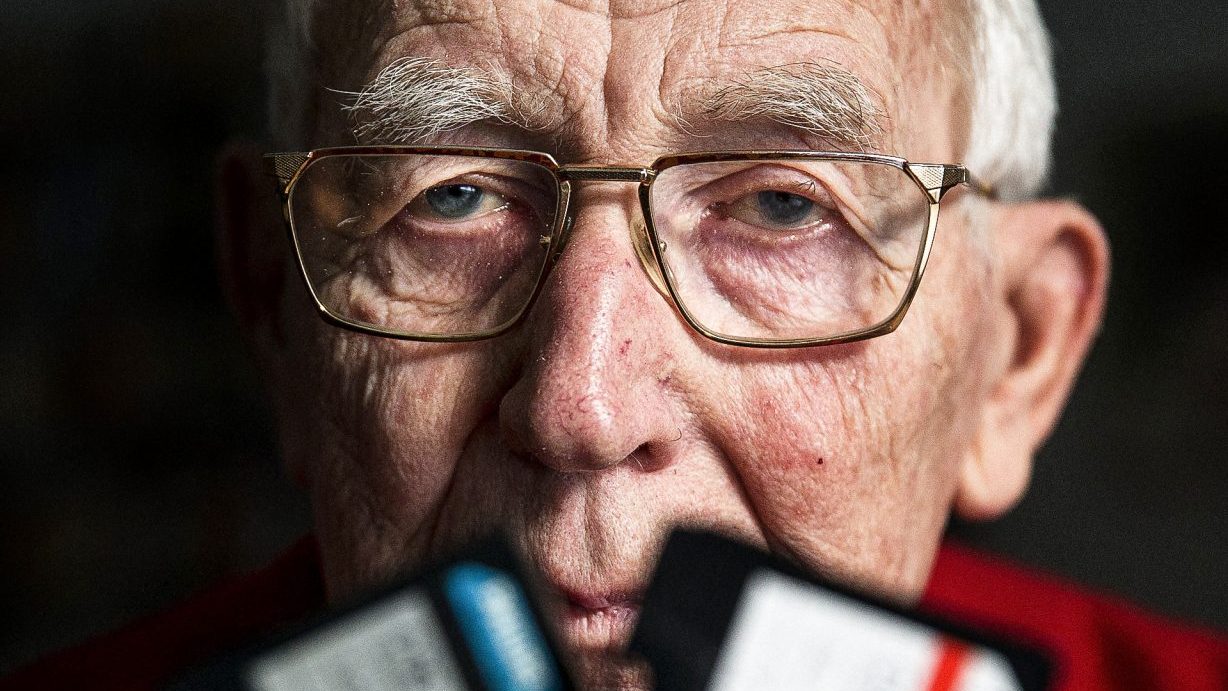
The genius behind this new invention is head of product development, 37-year-old Lou Ottens. His creation, the EL3300 recorder, a compact magnetic tape cartridge, is also known as the cassette tape.
To the astonishment of the journalists and visitors to the 1963 trade fair, this new compact device was tiny enough to sit in the palm of your hand. Ottens had instructed his team of designers that the contraption – advertised as being smaller than a packet of cigarettes – must fit inside a jacket pocket.
Throughout the 1950s and 60s, tape machines were large, mechanical and intimidating reel-to-reels. Not everyone found the process of laboriously threading tape across spools easy, including Ottens. “The cassette was born from the clumsiness of a very clever man,” a work colleague at Philips said of the creation. There was a desperation to find a solution to something so hard to use. What had been cumbersome was now light; what was too fiddly, even for Ottens, was now straightforward.
As a child, he loved Meccano, delighting at being able to build anything from the kit in front of him, making dumper trucks, racing cars and windmills. As a teenager, he built his own radio after the Nazi regime blocked people in the occupied Netherlands from listening to Radio Oranje.
He wanted to be able to sit with his parents and hear news of what was happening across the allied countries, so he added a directional antenna, meaning that, unlike other radio transmitters, his could not be blocked. He had a brain that never stopped trying to solve problems, to look for solutions, to make life easier.
Suggested Reading

Shane Warne, the drift, the turn, the legend
In 1965, Ottens went with his team to Japan to give a demonstration of the compact cassette, but the Japanese were not impressed. They found the hiss of the tape off-putting and struggled to understand how it could ever be something that would revolutionise people’s listening habits. It took years for its potential to be realised.
Ottens did not enforce a patent on his new invention, which meant that tapes could be played on any kind of tape machine, not just equipment made by Philips. He was always good-humoured about this, saying that this decision was philanthropically motivated, giving the whole world equal access to the affordable joy of cassettes.
But, in truth, he had completely misjudged how big his invention would become. Whatever the reason, people were now using cassettes, making their own recordings, documenting life’s important moments. The initial focus had been as a dictation machine rather than a way to listen to music. But that was about to change.
In the 1980s the mixtape industry took on a life of its own. Record collectors get misty-eyed at the crack of vinyl, but there is something equally special about the ker-chunk of a cassette, the hiss of a tape. Cassette tapes allowed personality and creativity; they meant you could be an archivist, a collector, a romantic, an auteur, a distributor. Ottens’s invention belonged to the underground. Cassettes were tangible objects for sharing. For music consumers of the 80s and 90s, tapes were considered an artform.
It is not the only portable media for which Ottens is remembered. He played a leading role in what came next, a technology that would leave cassette tapes almost (but not quite) obsolete. In 1979, Philips revealed its early compact disc prototypes, of which Ottens was a key innovator. He did not allow himself to get sentimental, preferring to look ahead, rather than back, accepting that the sound quality of a CD was far superior to that of the cassette; that there was something pure and unimprovable about its new digital clarity.
Shortly after the arrival of the CD, Ottens retired at the age of 60. The cassette tape has never been truly put out to pasture, though. It whirrs on today, identical in shape and size to that first presented to the world at that 1963 trade fair in Berlin.
Artists including Gorillaz and Taylor Swift still release their latest albums on cassette, but it is in the underground world of unsigned and lo-fi bands of all genres that the cassette tape thrives. Naturally, Ottens was pleased that his invention never quite disappeared. Describing those who use cassette tapes in a streaming world, he said: “They have a hobby – they love their cassette. It’s not really a rational activity [but] I like that.”
He died, aged 94, at his home in North Brabant in the Netherlands. A contented man, he accepted that although the concept of the cassette tape was his idea, the execution of it relied on a team of designers and engineers. “I have done nothing special,” he told a documentary film crew.
But he had. With cassette tapes, and then with compact discs, he truly made music accessible for the masses.