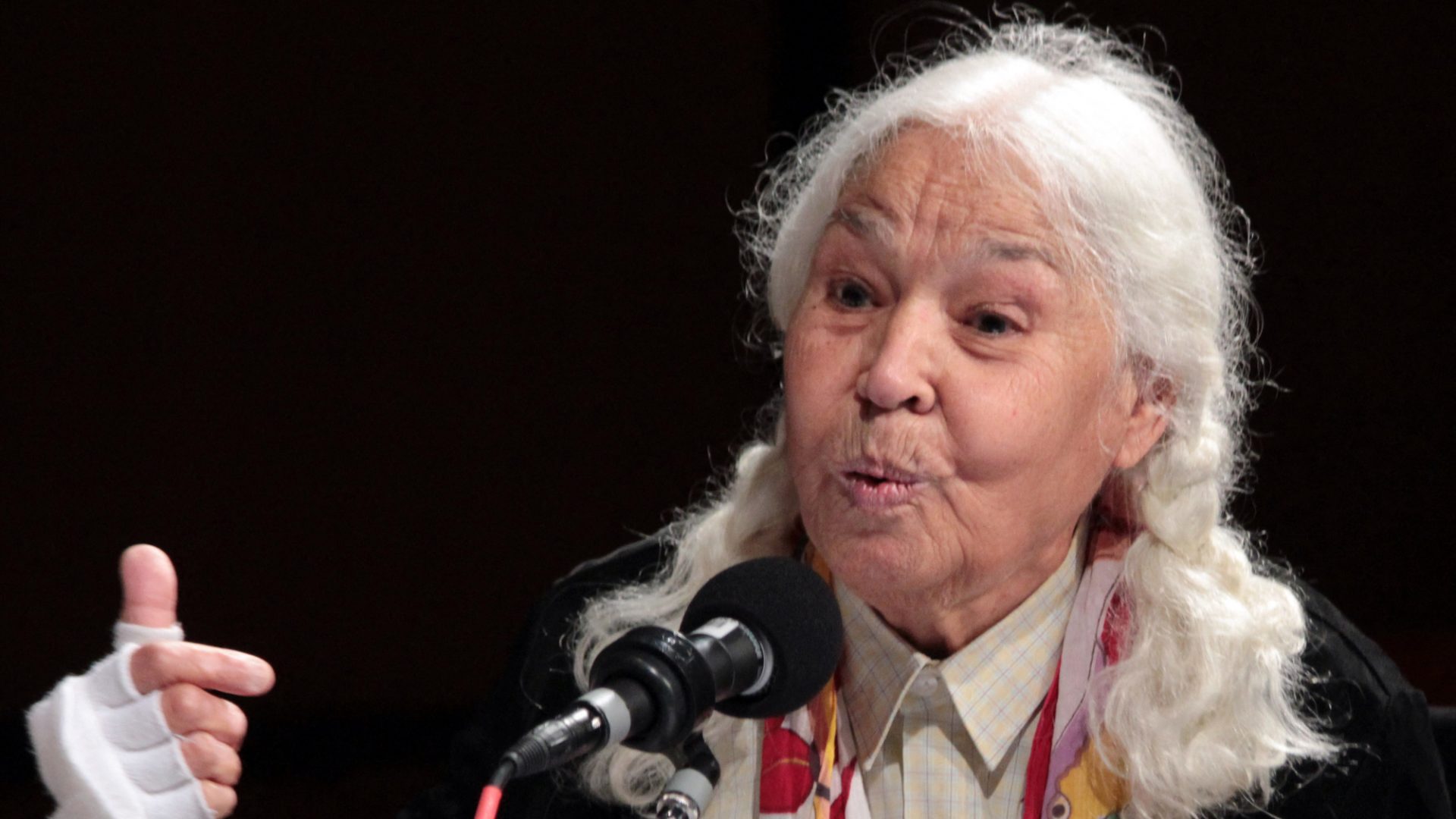
October 22, 1931 – March 21, 2021
Nawal El Saadawi sits on the floor of her squalid cell in Qanatir Women’s Prison near Cairo, sheets of prison toilet paper spread out on her knee, her face bent in concentration.
In 1981, under the rule of Anwar Sadat, over a thousand political activists, writers and dissidents have been arrested. El Saadawi has been detained for “crimes against the state”, after openly criticising Sadat’s government in articles, speeches, and interviews. She is denied paper and a pen in her confinement.
Never defeated, she improvises and scribbles away with a blunt eyeliner pencil, trying not to tear or smudge, filling sheet after sheet of toilet roll with thoughts and prayers, hope for a better future. Passed out through the hands of friends, these words become a book: Memoirs from the Women’s Prison.
After the assassination of Sadat weeks later, El Saadawi is released. The regime’s plan to put activists in prison to keep them quiet has not been a successful one. “They thought prison would silence me,” El Saadawi proudly said with her freedom restored, “but it only made my voice stronger.”
Nawal El Saadawi was no stranger to prisons. One of her roles as a psychiatrist was to spend time with female prisoners (at the same prison where she was later incarcerated). Here she met a woman named Firdaus, who had been sentenced to death for murder and refused to speak.
She agreed eventually to talk, but only to El Saadawi, revealing a lifetime of abuse. A forced marriage to an abusive husband led to a life of prostitution, until she was sent to prison for killing the abusive man who was controlling her. Firdaus had refused to appeal her sentence, saying she preferred death to returning to a society that oppressed her.
Suggested Reading

Lucie Aubrac, the pregnant spy who outwitted the Gestapo
El Saadawi turned Firdaus’s story into a novel, Woman at Point Zero. “In prison I discovered that the women there were not criminals,” El Saadawi wrote. “They were victims of society.” The novel became one of the most widely read in the Arab world, the dignity and calmness of Firdaus providing the tone and voice of the novel, recalling her feeling of being able to act freely for the first time in the murder of her abuser.
Born in Kafr Tahla, a small village north of Cairo, El Saadawi was one of nine siblings, and a rare instance of the girls being brought up to read and study as much as the boys. She loved to do things girls weren’t supposed to do, with climbing trees a favourite hobby: “From the tree, no one could tell me what girls should or should not do.”
At the age of six, like lots of girls her age, she was forced to undergo female genital mutilation, a life-changing experience that she would write and talk about extensively throughout her career.
Her parents encouraged her to read and to debate life and politics. Independent thought was recognised at home as a vital character trait. She kept a secret diary, where she wrote her own thoughts on religion, society and the unfair treatment of girls.
The diary was discovered by a family member, but even at an early age El Saadawi took delight in writing about injustice and saying what patriarchal society deemed unsayable.
She studied medicine at Cairo University, graduating in 1955, turning her experiences into her first book, Memoirs of a Woman Doctor. Her medical practice went hand-in-hand with her writing, and in 1972 her polemic Women and Sex, in which she spoke out against domestic abuse and openly criticised FGM, caused huge controversy. As a result, she lost her job as director of the Government Health Education Department in Egypt.
Her third husband Sherif Hatata, who she was married to for 45 years, also spent time in prison as a political activist. El Saadawi described conversations at the dinner table with her husband and children as being “like political seminars.” Her daughter Mona has carried on her mother’s distinctive voice, speaking out for what she believes in through her poetry, activism, and articles.
Nawal El Saadawi spent her whole life unafraid to challenge the truth and to speak out for what she believed in. She said: “For me feminism includes everything. It is social justice, political justice, sexual justice… it is the link between medicine, literature, politics, economics, psychology and history. Feminism is all that. You cannot understand the oppression of women without this.”
With her distinctive bold colours, grey curls and bright scarves, El Saadawi became a feminist icon in the Arab world, and was feted in the west. Margaret Atwood called her “one of the great radical voices of our time,” and Simone de Beauvoir described her as “Egypt’s most radical woman.”
She died in Cairo at the age of 89, having written more than 50 books, proud that in her 80s she was still writing and fighting injustice, just as she said she always would: “I have noticed that writers, when they are old, become milder. But for me it is the opposite. Age makes me more angry.”
When she was locked up simply for expressing her views, she recounted her time in prison, in words originally written on toilet paper: “In prison the jailers come in every day and they inspect my cell looking for a piece of paper and a pen, and the head of them used to tell me: ‘if I find paper and pen in your cell it is more dangerous than if I find a gun.’”
She delighted in this observation, seeing it as proof of the power of writing. “If the pen is used with responsibility, with freedom, then we can change the world,” she said.