August 12, 1924 – April 8, 2008
Stripped to his waist, wrestling and writhing, Kazuo Shiraga hurls, drags and presses himself into mud-like material. “I do not paint pictures, I perform them,” he says, emerging filthy and covered in bruises.
It’s 1955 and Shiraga’s Challenging Mud, a hybrid of sculpting, sumo wrestling and theatre, is part of the first art exhibition by the Gutai Art Association; their name taken from a word that can mean both “embodiment” and “concrete”. His “mud” is actually a mixture of clay and dry cement, and Shiraga is covered from head to toe in it. Eyes raised defiantly, he is dressed in nothing but a pair of shorts in the courtyard of the Ohara Hall in Ashiya.
Emboldened by Gutai founder Jirō Yoshihara’s belief that artists need to break free from tradition, at the age of 31, Shiraga is embracing everything the Gutai group believes in. This piece will have no final outcome no canvas, nothing to hang on your wall. To Shiraga, the art is in the stomping, the splatting, the dirt, the bruises.
Decades on, this visceral and violent exhibition can be seen as a direct response to the brutal aftermath of the second world war, in which Japan was close to complete destruction. With millions killed and Nagasaki and Hiroshima devastated, authority and tradition were being questioned like never before.
A new-found need for physical expression was helping to make sense of the new, nuclear world. In a dramatically changing society, artists like Shiraga were central to asking the questions: “What is our future? What is life? What do we do now?”
It was in the previous year that Shiraga made the decision to turn his back on traditional art, to put his emotions into his work and to create using anything other than a paintbrush. Giving himself a self-imposed handicap, he decided, might allow true art to thrive.
There was a need to deny himself something that would traditionally be thought of as essential, but what? “Then… it occurred to me,” Shiraga said. “Why not feet? Why don’t I paint with my feet?”
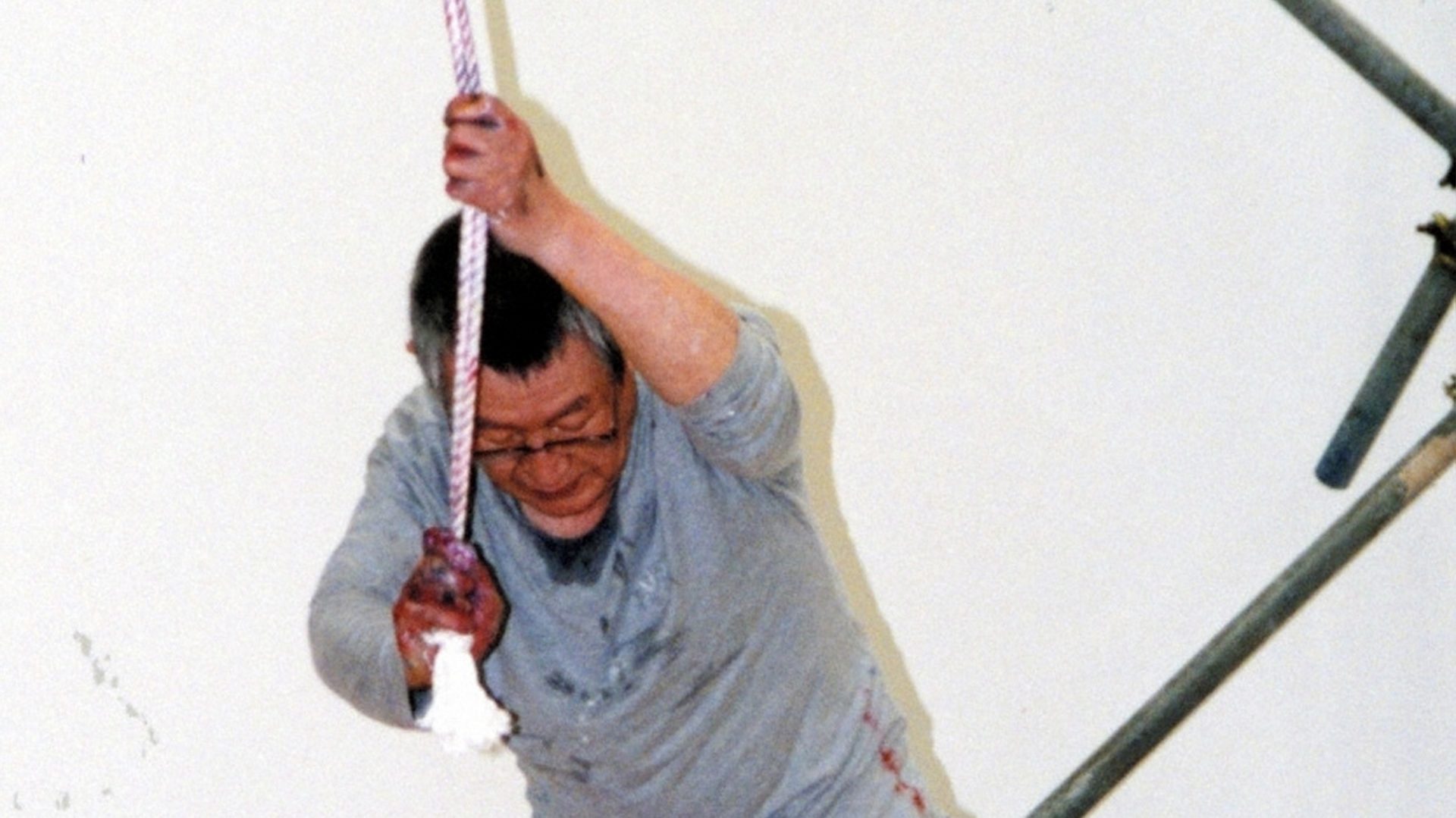
His feet became his tools. He developed a process that involved pouring oil paint directly on to the canvas, swinging from a rope attached to the ceiling and smearing paint with his bare feet. “I want to paint as though rushing around a battlefield,” he said about his “action painting” that was exhausting to perform or even to witness.
Suggested Reading
Billy Wilder, the outsider who understood the American soul
Born in 1924 in Amagasaki, Japan, the first child of a family of kimono merchants, Shiraga enjoyed judo and yoga from an early age, and grew up surrounded by art materials. An avid reader of translations of classical Chinese literature that would influence his work throughout his life, he studied Nihonga, the traditional and delicate art of painting with pigments ground from precious stones. His studies were interrupted in 1944 when he was drafted by the Japanese army, and even after the war ended, there was further disruption when he found himself bedridden for much of 1946 after contracting pneumonia.
On recovering, he graduated from Kyoto Municipal School of Painting and married Fujiko Uemura, a fellow artist. Rebelling against the formal art he had studied, he co-founded Zero-kai, the Zero Society, an avant-garde art collective that held the belief “that works of art should be created from nothing”. The group soon merged with the established Gutai Art Association, who had similar principles – a need to rebuild, a desperation for freedom.
As part of the Gutai movement, Shiraga thrived. With a fascination for violence and the grotesque, he used his energy to find his style, often a palette consisting only of crimson. His trademark became those foot paintings, assisted by his wife, who would pass her husband the paint as he worked: “This act of painting with my feet feels very important to me. It felt as though the scales dropped from my eyes. I felt cheered up, happy and exhilarated.”
Throughout the 1960s, the highly ambitious Gutai artists were encouraged to embrace their own completely distinct style. In 1963, Shiraga created a seminal piece of work, Wild Boar Hunting II. It was originally intended to be a wild boar he had hunted himself, but he was forced to scale it down by using a hide he had purchased, on to which he added layers of his own foot paintings, a grotesque message of the destruction caused by man.
After Yoshihara’s death in 1972, the group disbanded and Shiraga decided to stop painting and to train in Esoteric Buddhism. Once ordained as a Tendai Buddhist monk in 1974 under the name Sōdō, meaning “Simple Path,” he returned to art, his paintings now a reflection of his training, quieter meditations on presence and stillness. Previously, he had usually only created art in monochrome, now he was adding colour.
As the decades passed, his name has become increasingly celebrated across the globe. His work was presented as part of Japon des avant-gardes 1910-70 at the Pompidou, Paris, in 1986, for which Shiraga, who rarely left Japan, travelled to Europe for the first time.
Kazuo Shiraga died at the age of 83, in Amagasaki, where he lived and worked for most of his life, still creating foot paintings in the months before he died. “Painting is not separate from life,” he wrote, “it is the same struggle, the same movement, the same energy… only when I am completely exhausted do I know the work is truly alive.”