July 1957 – January 19, 1983
Ham wakes up early on his big day, one that could go down as among the most important in the history of space travel. It’s the last day of January, 1961, Will You Love Me Tomorrow by the Shirelles is No 1 in the American charts, and Project Mercury is about to be put to the test.
Before risking human life, Nasa needs to know if a living thing is able to think, react and follow instructions in space. Of Project Mercury’s 40 candidates, Ham is the chosen one, and for the last 15 months he has been in training, learning to pull levers and press buttons when lights flash or noises sound.
Correct actions earn him treats of banana pellets: “If there is a blue light, Ham, press the lever.” Ham remembers. Ham is ready.
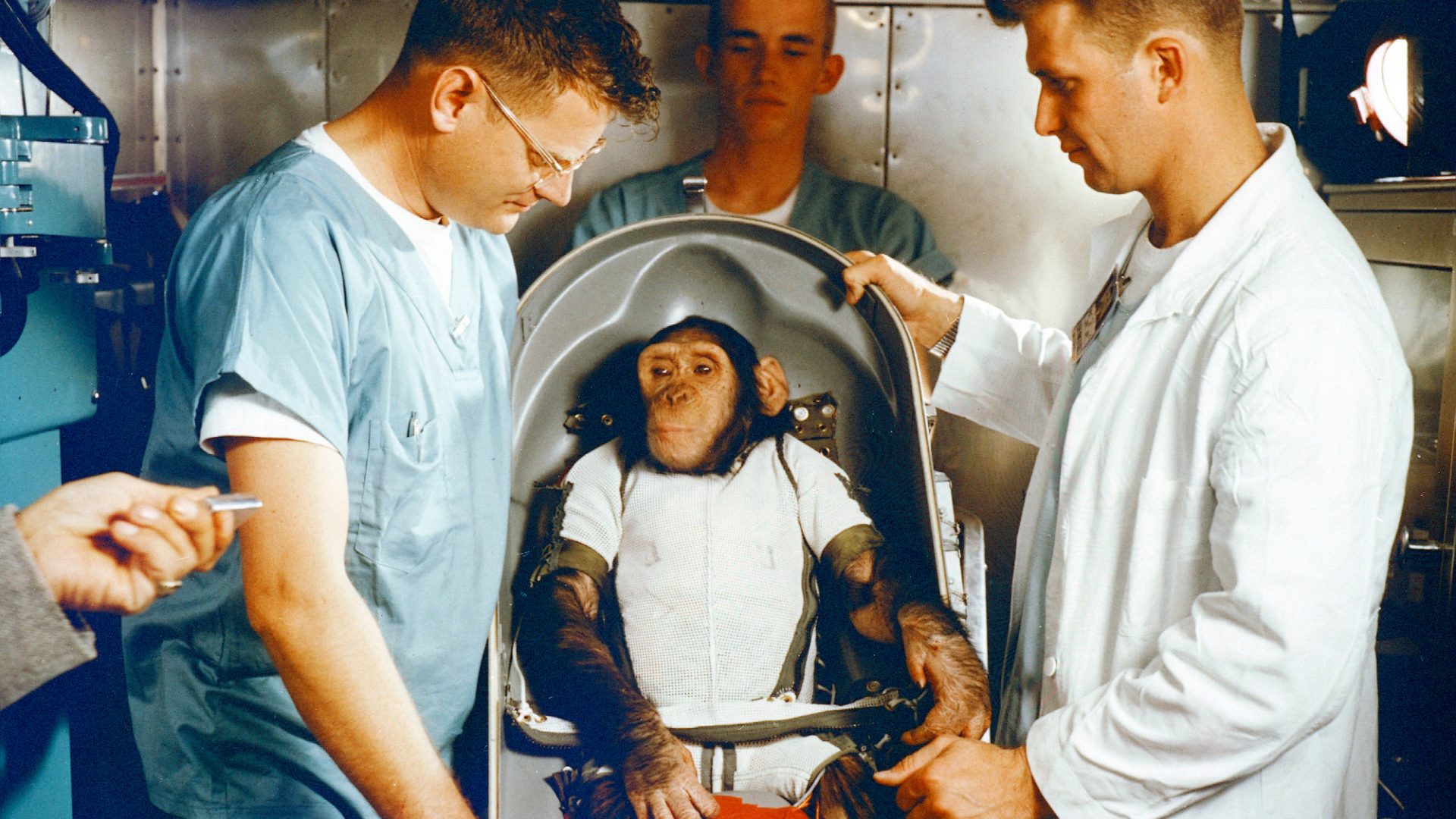
It is 11.55am on a beautiful clear day at Cape Canaveral in Florida and Ham has already been in his capsule for three hours, connected to heart monitors and breathing apparatus. The countdown begins:
“We are ready to rock… 5, 4, 3, 2…”
The Redstone rocket launches into the sky and two-year-old Ham sits alert and ready in his spacesuit with his controls. The world holds its breath. So does Ham.
In the control room there is immediate apprehension after launch. Things aren’t as they should be. The rocket is going faster and higher than had been planned and it is clear Ham is experiencing much stronger G-forces than expected.
Yet despite the jeopardy, they can see from their monitors that Ham is doing well. In the face of disaster, he has maintained a sense of calm. Ham carries on pulling his levers, pressing his buttons.
After 16 and a half minutes, he is back to Earth. The Mercury-Redstone 2 is only capable of sub-orbital flight, meaning that although it was capable of getting into space, there was never the possibility it would be able to return. Strapped into his container, Ham hurtles back to earth and splashes down in the Atlantic Ocean, 130 miles from his starting point just hours earlier.
After being recovered by a US Navy ship, his capsule is opened and Ham is there, breathing, alert, his name written in history. His beating heart is the data needed to show that space exploration is possible.
Other than a bruised nose, he is his usual self with a huge smile, the first living being to perform designated tasks in space.
Suggested Reading
Miep Gies, the ambassador for Anne Frank’s diary
Ham was born in the wild in French Cameroon in July 1957 and captured at a young age by animal trappers. At two years old, he was bought by the United States Air Force, then using chimps in their spaceflight testing as part of Project Mercury because they closely match the physiology of humans. It was hoped they could be trained not just to survive but to carry out tasks expected of a human.
News outlets across the world could not get enough of Ham and his beaming smile, the new pioneer of the American space programme, who against all odds had proved that future space travel could be safe for humans, that one day there may even be a human on the moon. He was Nasa’s poster boy for all that could be achieved, a victory in their race against Russia.
Like many in the media spotlight, however, Ham’s smile may not have been all it seemed. The environmentalist Jane Goodall was of the opinion that what looked like a smile of delight was actually a grimace, suggesting his pride and understanding of what he had achieved was wishful thinking on behalf of the humans he had been trained to help. “I have never seen such terror on a chimp’s face,” Goodall said.
Animal campaigners spoke out for Ham. Training had been a difficult experience; although he was rewarded with bananas when he did the right thing, electric shocks were applied to his feet when he made a mistake.
In some respects, he had been well looked after by Nasa: “He was wonderful,” said his handler, Edward Dittmer. “He performed so well and was a remarkably easy chimp to handle. I’d hold him and he was just like a little kid.” To some he was the hero of the space race, to others he was its victim.
Ham was initially only known to the public as “Number 65”, with the understanding that it is harder to mourn a being that hasn’t been named. To his colleagues he was “HAM”, an acronym for the Holloman Aerospace Medical Centre in New Mexico where he was trained, where the bananas were given and the levers were pulled.
After his adventures in space, Ham retired to the Smithsonian National Zoo, where he lived for almost 20 years. Some of the fan mail he received was answered by zoo staff with the ink-mark of his famous fingerprint.
When concerns grew about him being isolated from other chimps, in 1980 he was moved to North Carolina Zoo, one of the largest natural-habitat zoos in the world, where animals spent their days in the luxury of huge open spaces. It had been decades since he had enjoyed the company of other chimpanzees and he was perhaps happier there than ever before, relaxed, engaged and with friends.
Ham’s journey 157 miles above Earth was 10 weeks ahead of Yuri Gagarin becoming the first human in space, and three months before Alan Shepard became the first American to make the journey. He lived for another 22 years after his momentous mission and is buried at the Museum of Space History in New Mexico.
“We honour and remember Ham and all of the young chimpanzees who suffered through the tragic deaths of their mothers and the transatlantic journey to the United States to become test subjects for space flights,” wrote the charity Save the Chimps in tribute to him, the chimpanzee who paved the way for future space travel.