February 19, 1954 – December 4, 2011
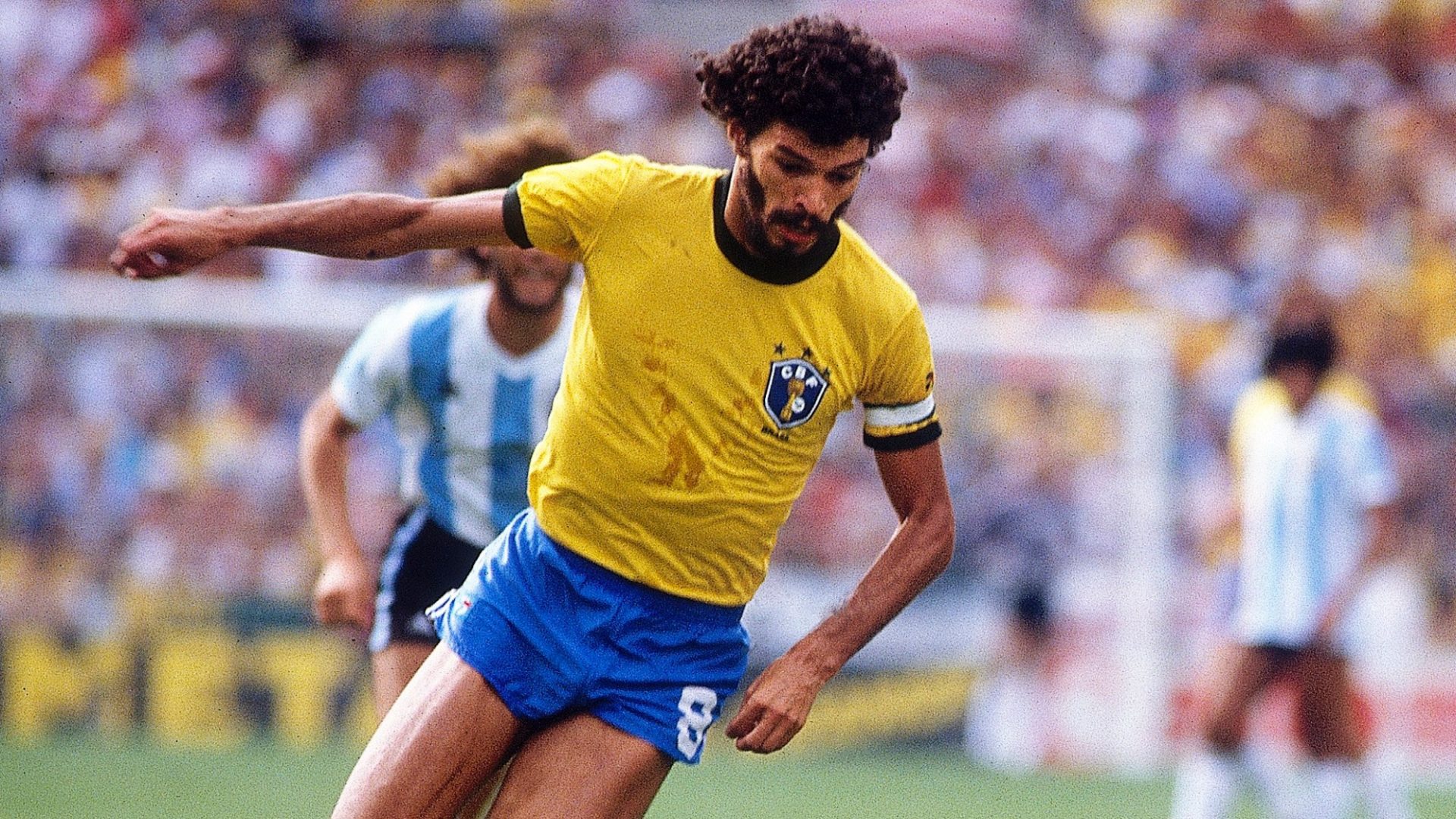
It’s the 1982 World Cup at the Estadi de Sarrià in Barcelona. With 11 minutes of their group match played, Brazil are one down to Italy. Then Sócrates, six foot four with his iconic number 8 electric yellow shirt neatly tucked into his blue shorts, looks up for the ball. Running on to Zico’s perfectly timed pass, he beats goalkeeper Dino Zoff and the teams are level again. His dream of emulating the great Brazil side of 1970 and to be the fourth captain of his country to lift the World Cup is back on track.
With thick curly hair and a full-bodied moustache and beard, Sócrates looked to have more time than anyone else on the pitch. A bohemian midfielder with a calm authority, together with Zico, he reinvented the art of how to play in central midfield.
In Brazil’s first four games of the 1982 World Cup they set the tournament alight, flicking passes to each other as they rotated, orchestrated and dominated their opponent’s halves. Even for the country of Pelé and Jairzinho, this was something special.
Sócrates Brasileiro Sampaio de Souza Vieira de Oliveira, a medical student who had only turned professional in his early twenties, had done everything to get to the World Cup. He called himself “an anti-athlete” and was open about his struggles to stay in shape, finding training difficult, particularly during the peak-summer Spanish heat when he had been sick while running laps of the training pitch. But he knew it was worth it. He would do what it took, for his country, for himself and for his teammates.
Back at home, expectation was high. Bunting was up in the streets and Brazil had started the tournament strongly. All they needed in the final game of the second group stage was a draw with Italy, but despite playing sparkling passing football, they fell behind three times, Paolo Rossi scoring a hat-trick.
With the Italians 3-2 up in the dying moments, Sócrates latched onto yet another perfect through-ball, but with the ball in the net, the offside flag was up. Dino Zoff made a last-gasp save from Oscar, and the game was over, leaving the Brazilian team distraught.
Sócrates admitted he found it particularly painful. “We had a hell of a team and played with happiness,” he said years later. “Then Rossi had three touches and scored a hat-trick. Football as we know it died on that day.”
Football had once been no more than a hobby for a young man focused mainly on his education and the completion of his medical degree. But his talent made a professional career inevitable.
This unusual introduction to life as a footballer meant he lacked the athletic build of his teammates, who called him “Magrão” – the skinny one. He was a heavy smoker and drank alcohol, but thought it had no real impact on his performance: “Alcohol did not affect my career, in part because I never had the physical build to play this game.”
Of course, Sócrates carried the weight of that name. Being named after a philosopher perhaps comes with its own expectations. His father was a lover of literature and philosophy, who passed down his love of ancient Greece through the naming of his children – Sócrates had brothers named Sófocles and Sóstenes.
Suggested Reading
Shane MacGowan, the poet laureate of chaos and loss
Nicknamed “Doctor” by the fans, Sócrates became a legend at Corinthians, playing 408 games and scoring 172 goals. It was his leadership that made him so revered.
In the early 1980s he was a prime mover behind what became known as Corinthians Democracy, where the manager took a step back and allowed decisions about tactics, training and team selections to be made by the players. This concept was a novelty in a country that had been ruled by a military dictatorship since 1964, and where freedom of speech was limited.
Aware that footballers had a moral duty to those without a voice, Sócrates started to use football as a way to communicate the need for social change. In the lead-up to one election, Corinthians players wore shirts during the pre-game warm-ups with the words: “Vote on 15 January.”
After an earthquake in Mexico City killed thousands, Sócrates adapted his distinctive headband to include the message “México Sigue En Pie” – “Mexico Still Stands”. Later headbands had the slogans “The People Need Justice”, “Yes To Love, No To Terror” and “No Violence”.
He was proud to make a difference. “While I was a footballer, my legs amplified my voice,” he said after retiring from international football following the 1986 Mexico World Cup. His Corinthians teammate Casagrande agreed: “We needed a genius like him, someone politicised, smart and admired. He was a shield for us. Without him, we couldn’t have Corinthians Democracy.”
After Corinthians, Europe came calling. Sócrates signed for Fiorentina but struggled with just five goals in 30 appearances and returned to Brazil the following year, where he played until his retirement at the age of 35. Not playing football meant he had more time to devote to social causes and he spent time writing and lecturing. He even made a return to medicine.
His death at the age of 57 left a nation in mourning. During a moment’s silence at the first Corinthians game after his death, fans and players lifted a closed right fist up in the air, imitating his regular goalscoring celebration, as seen by millions during that 1982 World Cup.
The team that Sócrates captained is still widely considered the best to never win the most famous of trophies and the 3-2 defeat against Italy as possibly the greatest World Cup match of all time.
Sócrates said he never rewatched it. He just couldn’t bear to. Although he never lifted the trophy, he is loved in his country as much as those who did because of the people he reached out to.
“A footballer must think about life, not just the game,” he said. “We have a duty to society.’