April 27, 1927 – January 30, 2006
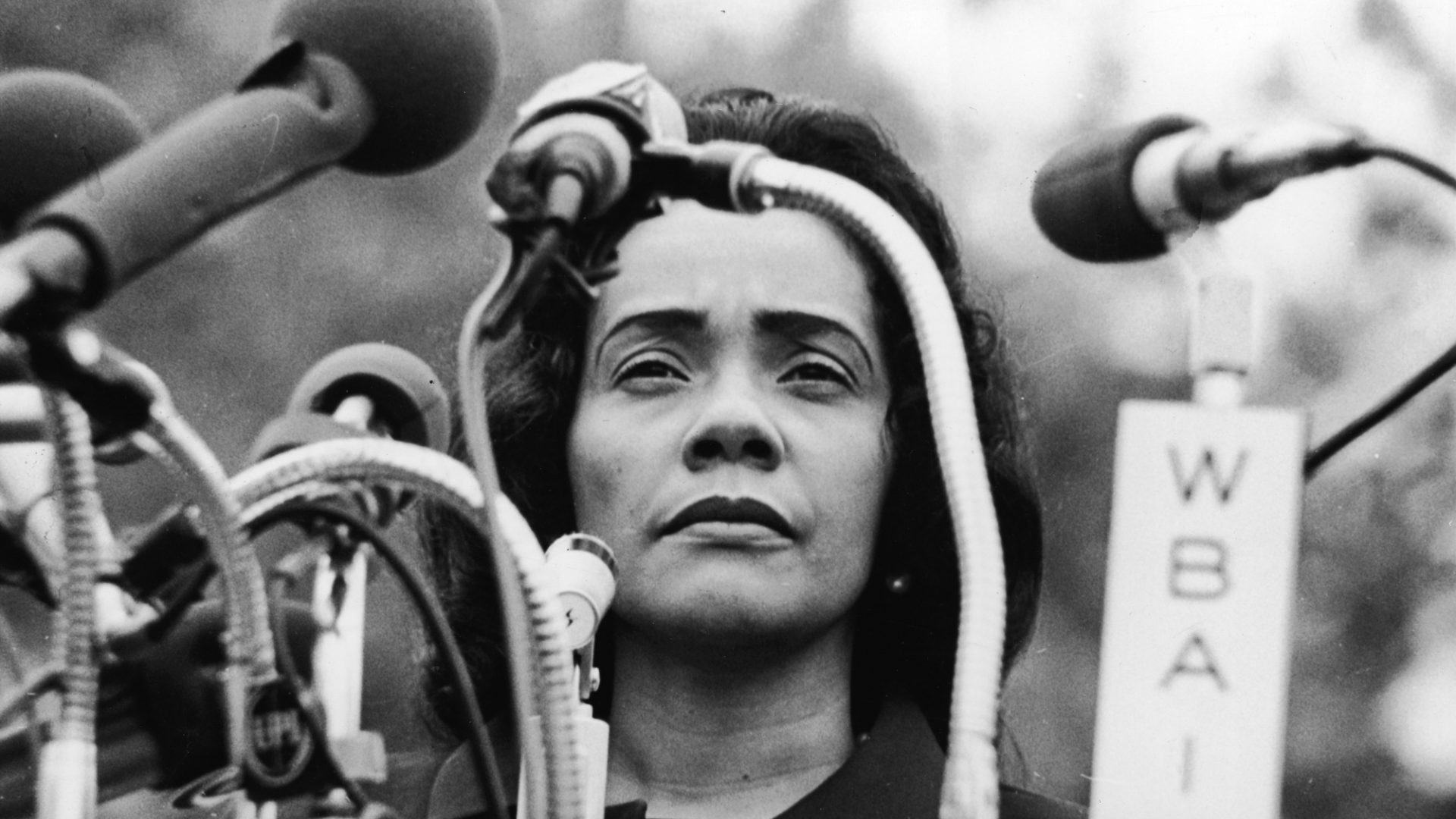
It is Monday, January 20, 1986, the first officially observed Martin Luther King Jr Day, and Atlanta’s Ebenezer Baptist Church is packed. The crowd, swelled today by journalists and by South Africa’s Desmond Tutu, who is being awarded a Nonviolent Peace Prize as part of the celebrations, is waiting for Dr King’s widow to speak.
When Coretta Scott King rises, she pauses to take in the congregation, the building, the enormity of the day. This is the church her husband served as co-pastor, alongside his father. This is where, on a spring day in 1968, Coretta sat in a black veil and comforted their five-year-old daughter Bernice, at Martin Luther King Jr’s funeral.
Today, people have travelled across the United States to be in Atlanta, Georgia, to celebrate, join parades, wave banners, to worship and to remember. A freedom train runs from San José to San Francisco and thousands parade in Birmingham, Alabama. It has taken the US Congress 16 years to endorse this as a national holiday.
Unlike other national holidays, this will be a Day On, rather than a Day Off, Scott King declares – a meaningful day of community service, reflection and solidarity. People are encouraged to spend the day volunteering, giving up their time, helping out in their community, a day to find time to devote to others.
When Scott King speaks, she recalls her husband’s most famous words. “It’s time to live the dream, rather than just talk about the dream,” she says, with the same determination she has displayed since she was a young girl.
Coretta’s father Obadiah Scott worked in a sawmill in Alabama, earning extra money by selling scrap iron and cutting hair in the evenings. Her mother, Bernice, refused to accept that women could not do traditionally male jobs, and became one of the first women in her community to drive a school bus.
Their home was small, but crucially for Coretta they had a record player, and together the family listened to gospel, jazz and blues. As a child, she confidently sang duets in church with her sister Edythe. She knew from an early age that music would form a crucial part of her life.
Her talents helped her secure a scholarship to a liberal arts university in Yellow Springs, Ohio. This was not just where her love of music grew but where she learned to engage with the world around her, joining any club, society or group that reflected her beliefs and politics, particularly the peace movement popular on college campuses in the 1940s, which led to her lifelong devotion to pacifism.
She performed in her first public concert in 1948, and was accepted at the prestigious Boston Conservatory of Music. It was in Boston that she met a man called Martin, who asked her out immediately. She was not certain it was the right thing to do, knowing a relationship would get in the way of her singing career, but as this new man shared her love of music and seemed a caring and considerate soul who made her laugh, the two became close.
On their wedding day in 1953, conducted by Martin Luther King Sr outside her family’s home, Coretta refused to “obey”, omitting that instruction from their vows. As a newly married woman, her singing ambitions had to be re-evaluated, but her passion for music never stopped, singing in the Dexter Avenue Baptist Church choir and teaching music locally, making it very clear that she would never settle for being a passive pastor’s wife.
Two weeks after their first baby, Yolande, was born, Rosa Parks was arrested for refusing to give up her seat on a segregated bus just a few miles from the King family home. Together, the new parents became central figures to the Montgomery Bus Boycott, a 381-day protest that played a huge role in the civil rights movement.
“People really forget about how much of a role she played with the movement, and how influential she was,” Coretta’s granddaughter, also called Yolande, has said. “She was a human rights activist. She worked on rights for the LGBTQ community, she worked on women’s rights.”
Coretta Scott King was at home in Atlanta with their four children when she was told the news that her husband had been killed. President Lyndon B Johnson called her personally to express condolences.
Days later, dressed in black, she walked silently at the front of a march of sanitation workers with flowers in her hands. This was the protest her husband had gone to Memphis to support. There had been fears there would be a violent response to the murder, but her presence meant the message was clear, that people needed to mirror her calm, dignified response. At his funeral the next day, her husband’s final sermon – “I’ve been to the mountaintop” – was played at her request.
Shortly after the assassination, the Martin Luther King Jr Centre for Nonviolent Social Change was opened “to empower people to create a just, humane, equitable, and peaceful world by applying Dr King’s principles and methodology of nonviolence.”
Everything from the initial concept to the building was the work of Coretta Scott King. Throughout the 1980s and 1990s, the Centre advocated for an end to apartheid in South Africa. When Nelson Mandela took the oath of office as president, Scott King was standing by his side. When she died, at the age of 78, Coretta Scott King’s funeral was attended by more than 16,000 people. She is now laid to rest at the King Centre, side-by-side with her husband.
“As you honour my father today, please remember and honour my mother as well,” their daughter Bernice wrote on the morning of the 2026 public holiday. “She was the architect of the King legacy and founder of the King Centre, which she founded two months after Daddy was assassinated. Without Coretta Scott King, there would be no Martin Luther King Day.”