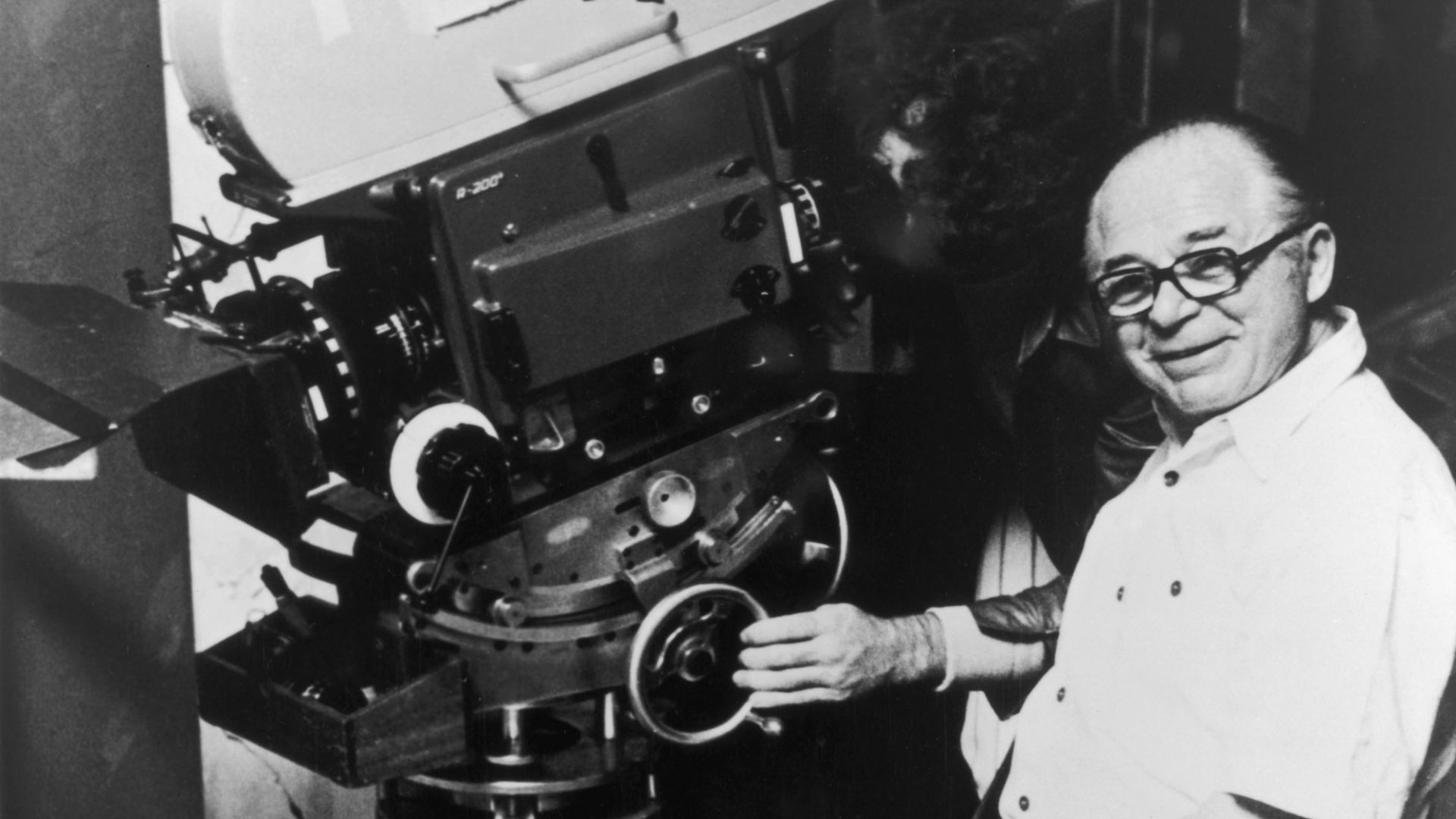
June 22, 1906 – March 27, 2002
Los Angeles, 1944. Barbara Stanwyck prowls elegantly down a steep staircase, each foot sliding into shot. Beneath her awaits a dapper Fred MacMurray, playing Walter Neff, the slick insurance salesman who will help her to see off her rich husband in one of film noir’s most memorable moments.
Stanwyck purrs through her dialogue, quickfire. “There’s a speed limit in this state, Mr Neff – 45 miles an hour,” she drawls as his eyes dip down her leg to her anklet. “How fast was I going, officer?” asks MacMurray, playing along flirtatiously. “I’d say about 90.”
Power dynamic established, the scene glides onward.
These moments from Double Indemnity helped establish Wilder, new to Hollywood having fled his beloved Berlin, as one of 20th-century cinema’s most exciting writers and directors, a man who helped keep the Golden Age alive.
A confident boy, Samuel Wilder was born in 1906 in the Austro-Hungarian Empire, sharing with his mother a love of all things American. Later, living in Berlin, he pursued life as a journalist, claiming that it was because he liked the way they dressed in the movies.
In need of both money and something to write about, the young Wilder became an Eintänzer. This was a role not uncommon in 1920s Berlin and involved spending time with women who wanted someone to dance with, whether it was for company, for romance or out of a love of the dancehall.
He started to write about his experiences, with the newspaper he worked for giving him an outlet for his dancing diaries. “I dance with ladies who are there every day, and no one knows where they are from or where they are going… I dance with a thousand kinds,” Wilder wrote.
This understanding influenced Wilder’s sympathetic depiction of female powerbrokers, heartbreakers and femmes fatales. He was one of the first scriptwriters to give Hollywood women a voice beyond the cliches.
As an Eintänzer he met an array of people, many of whom – impressed by his charisma and his dancing shoes – offered him jobs, as a tour guide, as a road manager for jazz acts and as a ghostwriter. In 1929 he was commissioned to write a script for a silent film, Der Teufelsreporter, the part-farce story of a journalist who rescues a group of American women kidnapped by gangsters. This opened his world up to screenwriting, silent film after silent film, his involvement often uncredited in works he would later dismiss as “lousy.”
But these “lousy” films were making him money and new creative connections. On one job, a group of writers around a table were thrown coins by a producer when they contributed good ideas – perfect for Wilder, who had more good ideas than most, and filled his pockets in exchange for his jokes.
Suggested Reading
Charles M Schulz, the cartoonist of melancholy
He tirelessly wrote spec-scripts that often led nowhere, but there was occasional success, with one being remade in Hollywood, giving Wilder his first screen credit.
Just as his career as a Berlin scriptwriter was blossoming, Hitler was appointed chancellor. “I think we need to leave,” Wilder told his girlfriend in 1933. In his words, “the exodus started.”
Like many others, he started a new life in Paris, where he spent a year directing for the first time – an experience he did not enjoy and vowed never to repeat. The film, Mauvaise Graine, was made with other German exiles, and when not on set he continued to send out scripts to a friend at Columbia Pictures. This led to his screenplay Pam-Pam being picked up for production, which came not just with a writing fee, but crucially with a one-way ticket from Paris to Hollywood.
Wilder had almost no paperwork when applying for his visa, so an official at the US consulate asked what he did professionally. “I write movies,” Wilder told them. “Well, write some good ones,” came the reply, and his visa was granted.
As he settled into his new life in Hollywood, war was declared. His mother, stepfather and grandmother all died during the Holocaust.
Wilder’s reaction was to make people laugh. Like many others, he dedicated himself to his craft. He married Judith Coppicus Iribe, known for her wit, and found a co-writer, Charles Brackett. The comedies they wrote together did not prove successful, but Wilder was still learning the language, both cinematically and linguistically.
His breakthrough came with Double Indemnity, co-written with Raymond Chandler, followed by The Lost Weekend, his legendary depiction of an alcoholic bar fly which won Wilder his first Oscar for best director.
Influenced by European cinema, Wilder had arrived in Hollywood with an essence of what storytelling was, that it was not about glamour but about soul and feelings, relatable stories about flawed human beings. Throughout his career he created roles for specific actors, including Walter Matthau, Marilyn Monroe and Audrey Hepburn, knowing that no other actor could take the role.
The Apartment, a collaboration between Wilder and IAL Diamond, became one of the most loved and written-about films of all time. It came from a desperation to give Jack Lemmon a leading role after working with him on Some Like It Hot. The film won Wilder another best director Oscar, this time beating Alfred Hitchcock, nominated for Psycho.
Diamond was the perfect partner and the pair spent day after day writing together, making each other laugh, devoting their lives to words and stories. “Billy believed that if something wasn’t funny, we should throw it out and try again,” Diamond said. “Billy always knew exactly what he wanted the audience to feel.”
When he died at the age of 95, the French paper Le Monde ran the headline “Billy Wilder is dead. Nobody’s perfect,” a reference to the ending of Some Like It Hot, often considered one of the funniest comedies of all time and possibly the one most beloved of audiences thanks to its screwball plot and the shimmering presence of Monroe.
Wilder himself held a particular fondness for Double Indemnity, the film that announced him to the world. “It was the first picture where I had the courage to really be nasty,” said this decidedly nice man about the script that helped define the film noir genre and began another unique genre, simply known as “Billy Wilder films.”